
Raijin (雷神) is the Japanese god of thunder and lightning, a Shinto kami who makes the storm himself by striking a ring of drums that hangs around his back. He is one of the eldest kami, a child of the creator deities Izanagi and Izanami, and Japanese art almost never places him in a frame without his brother Fujin, the wind god, somewhere in it.
He is also, depending on the story, a demon who escaped the land of the dead, a criminal the emperor had arrested, the reason a typhoon sank a Mongol fleet, and the reason Japanese children were told to cover their navels when the sky went dark.
What the Name Raijin Means
Raijin (雷神) means thunder god, and the compound is as literal as it looks: 雷 is thunder or lightning, 神 is god or kami. English guides render the pronunciation as RYE-jin or RAY-jeen, and both are attempts at the same two syllables, rai and jin.
Raijin answers to more names than almost any other kami, and each one frames him differently.
| Name | Japanese | Meaning |
|---|---|---|
| Raijin | 雷神 | Thunder god, the standard name |
| Kaminari-sama | 雷様 | Lord Thunder |
| Raiden-sama | 雷電様 | Lord Thunder and Lightning, the reading that traveled furthest outside Japan |
| Narukami | 鳴る神 | The Resounding God |
| Yakusa no ikazuchi no kami | God of storms and disaster, the harshest of the set and the closest to how the early stories treat him |
The 神 ending is worth learning because it unlocks the rest of the pantheon. 風神 is wind plus god, which gives Fujin, the wind god who works the other half of every storm.
Who Raijin Is in Shinto and Buddhism
Raijin is a Shinto kami of thunder who was also absorbed into Japanese Buddhism, where he works as a guardian figure. He ranks among the eldest of the Shinto gods and descends directly from the first divine couple rather than from any later generation. Between them, Raijin and Fujin are held responsible for most of Japan’s bad weather, and statues of the pair stand at temples the length of the country.
That puts Raijin among the kami rather than among the creatures that fill the rest of Japanese folklore, even though sculptors give him fangs and a face built to frighten. Buddhism absorbed him too. He appears in Buddhist contexts with a halo ringing his entire body, marked with Buddhist, Shinto, and Daoist symbols at once, and one of his working jobs in both traditions is guarding the gate of the building he stands in.
His portfolio is not only destruction. Thunderstorms bring rain, rain brings rice, and an old belief that lightning fertilizes the fields made Raijin a god of agriculture as well as a god of the storm.
How Raijin Was Born in Yomi
Raijin was born in Yomi, the Japanese land of darkness and death, from the corpse of his mother Izanami, and the Kojiki counts him among the spirits she sent to pursue Izanagi back toward the living world. It is one of the least dignified entrances in Japanese myth, and that underworld origin is why his imagery reads as monstrous rather than stately.
Izanami had died giving birth to the fire deity and descended to Yomi. Izanami set her husband one condition when he came down after her, and Izanagi broke it by looking at her decomposing body. He fled. Izanami, humiliated and furious, sent the spirits that had grown out of her rotting corpse to chase him, and Raijin was one of them.
So the thunder god starts his career as a pursuer sent up out of the underworld. His connection to Yomi is not a footnote in his character, it is the reason several sources file him alongside the oni instead of with the serene deities.
What Raijin Looks Like
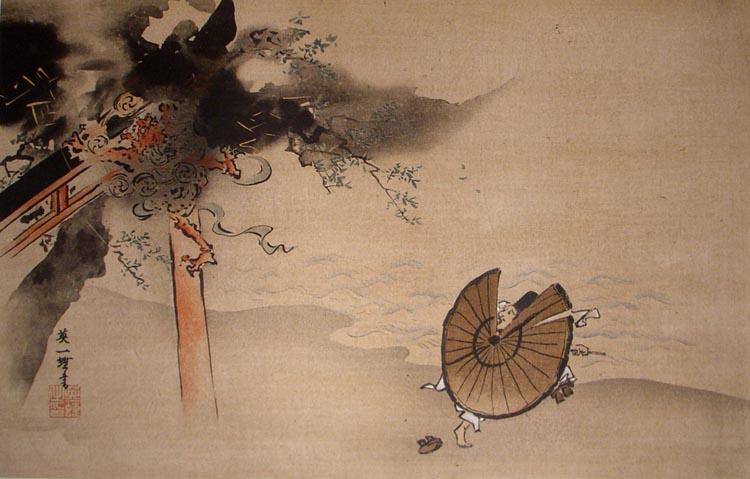
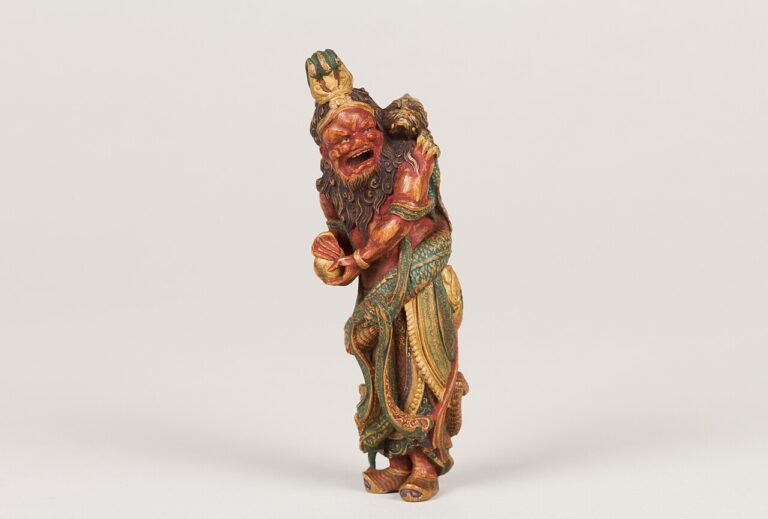
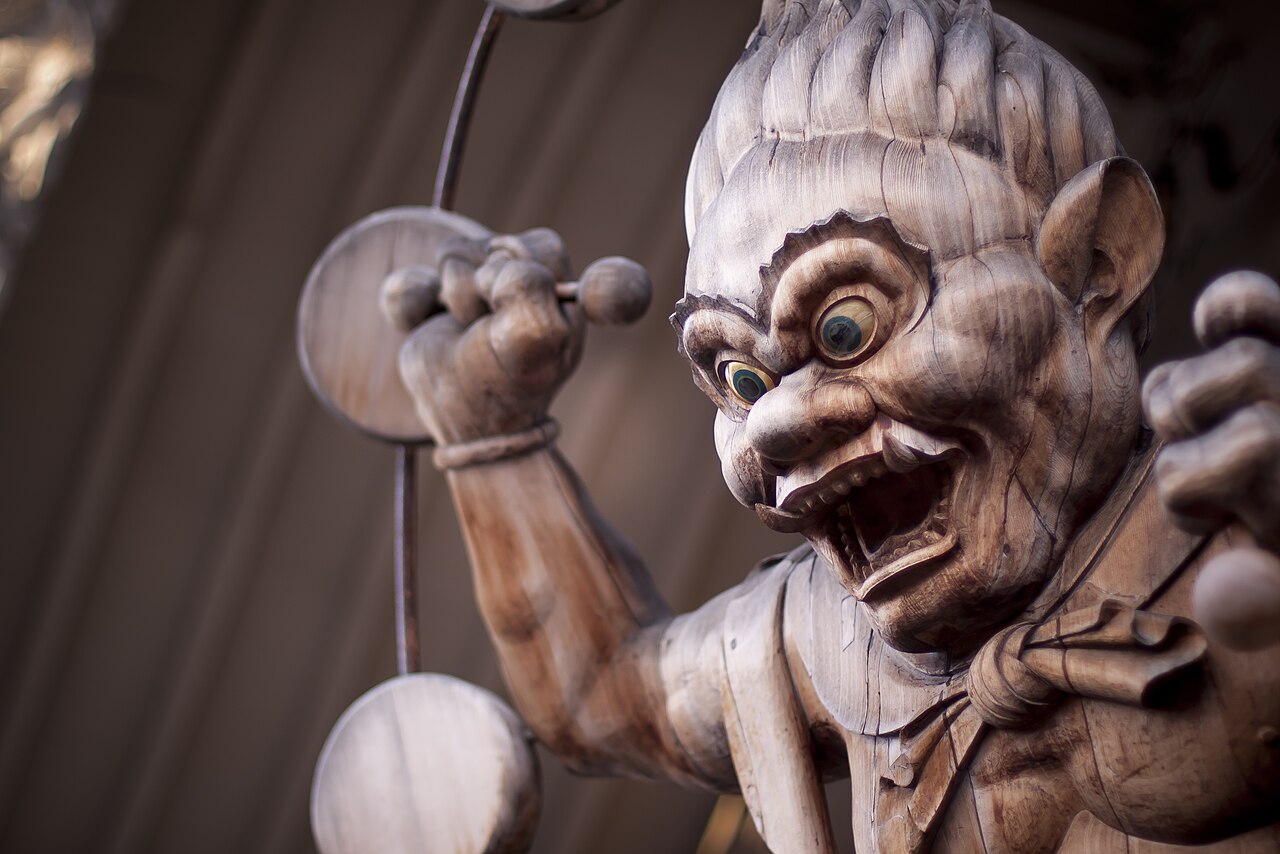
Raijin is painted and carved as a large, heavily muscled figure with a terrifying face, animal teeth, and hair that stands out from his head in spikes, wearing very little beyond simple trousers or animal skin. His identifying attribute is the ring of drums curving around his shoulders and back, commonly counted as eight or nine, which he beats with mallets to produce thunder.
Some versions give him horns. Some give him a potbelly on top of the muscle. His skin is occasionally red, read as protective energy rather than rage, and his expression sits somewhere between furious and delighted by the damage.
In some traditions the drums are taiko, and the drumheads carry the tomoe, the comma-shaped swirl that stands for the movement of the world and connects to the yin and yang symbol. Magatama beads turn up in the same iconography, and the spiraling cloud patterns behind him echo the tomoe shape.
Not every region draws Raijin this way. Under the name Raiden he appears instead as a robed man in a straw hat, which is a far quieter figure than the drum-ringed demon of the temple statues. A handful of depictions give each hand only three fingers, a detail one reading takes as past, present, and future.
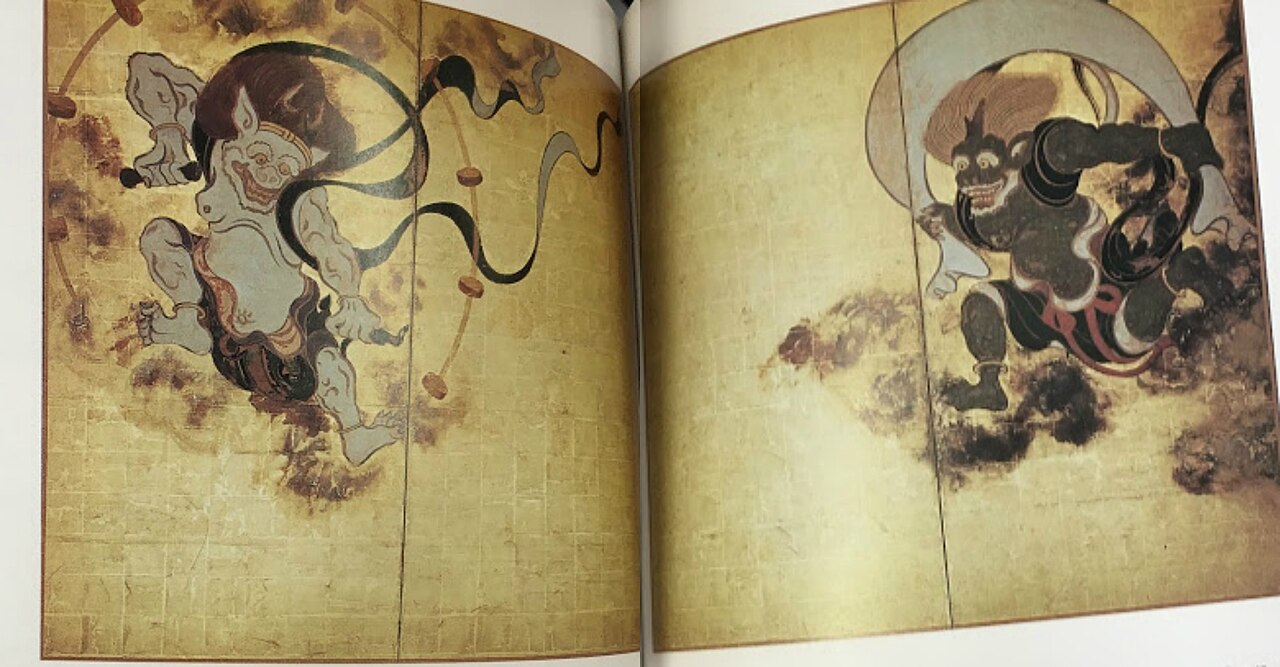
Next to his brother the two are easy to separate: Raijin carries drums, Fujin carries a bag of wind.
Raijin’s Powers
Raijin’s powers all run through weather, and the ring of drums is the mechanism rather than a symbol of it. He generates thunder and lightning by striking the drums, raises storms and typhoons, and can settle them again, which is why priests have petitioned him during a drought. The rain he brings also makes him a god of harvest.
- Thunder and lightning, generated by striking his ring of drums, with the bolts themselves used as weapons.
- Storm summoning, including the typhoons that Japanese legend credits him with raising.
- Weather balance in the other direction, since priests have appealed to him to break a drought or push a typhoon away from a harvest.
- Rain and the bounty that follows it, the reason farming communities courted him at all.
- Control over trees, specifically the growth and movement of their branches and roots.
- Guardian force, with his statues set at temple gates to turn away evil spirits and storm damage.
Lightning in Raijin’s hands is described as splitting trees outright and setting sacred fires alight, which is the same power read as either a disaster or a blessing depending on what it lands on.
Raijin’s Family and the Thunder Beast Raiju
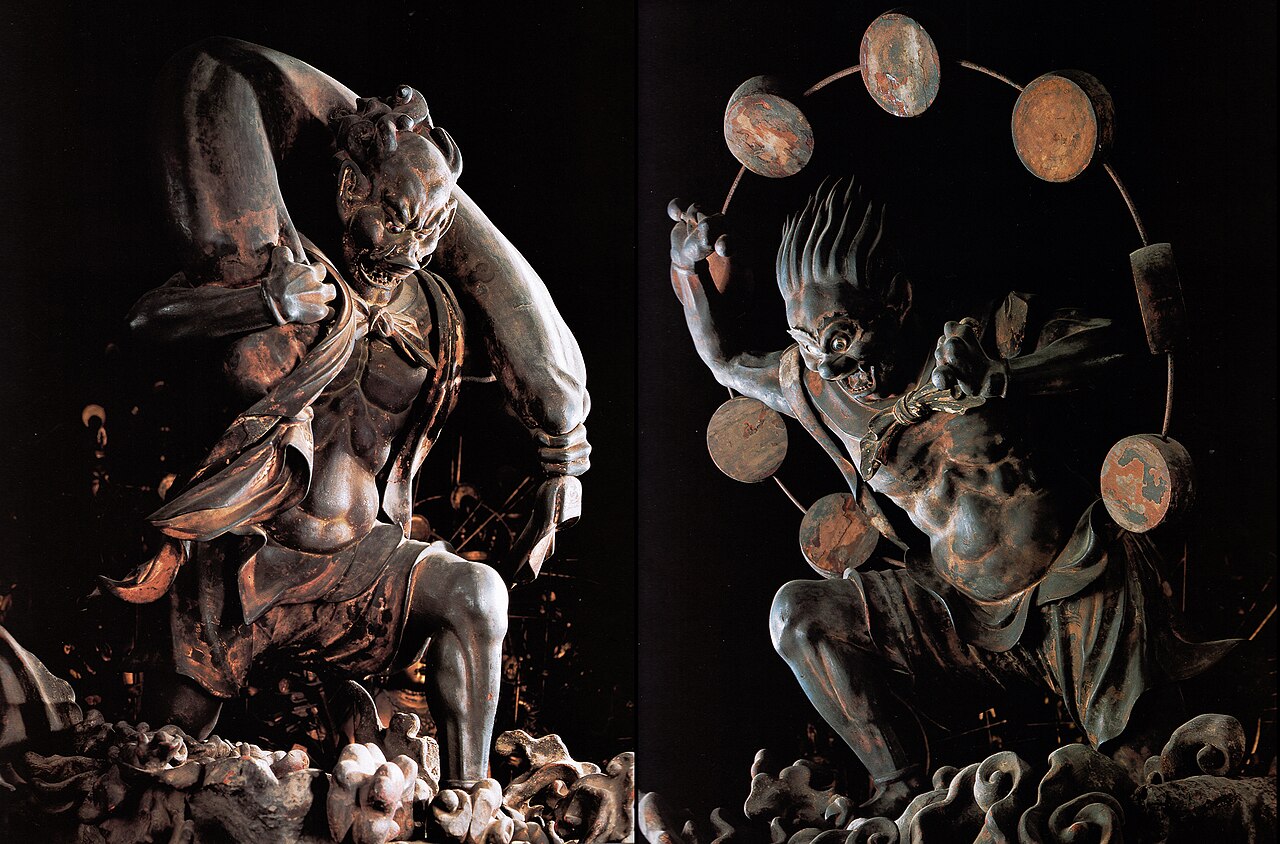
Raijin’s parents are the creator deities Izanagi and Izanami, his son is Raitaro, a thunder god in his own right, and the sibling he is named with most often is Fujin, the god of wind. Descent from that first couple technically gives him an uncountable number of siblings, so the relatives who actually appear in his stories are a much shorter list.
| Relation | Who |
|---|---|
| Parents | Izanagi and Izanami |
| Brother he is always paired with | Fujin, god of wind |
| Other siblings named in his myths | Susanoo, Tsukuyomi, Kagutsuchi, Ebisu, Amaterasu |
| Son | Raitaro, also a thunder god |
| Companion beast | Raiju, the thunder beast |
Not every account agrees on that sibling list. The Kojiki tradition holds that Amaterasu, Tsukuyomi, and Susanoo were not born from Izanami at all but from Izanagi’s purification after he escaped Yomi, so treat the wider family tree as one telling among several rather than a settled genealogy.
The relationship that carries the most weight is with Fujin, and it is not purely affectionate. One strand of the mythology has the two brothers dueling over rulership of the sky, a rivalry old enough to be a fixture in its own right. Another strand has them working as a matched pair, which is the version Japanese painters and sculptors overwhelmingly chose.
Raijin also comes with an animal. Raiju, the thunder beast, is the creature attached to him in folk belief, and it belongs to his iconography the same way the drums do.
The God-Catcher and the Mongol Typhoons
Two legends carry most of Raijin’s reputation and they pull in opposite directions. In the first, an emperor has the thunder god arrested by Sugaru the God-Catcher and put to work bringing rain instead of ruin. In the second, Raijin and Fujin destroy the Mongol invasion fleets of 1274 and 1281 with typhoons later remembered as the kamikaze, the divine wind.
How Sugaru the God-Catcher Arrested Raijin
Raijin’s destruction got bad enough that an emperor decided to have a god arrested. The job went to Sugaru, remembered as the God-Catcher, who invoked Kannon, the Buddha of Compassion, and forced Raijin to surrender. Under imperial control the thunder god was made to stop wrecking the country and bring rain and harvest instead. It is one of the very few myths anywhere in which a storm deity is taken into custody.
How Raijin and Fujin Sank the Mongol Fleets
Mongol fleets came for Japan in 1274 and again in 1281, and both times they were broken up by typhoons before they could take the country. Legend hands the credit to Raijin and Fujin, one raising the storm and the other driving the wind, sinking the ships from a cloud. Those storms were later remembered as the kamikaze, the divine wind, and the episode is the main reason Raijin reads as a national protector rather than a hazard.
Why Children Cover Their Belly Buttons
Japanese children are told to cover their navels during a thunderstorm because Raijin is said to envy belly buttons and to swoop down and take them, in the harsher versions eating the child outright. It is the single most widely repeated piece of Raijin folklore and it survives as a half-joking reflex rather than a genuine fear.
Two practical readings get offered for where the warning came from. A storm brings a temperature drop, so an uncovered stomach invites a chill. And a child curled up to hide their navel is smaller, lower, and less likely to be struck.
Where Raijin Is Worshipped
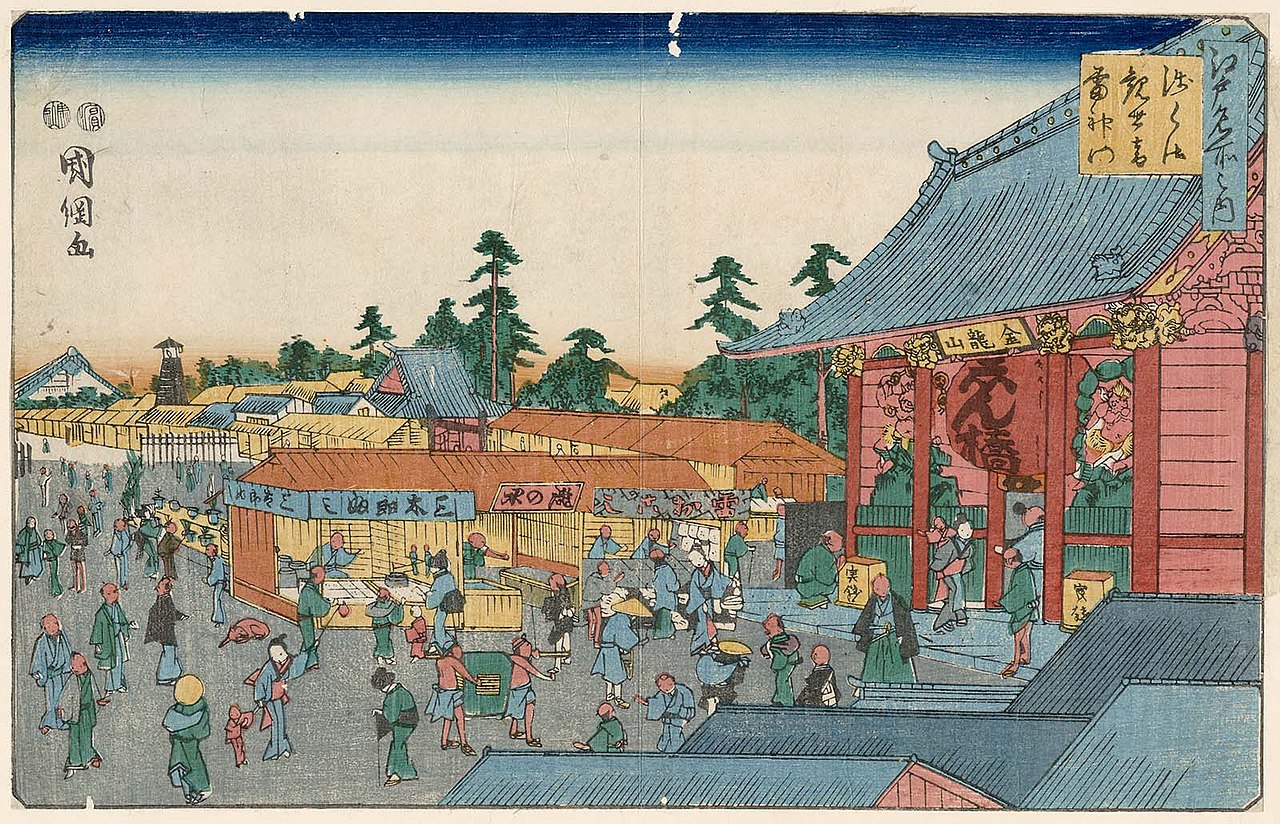
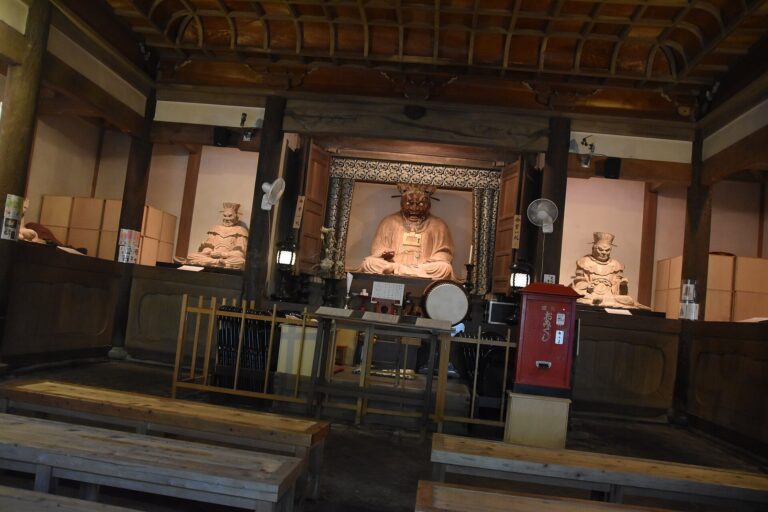
Raijin is worshipped at temples and shrines across Japan, and the usual way to meet him is as a guardian statue standing at a gate. The most celebrated pair sits at Sanjusangen-do in Kyoto, counted among the most beloved works in Japanese art, and the most visited stands at Sensoji in Asakusa, Tokyo.
The great gate at Sensoji is known to everyone as Kaminarimon, the Thunder Gate, but the temple’s own formal name for it is Fujin Raijin Mon, the gate of the wind god and the thunder god, after the two statues standing in its niches. Their stated job there is to govern wind and rain, ward off storm damage, and protect the temple buildings behind them.
Away from the famous gates, Raijin’s worship is agricultural. Rice-planting rituals ask him for steady rainfall, autumn observances have children beating drums in imitation of him, and summer matsuri processions carry chants in his name.
Raijin in Modern Culture
Raijin remains a fixture of modern Japanese and global pop culture. Noh theatre gave him masks, manga and anime kept him in circulation, and video games turned him into a recognizable character type. He appears in InuYasha and in Pom Poko, as one of a pair of criminal ninja in Naruto, and as Seifer’s lackey in Final Fantasy VIII.
Mortal Kombat’s Raiden takes his powers and his alternate name, Metal Gear Solid borrows the same name again, and Smite puts him on its roster outright. Raijin is also a steady presence in tattoo work, where he is read as the balance between chaos and calm rather than as a threat.
He travels well because the design is so economical. Two or three fixed attributes carry the whole figure, which is why the god stays legible at any size, and the same holds for the rest of the cast Japanese art keeps returning to, from the horned oni to Ryujin the dragon god who rules the tides.
If a storm kami is something you would rather wear than read about, Kamicrew’s mythology range is built on exactly these motifs.
FAQs
How is Raijin pronounced?
The name has two syllables, rai and jin, and English guides write it as either RYE-jin or RAY-jeen. Both are pointing at the same Japanese reading of 雷神.
What does Raijin mean in English?
Thunder god. The kanji 雷神 join 雷, thunder or lightning, with 神, god or kami. His other names translate just as plainly: Kaminari-sama is Lord Thunder, Raiden-sama is Lord Thunder and Lightning, and Narukami is the Resounding God.
Is Raijin an oni or a demon?
Raijin is a kami who is frequently depicted as an oni, and in Japanese tradition that is not the insult it sounds like in English, since a demon is not automatically evil. Early Buddhist tales treat Raijin and Fujin as troublesome spirits, later ones celebrate them as guardians, and the fangs and wild hair are there to signal raw power rather than malice.
Why does Raijin carry drums?
The drums are how Raijin makes thunder. He strikes a ring of them, commonly counted as eight or nine and curving around his shoulders and back, with a pair of mallets. In some traditions they are taiko drums, and their heads carry the tomoe, the comma-shaped swirl that stands for the movement of the world.
Are Raijin and Fujin brothers?
Yes. Both are children of Izanagi and Izanami, and Japanese painters and sculptors overwhelmingly depict them as a matched pair, Raijin with his drums and Fujin with his bag of wind. Another strand of the mythology has the two brothers dueling over rulership of the sky.
What is Raiju, Raijin’s thunder beast?
Raiju is the thunder beast associated with Raijin in Japanese folk belief, a companion creature that belongs to his iconography alongside the drums, the halo, and the lightning.
Who are Raijin’s parents and children?
His parents are the creator deities Izanagi and Izanami, and he was born from Izanami’s corpse in Yomi. His son is Raitaro, a thunder god in his own right. His brother Fujin, god of wind, is the family member he appears with most often in art.
Why do Japanese children cover their navels during a thunderstorm?
Folklore says Raijin envies belly buttons and will swoop down to take them, so children are told to cover their navels when thunder starts. Two practical readings sit behind the warning: a storm brings a temperature drop that chills an uncovered stomach, and a child curled up to hide their navel is lower and less likely to be struck.
Kamicrew Best Seller

Dont Touch Me Yokai Ukiyo-E Japanese T-Shirt
$25.49+
$29.99
(15% off)


Summer Vibes Salty Kawaii Japanese Hoodie
$44.99+
$49.99
(10% off)


Japanese Pin Horror 80s Retro Aesthetics T-Shirt
$25.49+
$29.99
(15% off)


El Gran Maja Japanese Kaiju T-Shirt
$25.49+
$29.99
(15% off)


Who Wants The Perfect Body Japan Capybara Kawaii Japanese Unisex Shirt
$25.49+
$29.99
(15% off)


Monster 8 Mask Vintage Animal Hoodie
$44.99+
$49.99
(10% off)


I Hate People Japanese Opossum Vintage Animal Hoodie
$44.99+
$49.99
(10% off)


I Got That Dog In Me Small Turtle Vintage Animal T-Shirt
$25.49+
$29.99
(15% off)

The Creation Of Cat Ukiyo-E Japanese T-Shirt
$25.49+
$29.99
(15% off)