
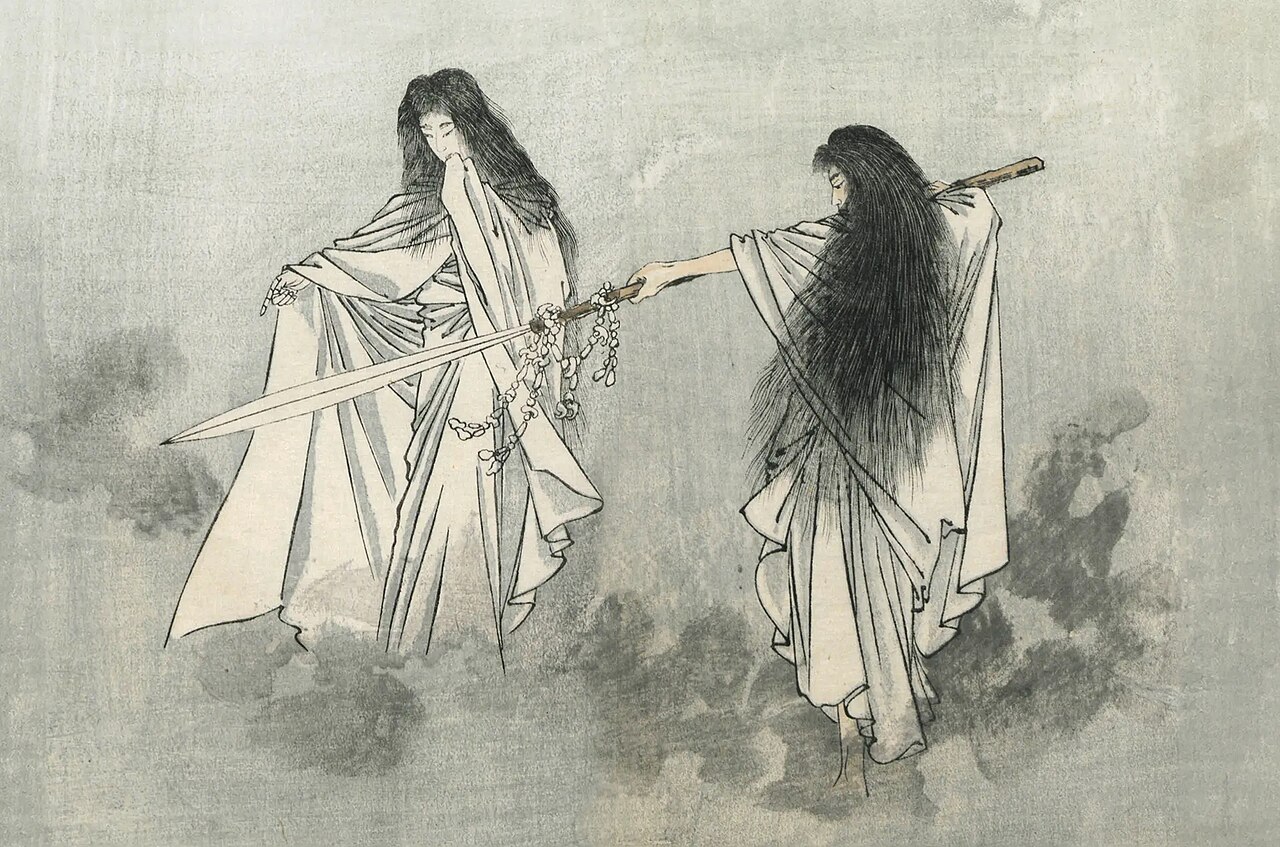
Izanami, formally Izanami-no-Mikoto (伊邪那美命), is the Shinto mother goddess whose name means “She-who-invites”. With her brother and husband Izanagi she created the Japanese archipelago and produced many of its deities. She then died giving birth to fire, passed into Yomi, the land of the dead, and from behind its sealed entrance gave humanity death. That double role makes Izanami the source of both creation and death in Japanese mythology, and the Nihon Shoki goes further than the Kojiki by crediting her, alongside Izanagi, with the sun goddess Amaterasu, the moon deity Tsukuyomi and the storm god Susanoo.
Because she gave humans death, Izanami is sometimes counted as a shinigami. Her story survives in the two oldest Japanese chronicles, the Kojiki of about 712 and the Nihon Shoki of 720, and the two do not agree on the ending. The Kojiki sends Izanagi down into the underworld to find her. The Nihon Shoki keeps him above ground on the island of Awaji and never stages the descent at all.
What the Name Izanami Means
Izanami means “Female-who-invites”. Both names in the pair are usually traced to the Old Japanese verb izanau, historically written izanafu, meaning “to invite”, with the suffix -mi marking the feminine and -ki or -gi the masculine. Read literally, Izanami and Izanagi are the female who invites and the male who invites.
The characters differ by chronicle. The Kojiki writes her name both as Izanami-no-Kami (伊弉冉神) and as Izanami-no-Mikoto (伊邪那美命), while the Nihon Shoki uses a third spelling for the same honorific form, 伊弉冉尊. Not every scholar accepts the izanau derivation. Shiratori Kurakichi proposed instead that the root is isa-, from isawo, meaning achievement or merit.
Two further titles attach to Izanami only after she dies. She is called Yomotsu Okami (黄泉津大神), the great kami of Yomi, and Chishiki no Okami (道敷大神), which Kokugakuin University’s Encyclopedia of Shinto renders as the road-pursuing great kami. Both names describe what she became rather than what she was, and both belong to the pursuit through the underworld.
Izanami as the Goddess of Creation
Izanami is a creation deity in the literal sense: she and Izanagi made the land. The first gods, Amenominakanushi and Kunitokotachi, summoned the female Izanami and the male Izanagi into existence and charged the two of them with creating the first land, handing them a spear decorated with jewels called Amenonuhoko, the heavenly spear.
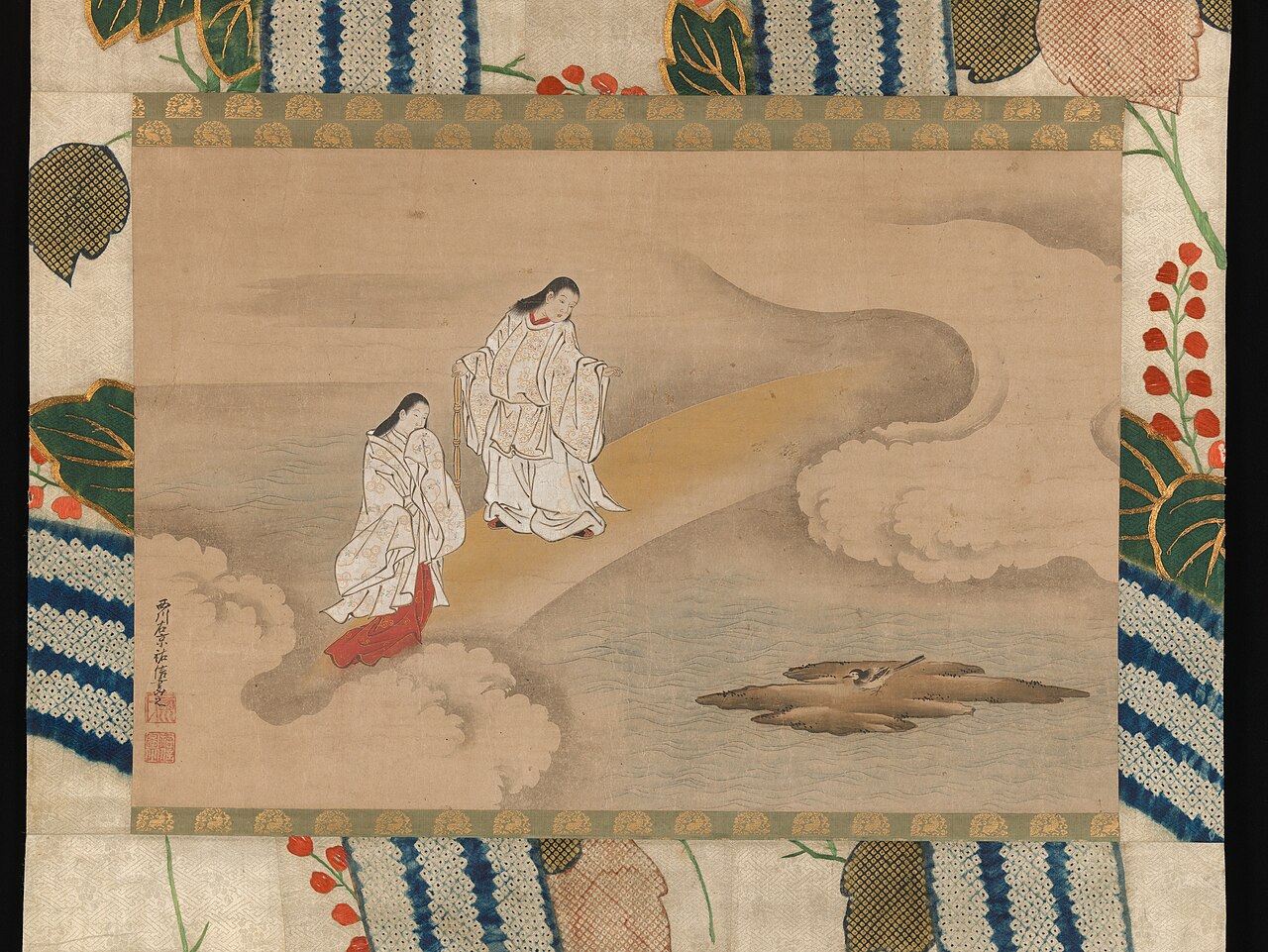
The pair went to Ame-no-ukihashi, the floating bridge of heaven, and churned the sea below with the spear. Salt water dripped from the tip, and where the drops fell the island Onogoroshima formed. They came down from the bridge and made their home on it. This episode opens the creation myth that sits at the centre of Japanese folklore, and everything else in the cycle, including the sun, follows from it.
Wanting to produce children, they raised a pillar called Ame-no-mihashira (天の御柱), the pillar of heaven, and around it built a palace called Yahiro-dono (八尋殿). One hiro measures roughly 1.82 metres, so an eight-hiro palace would stand about 14.56 metres across, though ya was a sacred number in Japan and is often better read as “myriad” than as a count. Izanami and Izanagi then circled the pillar in opposite directions, and when they met on the far side Izanami spoke the greeting first. Izanagi did not consider it proper for the wife to speak first. They united anyway, and the result was two children born deformed and not recognised as legitimate: Hiruko, the leech-child, later worshipped in Shinto as Ebisu, and Awashima, the island of foam. The pair set both children adrift in a boat and asked the other gods what they had done wrong. The answer was that the male deity should have spoken first in the marriage greeting. They circled the pillar again, Izanagi spoke first, and the marriage took.
From that union came the Ōyashima, the great eight islands of the Japanese chain:
- Awaji
- Iyo, later Shikoku
- Oki
- Tsukushi, later Kyūshū
- Iki
- Tsushima
- Sado
- Yamato, later Honshū
Hokkaido, Chishima and Okinawa are absent from the list because they were not counted as part of Japan in ancient times. Six more islands followed, and then a long series of deities. The Encyclopedia of Shinto summarises that stretch of the Kojiki as the birth of kami standing for natural elements, wind and trees and mountains and fields among them, which is the point at which Izanami stops making geography and starts making the forces that move across it.
The Birth That Killed Izanami
Izanami died in childbirth, killed by the child she was bearing. The Kojiki names him Kagu-tsuchi, the incarnation of fire, also called Ho-Musubi, the causer of fire. The Encyclopedia of Shinto states the mechanism plainly: burning her genitals as she gave birth to the god of fire, Izanami fell sick and then died, after producing the gods of metal, earth, water and wood.
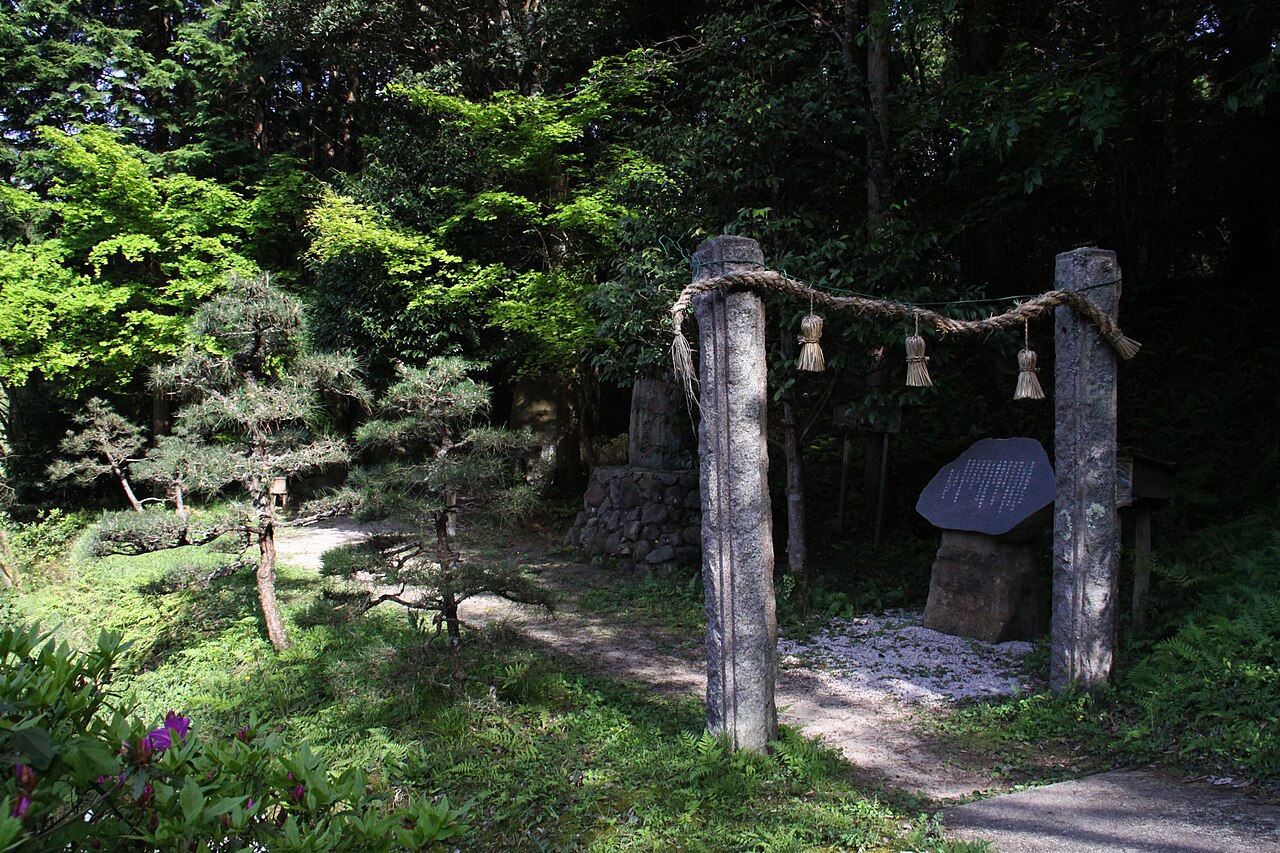
She was buried on Mount Hiba, on the boundary of the old provinces of Izumo and Hōki, near what is now Yasugi in Shimane Prefecture. The Nihongi puts her grave at Kumano instead, one of several places where the two textual traditions part company over her. Izanagi’s reaction was not grief alone. He was angry enough at his wife’s death to kill the newborn Kagu-tsuchi, and dozens of further deities came out of that killing.
Yomi, and How Izanami Became a Goddess of Death
Izanami became a goddess of death after her burial, when she refused to come back. Izanagi lamented her and travelled to Yomi, the shadowy land of the dead, to fetch her. He found her, though at first he could not see her because the shadows hid her, and asked her to return. She told him he was too late. She had already eaten the food of the underworld and belonged to the land of the dead, but she would go and ask for permission to leave.
He did not wait. While she slept, Izanagi took the comb binding his long hair and set a tooth of it alight as a torch, and the sudden light showed him what she had become: a rotting form of flesh with maggots and foul creatures running over the body. The Encyclopedia of Shinto entry on Yomi notes that the texts never settle the underworld’s appearance, and that this comb-torch scene is the evidence that the palace interior at least was dark, without implying darkness everywhere in the realm.
Izanagi ran. Izanami woke shrieking and gave chase, and she sent pursuers after him: Yakusa-no-ikazuchi-no-kami, thunder deities of the kind later art gives the shape of Raijin, along with the shikome, the foul women of Yomi. Izanagi threw a peach at them to drive them off, a detail that carries Chinese influence, since the peach is treated in China as a sacred amulet fruit. He then declared the peaches divine, named them Ōkamuzumi, and told them to help the people of the living world in their moments of distress exactly as they had helped him.
At the mouth of Yomotsuhirasaka (黄泉津平坂), the cavern that served as the entrance to Yomi, Izanagi pushed a boulder into place. That boulder separated the living from the dead, and it separated him from his wife. It also became a deity in its own right, known in both chronicles as Yomido ni Sayarimasu no Ōkami and alternatively as Chigaeshi no Kami, worshipped since as a guardian of roads and borders, a sai no kami. From behind the barrier Izanami called out that if he left her she would kill a thousand residents of the living world every day. Izanagi answered that he would give life to fifteen hundred. Deaths and births in the world are the terms of that argument, which is why the Encyclopedia of Shinto reads the exchange as an account of where life and death themselves come from.
Two other consequences follow the escape. Izanagi performed harai, ritual cleansing, after seeing his wife’s decomposing body, and that act is the traditional explanation for the purification with water that shrine-goers still perform before entering a sacred space. While he bathed, three of Japan’s central deities came out of him: Amaterasu, the sun goddess, from his left eye, Tsukuyomi, the moon god, from his right eye, and Susanoo, the storm god, from his nose. The same washing away of Yomi’s spiritual pollution, kegare, also produced Yasomagatsuhi and Ōmagatsuhi, two kami generally regarded as the source of disorder in this world. Where exactly Yomi lay, and where the idea came from, became one of the central problems of Edo period National Learning, argued over hardest by Hirata Atsutane.
What the Nihon Shoki Tells Differently
The Nihon Shoki follows the Kojiki for most of Izanami’s story and then removes its most famous scene. It keeps Izanagi above ground on Awaji instead of sending him down into Yomi, places Izanami’s grave at Kumano rather than on Mount Hiba, and credits Amaterasu, Tsukuyomi and Susanoo to both deities rather than to Izanagi alone.
| Detail | Kojiki | Nihon Shoki |
|---|---|---|
| Izanagi after her death | Descends into Yomi | Stays on Awaji, in a temple |
| Her burial place | Mount Hiba, Izumo and Hōki border | Kumano |
| Amaterasu, Tsukuyomi, Susanoo | Born from Izanagi alone | Created by both deities |
The third row matters most for Izanami herself. In the Kojiki she has no part in the birth of the sun, the moon and the storm, because they emerge from Izanagi’s purification after he has already abandoned her. In the Nihon Shoki those three are the work of both parents, and Izanami keeps a share in the gods who govern the visible world.
The Gods Who Descend From Izanami
Izanami’s offspring include the great eight islands of Japan and six more, the kami of natural elements such as wind, trees, mountains and fields, the fire god Kagu-tsuchi together with the kami of metal, earth, water and wood, and, in the Nihon Shoki account, Amaterasu, Tsukuyomi and Susanoo. On that Nihon Shoki reading the line runs through Amaterasu to the Japanese imperial family, which puts a goddess of the dead at the head of an imperial genealogy; in the Kojiki, where Amaterasu is born from Izanagi alone, Izanami stands outside that descent.
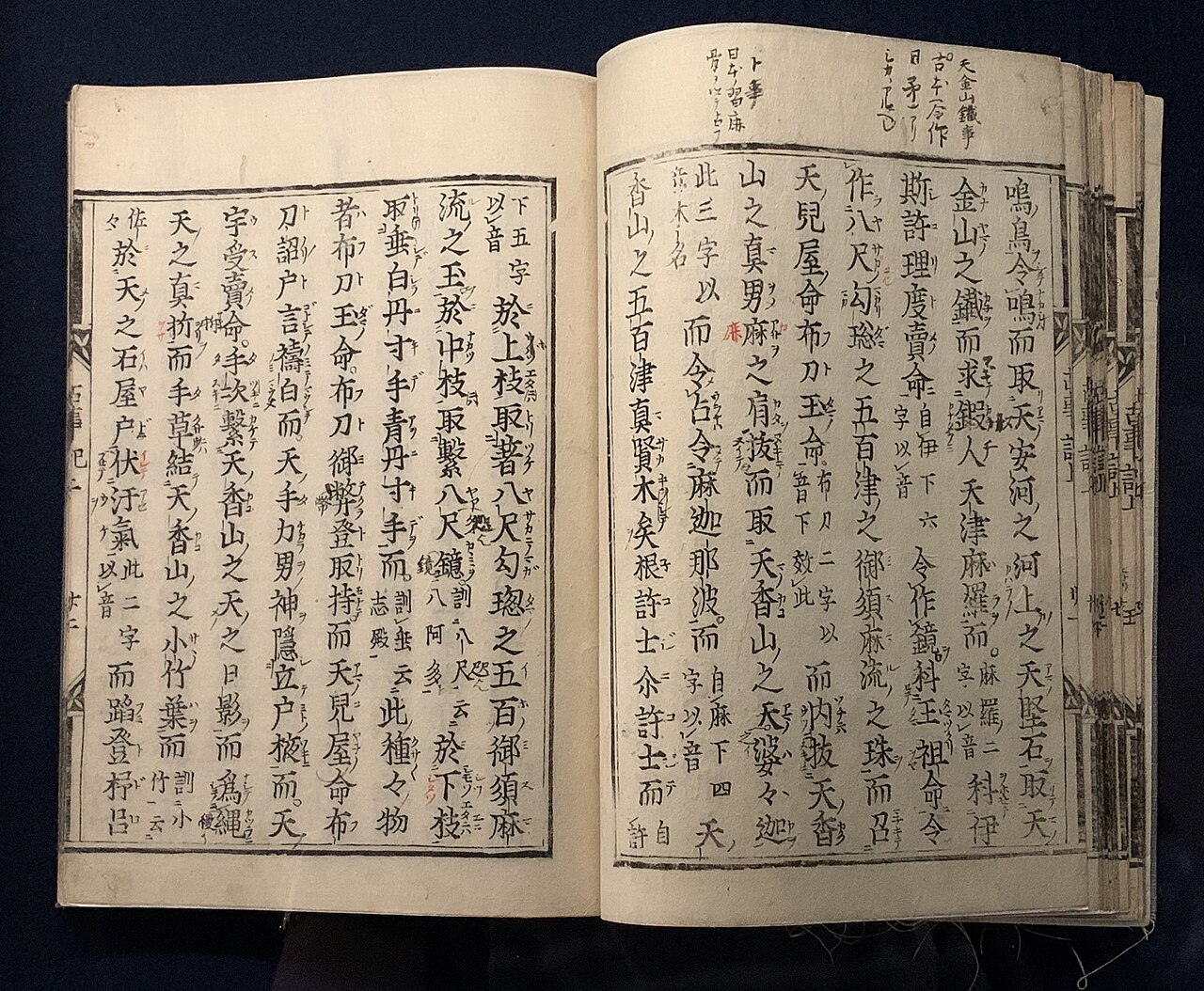
Izanami and Izanagi are themselves the last of the seven generations of primordial deities that manifested after heaven and earth formed, and they are siblings as well as consorts. Her genealogy above that point is thin. Neither the Kojiki nor the Nihon Shoki names her parents, and the variant traditions that do supply them disagree, offering Aokashikine-no-Mikoto, Awanagi-no-Mikoto, Omodaru and Ayakashikone.
Downward, the list is long. The kamiumi, the birth of the gods, adds Hiruko and Awashima from the failed first union, the two children set adrift before the marriage rite was corrected. The Sendai Kuji Hongi preserves further material on the same generations.
Where Izanami Is Still Honoured
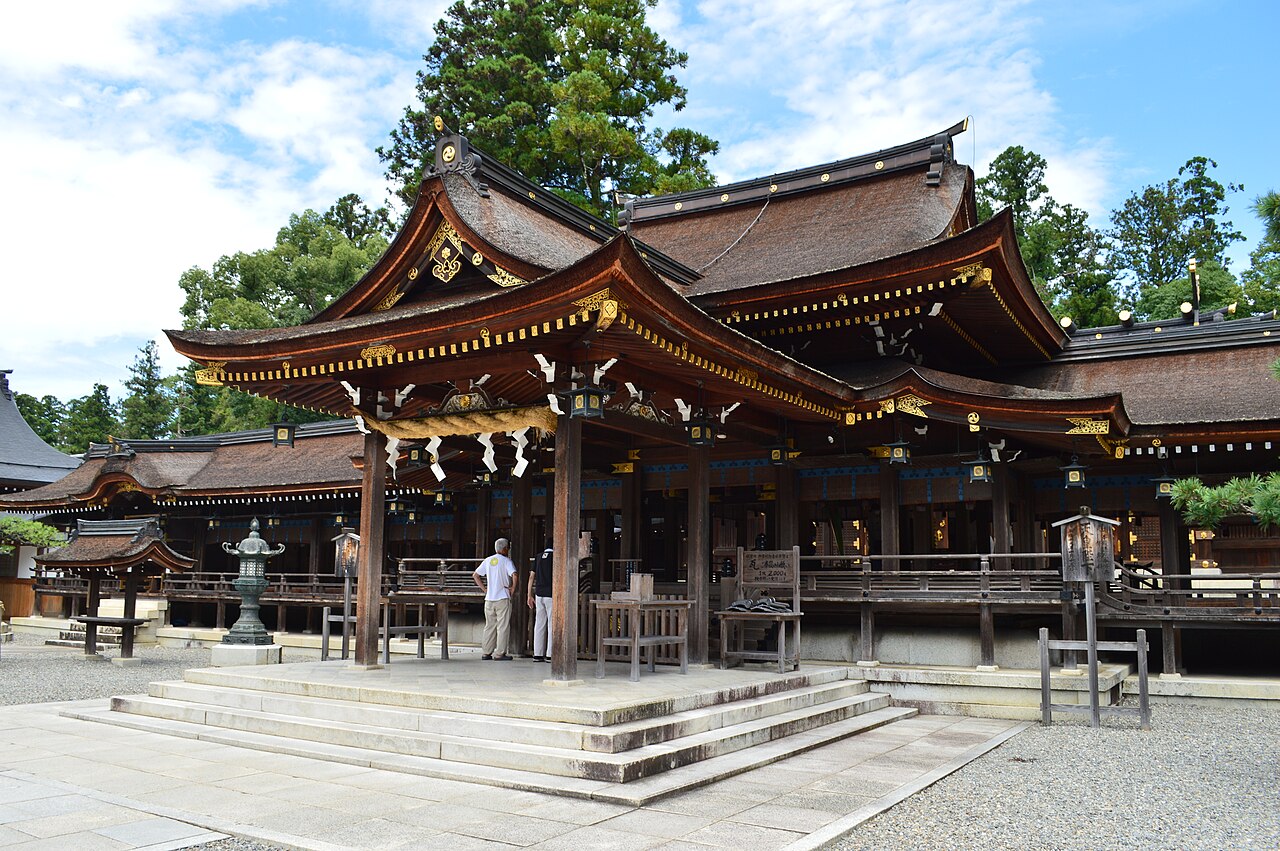
Izanami is an active object of worship, not only a figure in two old books. Her major cult centre is Taga Taisha, Mount Hiba near Yasugi in Shimane carries her burial tradition, and the boulder that shut her into Yomi is itself enshrined, worshipped as a sai no kami guarding roads and boundaries.
She also holds a place in a much younger religion. In Tenrikyo, Izanami-no-Mikoto is one of the Ten Aspects of God’s Providence, the jūzen no shugo (十全の守護). And the water basin at a shrine gate belongs to her story too, since the purification rite performed there descends from Izanagi’s cleansing after Yomi.
Izanami in Modern Art and Design
Modern treatments of Izanami work from the second half of her story, the death and the descent into Yomi, rather than the creation myth. The Frye Art Museum gave the ceramic artist Hanako O’Leary her first solo museum exhibition, Hanako O’Leary: Izanami, from November 2023 to January 2024, built around vessels and masks inspired by Izanami as goddess of both creation and death. The museum’s own retelling is deliberately irreverent, written in contemporary speech, and it makes a pointed observation about the source material: the classical texts leave Izanami at the boulder while Izanagi walks away and carries on as an active patriarch.
That imbalance is also the design problem. Kamicrew works with Japanese mythology as apparel graphics, and Izanami is harder to put on a garment than a yokai is, because she has no fixed face in the tradition and her most recognisable moments are objects rather than a figure: the jeweled spear over the water, the comb burning as a torch, the peach, the sealed boulder. Ceramic and carved Japanese mask traditions solve it by giving her an expression she never had in the Kojiki, the same move O’Leary’s masks make.
If the creation myth is the part of Japanese mythology you keep coming back to, Kamicrew’s mythology range is where those motifs end up on jackets, tees and hoodies.
FAQs
Who is Izanami in Japanese mythology?
Izanami is the Shinto mother goddess who, with her brother and husband Izanagi, created the Japanese islands and many of its kami. Her name, Izanami-no-Mikoto (伊邪那美命), means “She-who-invites”. After dying in childbirth she became a ruler of Yomi, the land of the dead, and the origin of human death.
How did Izanami die?
Izanami died giving birth to Kagu-tsuchi, the fire god, who burned her as he was born. According to the Encyclopedia of Shinto she fell sick and died after also producing the gods of metal, earth, water and wood. She was buried on Mount Hiba near modern Yasugi in Shimane Prefecture, or at Kumano in the Nihongi account.
What happened to Izanami after her death?
Izanami passed into Yomi and ate the food of the underworld, which bound her to it permanently. When Izanagi lit a comb tooth as a torch and saw her decomposing body, he fled, and she chased him with thunder deities and the shikome. He sealed the entrance with a boulder, and she vowed to kill a thousand people a day, to which he answered that he would give life to fifteen hundred.
How are Izanagi and Izanami related?
Izanagi and Izanami are siblings and consorts at once, the last of the seven generations of primordial deities that appeared after heaven and earth formed. Their marriage rite around the pillar Ame-no-mihashira only succeeded on the second attempt, once Izanagi rather than Izanami spoke the greeting first. Their divorce at the entrance of Yomi is what separates the living world from the dead one.
What is Yomi in Shinto belief?
Yomi, also called Yomotsukuni, is the underworld of the Kojiki and Nihon Shoki, the realm Izanami entered after death. Its appearance is never fully described, though the palace interior was dark enough that Izanagi needed a burning comb tooth to see. A boulder placed at Izanagi’s command separates it from both Takama no hara and Ashihara no nakatsukuni, the human world.
Kamicrew Best Seller

Dont Touch Me Yokai Ukiyo-E Japanese T-Shirt
$25.49+
$29.99
(15% off)


Summer Vibes Salty Kawaii Japanese Hoodie
$44.99+
$49.99
(10% off)


Japanese Pin Horror 80s Retro Aesthetics T-Shirt
$25.49+
$29.99
(15% off)


El Gran Maja Japanese Kaiju T-Shirt
$25.49+
$29.99
(15% off)


Who Wants The Perfect Body Japan Capybara Kawaii Japanese Unisex Shirt
$25.49+
$29.99
(15% off)


Monster 8 Mask Vintage Animal Hoodie
$44.99+
$49.99
(10% off)


I Hate People Japanese Opossum Vintage Animal Hoodie
$44.99+
$49.99
(10% off)


I Got That Dog In Me Small Turtle Vintage Animal T-Shirt
$25.49+
$29.99
(15% off)

The Creation Of Cat Ukiyo-E Japanese T-Shirt
$25.49+
$29.99
(15% off)