
The Japanese god of death is Enma Daio, the Buddhist king who judges the newly dead and decides where each soul goes next, a figure whose ancestry runs back to the Vedic god Yama. The Japanese god of war is Hachiman, a Shinto kami whom Britannica describes as the patron deity of the Minamoto clan and of warriors in general, and who is commonly regarded as the deification of Ojin, the fifteenth emperor of Japan. The two answers come from two different religious systems: Enma arrived with Buddhism from India by way of Tang China, while Hachiman is a native kami whose cult began in Kyushu.
Neither of them is a grim reaper, and neither is a war god in the Greek sense. Enma does not kill anyone. He sorts the dead after somebody else has already done the killing. Hachiman was not worshipped for bloodshed either. Symbol Sage describes him as a patron kami of warriors and archery rather than a god of warfare itself, and the same kami is invoked by farmers and fishermen. This piece takes the two halves separately, because they belong to separate systems that only meet in the mixed religious landscape of medieval Japan.
Enma and Hachiman at a glance
Enma Daio and Hachiman differ in tradition, domain, origin story and place of worship. Enma is an imported Buddhist judge of the dead met in temple halls. Hachiman is a native Shinto kami of warriors and archery met at shrines. The table sets the two side by side.
| Enma Daio | Hachiman | |
|---|---|---|
| Domain | Judgment of the dead, rule of hell | Warriors, archery, protection |
| Tradition | Buddhist, via China and India | Shinto kami, later Buddhist title |
| Earlier identity | Yama, god of death in Vedic myth | Emperor Ojin, deified centuries later |
| Where he is met | Temple halls of the ten kings | Hachiman shrines, head shrine Usa Jingu |
| Attributes | Tang official robes, scroll of deeds | Bow and arrow, the dove |
Enma Daio, the judge who decides where the dead go
Enma Daio is the ruler of hell, both Jigoku and Meido, and the foremost of the judges of the dead. Yokai.com gives his chief duty as judging the souls of the newly dead and sending them on to their next location. He keeps a great scroll in which the good and evil deeds of every single person are recorded, which is the detail that makes him a judge rather than an executioner.
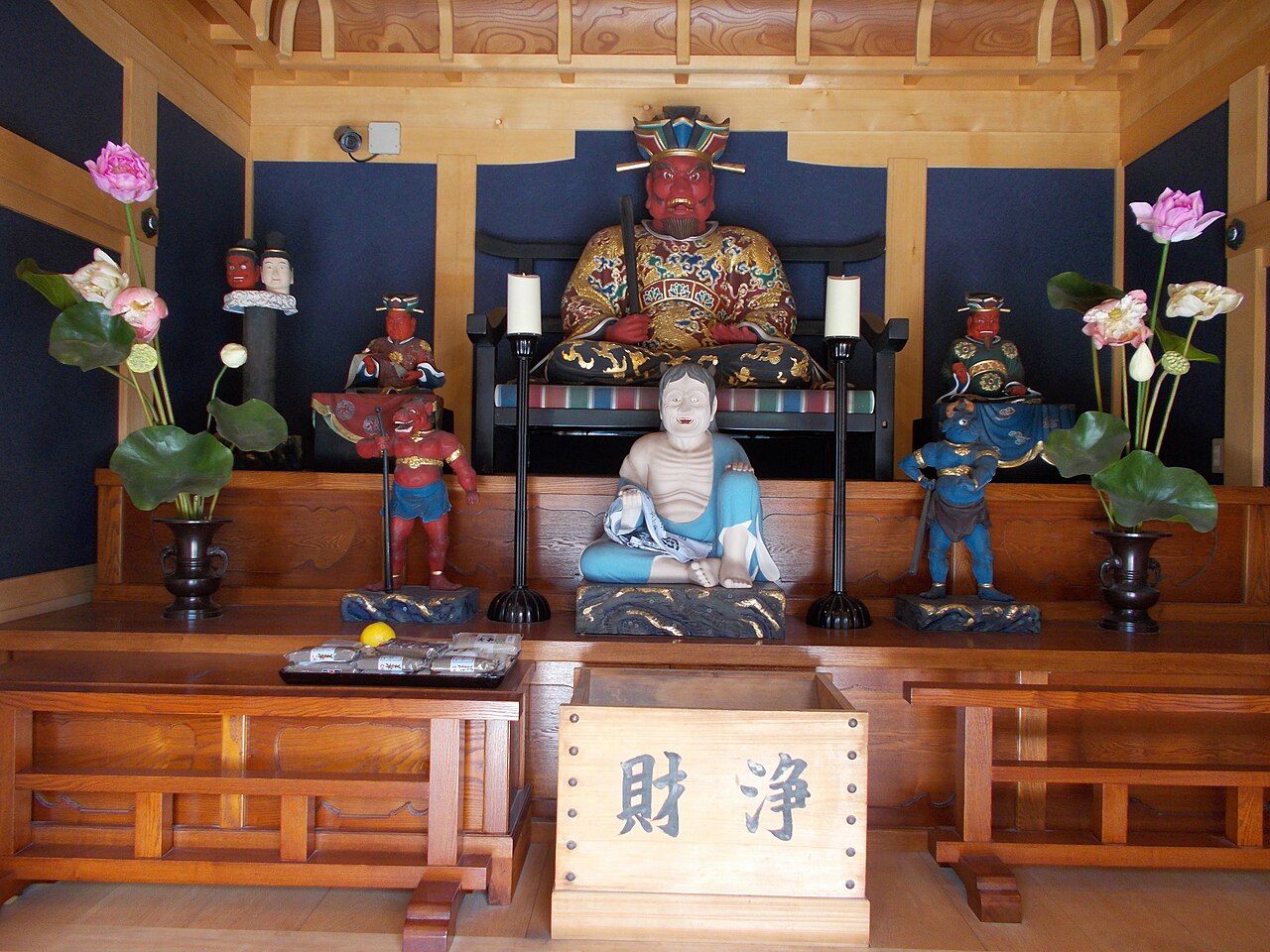
The verdict is read out of a ledger that was written while you were still alive, and Enma does not keep that ledger alone. His court staff is fixed in the sources:
- Shiroku and Shimyo, two secretaries who handle his records
- Gozu and Mezu, the two chiefs commanding a staff of demonic servants, named for the animal heads they wear, an ox head for Gozu and a horse head for Mezu, and sent out to drag the particularly wicked back to hell
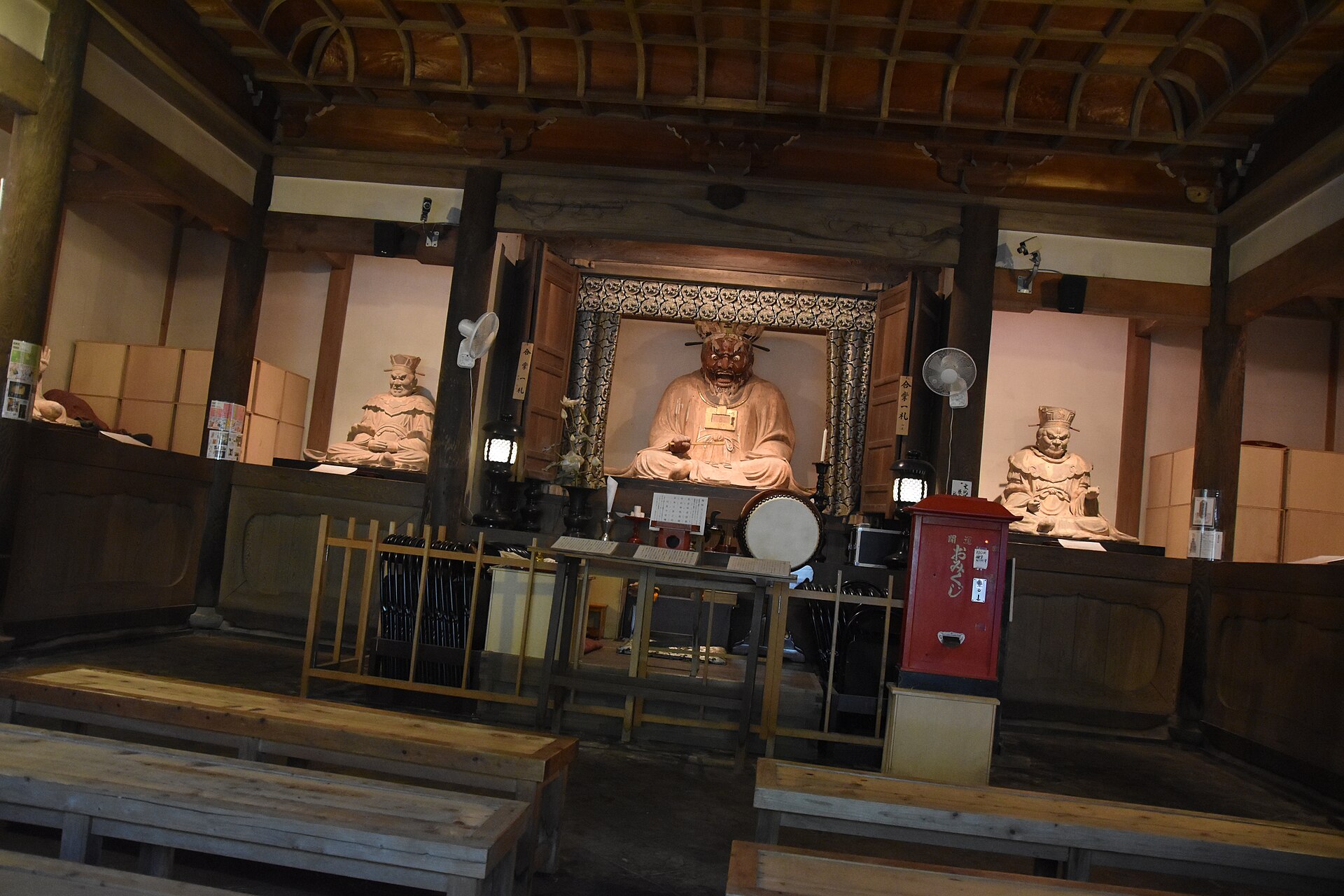
Enma himself wears the robes of an ancient government official of the Chinese Tang dynasty and a fearsome expression, which is why so many temple statues of him look less like a demon and more like a furious bureaucrat.
The most surprising thing about Enma sits underneath that anger. In Japanese Buddhist tradition his true form is Jizo Bosatsu, the guardian of the underworld, god of travelers and protector of children. The terrifying face is a working costume, not the whole of him.
How Japanese Buddhist judgment of the dead works
Judgment in Japanese Buddhism is a sequence of hearings before a panel of kings, not a single verdict, and the sources disagree on the panel’s size. Yokai.com describes Enma as the foremost of thirteen judges of the dead. The scheme that Japanese temple art pictures most often is the Ten Kings of Hell, and the Japan Tourism Agency’s guide to the Buddhist underworld records that the dead are judged over a period of 49 days by those ten kings, who are led by Enma and who pass judgment in turn on sins such as killing, theft and lying. Both counts treat Enma as the most powerful of them.
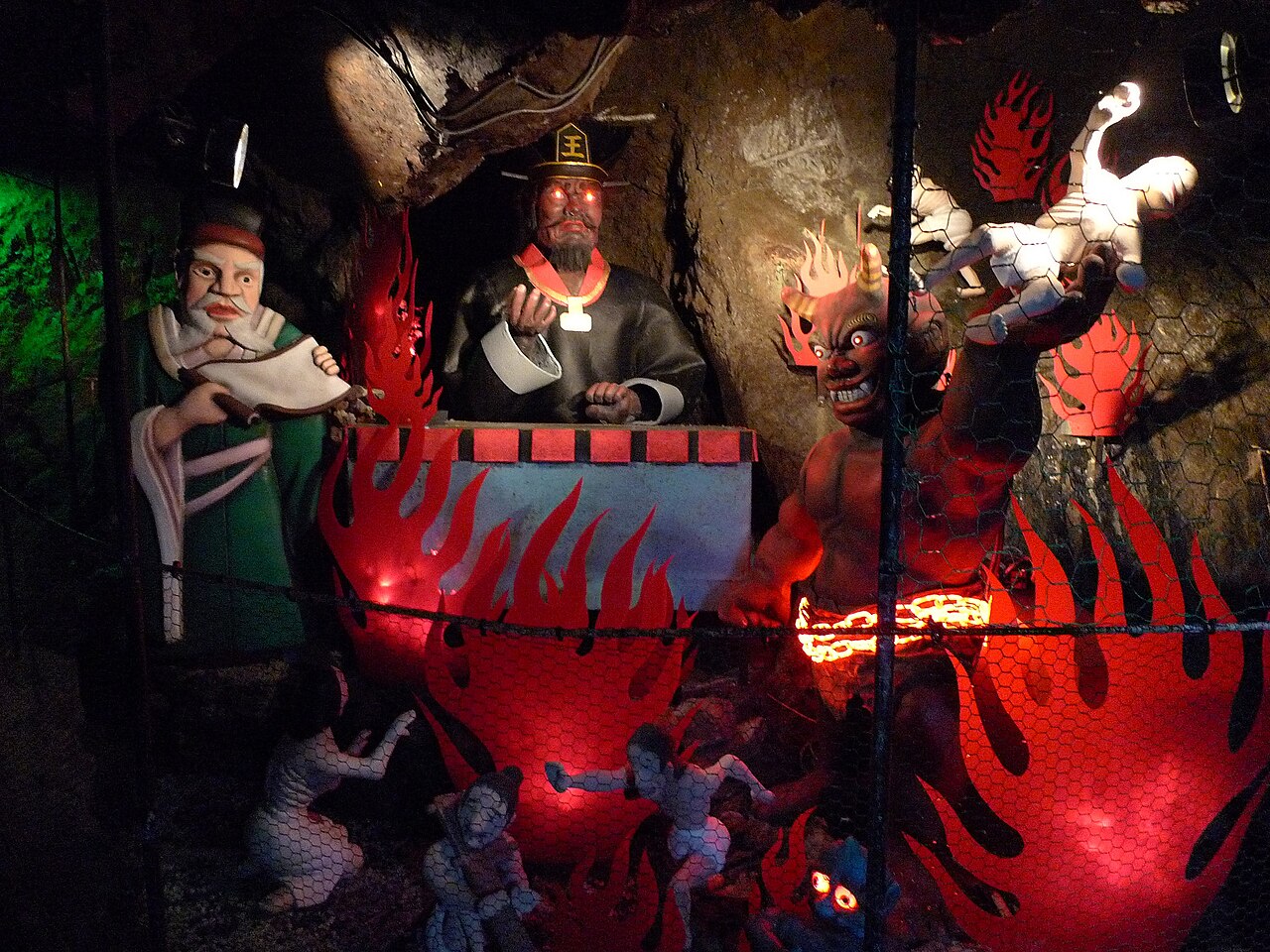
Those hearings fall at strict seven-day intervals across the 49 days, which is why Japanese families hold memorial services on the same rhythm: the seventh, fourteenth, twenty-first, twenty-eighth and thirty-fifth days after a death, then the forty-second and the forty-ninth. Enma is the fifth king in that order. Mark Schumacher’s Japanese Buddhist Statuary A-to-Z, which sets the tribunal out king by king, records that Enma-o makes his ruling on the thirty-fifth day, after hearing the judgments passed down by the four kings before him, and that his is the decisive verdict, because it settles which of the six realms of existence the dead person is reborn into. All of the judges are pictured as Tang dynasty Chinese officials, because Chinese influence was overwhelming when the idea reached Japan.
Judgment has a folk edge that survived long after anyone stopped reading the scriptures. Yokai.com records the line Japanese parents still use on a child caught lying: if you tell a lie, Enma will rip out your tongue. The threat is the courtroom in miniature, a promise that the ledger is already being written.
The literary version of the tribunal is bleaker. In the Tales of the Heike, the Nun of the Second Rank dreams of a carriage sent from the tribunal of King Enma to fetch Taira no Kiyomori, with a decree that he will fall into the Hell of Never Ceasing Torment, the Avici Hell of Buddhist cosmology and the worst level of the Buddhist hells.
Where Enma came from: Yama, India, and Tang China
Enma is not native to Japan. The name comes from Yama in Sanskrit and Pali, and in Vedic mythology Yama is the god of death. Buddhism carried the figure out of India and through China, and he reached Japan during the Tang dynasty, arriving with the Chinese official’s robes that Japanese temple statues still show him wearing.
His job description shifted on the way, and the shape it settled into is Chinese rather than Indian. Kyoto National Museum’s entry on King Enma and his attendants describes how Buddhism blended with Chinese religious tradition to produce the Ten Kings worship, the system of ten judges and ten hearings that Japan then inherited whole, along with the court dress the judges wear. What arrived in Japan was therefore not the Vedic god on his own but a fully built afterlife bureaucracy with Enma at its head.
The museum dates the oldest surviving Japanese sculptures of that court, originally from a hall called Enmado and now kept at Hoshaku-ji in Kyoto, to the early Kamakura period in the thirteenth century. They carry the inlaid quartz eyes typical of Kamakura sculpture, which is a large part of why a room of them still reads as a bench of living officials rather than a set of idols, and why the same imagery kept its grip on Japanese visual culture for the next eight hundred years.
Why Enma is not the same as Izanami
Enma and Izanami are both attached to death in Japanese religion, but they belong to different systems and answer different questions. Izanami rules Yomi, the polluted land of the dead that comes from the oldest layer of native myth. Enma presides over Jigoku and Meido, a judicial afterlife with a courtroom, a ledger and a sentence, imported with Buddhism.
A lot of “Japanese god of death” results point at Izanami for that reason. The native tradition already had a land of the dead before Buddhism arrived, and its story belongs to Izanami and Yomi. If you are looking for the deity who processes the dead and assigns them a destination, that is Enma, and he sits in a completely different system from the creation myth that gave Japan its first death.
Hachiman, the kami warriors actually prayed to
Hachiman is one of the most popular Shinto deities in Japan and, per Britannica, the patron deity of the Minamoto clan and of warriors in general, which is why he is so often called the Japanese god of war. Symbol Sage frames his portfolio as archery and warriors rather than war as such, and lists samurai, archers, farmers and fishermen among those under his protection. His symbols are the bow and arrow and the dove.
His name is a clue to how he was understood. He is known as Yahata no Kami, and the name translates as the God of the Eight Banners, a reference to the eight heavenly banners said to have appeared at Emperor Ojin’s birth. Britannica also notes that Hachiman is seldom worshipped alone, and Ancient Origins confirms that he is normally venerated alongside other deities in his shrines. Among the many figures in the Shinto pantheon, Hachiman is unusual in being both a state protector and a working patron of ordinary rural life.
From Emperor Ojin to Great Bodhisattva
Hachiman became an emperor and a bodhisattva by stages. Ancient Origins explains that during the Nara period he had established himself as a protector of the imperial family without yet being identified with the deified emperor, and that the identification with Ojin only settled during the following Heian period. In 781 the imperial court granted Hachiman the title Daibosatsu, or Great Bodhisattva.
Ojin himself is a semi-legendary figure, credited with consolidating imperial power, instituting land reforms, and encouraging exchange with Korea and China that brought Korean weaving techniques, the Chinese writing system and Confucianism into Japan. His grave is traditionally placed at Habikino near Osaka, in the second largest kofun burial mound in the country at about 425 metres long, although Ancient Origins is careful to note there is no solid evidence that either it or the larger Nintoku mound actually holds an emperor.
The turning point was a construction project. When Emperor Shomu ordered the casting of the Great Buddha for Todai-ji in the Nara period, an oracle from Hachiman promised that the kami would help, and the Kokugakuin University Encyclopedia of Shinto entry on Hachiman worship records that the message was carried to the capital by Oga no Ason Morime, a shrine priestess of Usa. That journey moved a regional Kyushu cult into the centre of Japanese religion. Ancient Origins notes Hachiman was the first Japanese deity to receive the Daibosatsu title, and the Kokugakuin entry adds that Hachiman shrines were established as guardian shrines for temples including Todai-ji, Yakushi-ji and To-ji, while in 860 an emanation of Hachiman was installed at Iwashimizu Hachimangu, which became the focus of the cult in the capital.
The Minamoto clan and the samurai who claimed him
The Minamoto, also called the Genji, claimed descent from Emperor Ojin, which made Hachiman their ancestral kami as well as a useful war patron. After the clan under Yoritomo destroyed the rival Taira in the Genpei Wars and founded the Kamakura shogunate, Hachiman’s role widened from clan deity to protector of the nation.
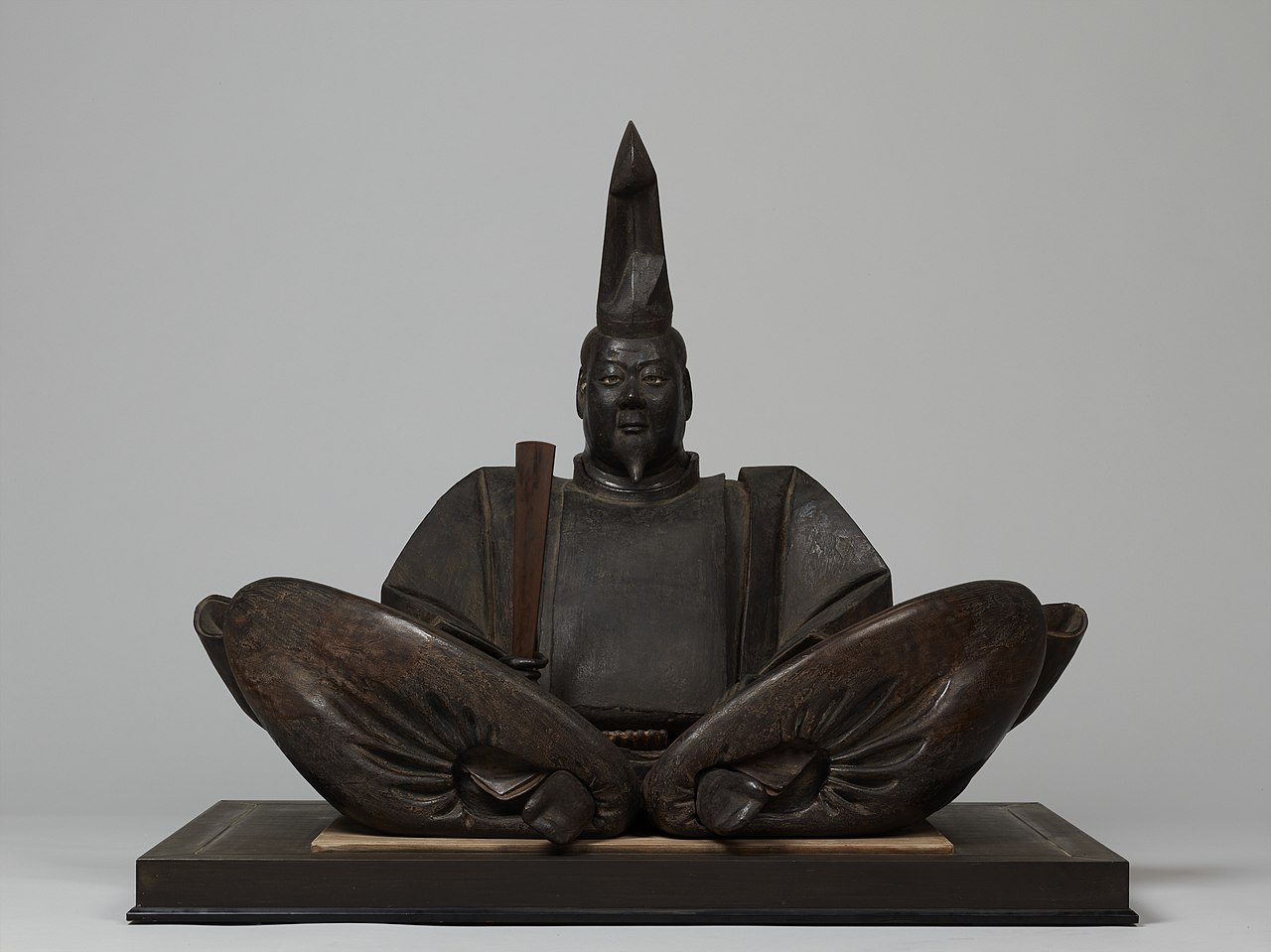
The clan’s devotion is documented in individual acts. Minamoto Yoriyoshi dedicated a Hachiman shrine in thanks for a military victory. His son Yoshiie was nicknamed Hachiman Taro and was believed by some to be Hachiman reincarnated, and the story attached to him has the god telling him to shoot an arrow into a rock during a northern campaign, at which point water gushed out and saved his thirsty army.
Hachiman’s national role was sealed by the Mongol invasions of 1274 and 1281, when both invasion fleets were wrecked by typhoons the Japanese called kamikaze, the divine wind. Hachiman is widely credited with sending them, though Symbol Sage notes the same storms are also attributed to Raijin and Fujin, the thunder and wind deities. Two further sides of him are easy to miss: he is worshipped as a protector of children, and he is considered the patron of spies, because Ojin was said to have disguised himself as a commoner to see how his subjects really lived.
Usa Jingu and the tens of thousands of Hachiman shrines
Usa Jingu, also called Usa Hachimangu, in the city of Usa in Oita prefecture on Kyushu, is the head shrine or sohonsha of the Hachiman cult. Counting the branch shrines is inexact and the references disagree. Symbol Sage puts the figure at over 25,000, while Ancient Origins gives various estimates of between 30,000 and 44,000 registered and unregistered shrines. Both agree that only Inari has more shrines in Japan than Hachiman.
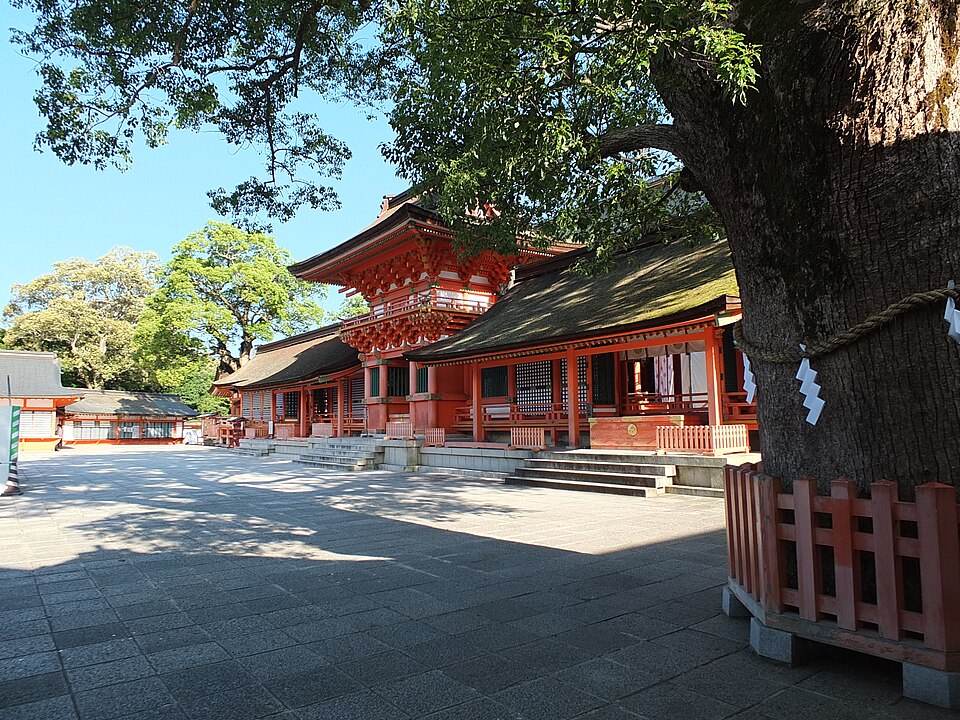
The Kokugakuin entry traces the whole cult back to this site and to five other Hachiman shrines in Kyushu, and records that a shrine temple complex, Miroku Temple, was established there in 725, which is why the mixing of kami and Buddhas developed unusually early at Usa. Ancient Origins reports that the shrine’s power grew to the point that an estimated two thirds of the arable land on Kyushu belonged to it at its height, and that in prestige it stands second only to Ise Grand Shrine.
Its main hall, the Jogu, is a designated National Treasure and holds three altars, closed to visitors, dedicated to:
- Hachiman himself
- Empress Jingu, the deified mother of Ojin
- Hime Okami
That trio is the standard arrangement at Hachiman shrines, which is the practical meaning of Britannica’s remark that Hachiman is seldom worshipped alone. The legend behind the second altar is a strange one: Empress Jingu is said to have launched an invasion of Korea after her husband’s death while pregnant with Ojin, and to have given birth only three years later, once the campaign was over.
How Enma and Hachiman show up in art and in what people wear
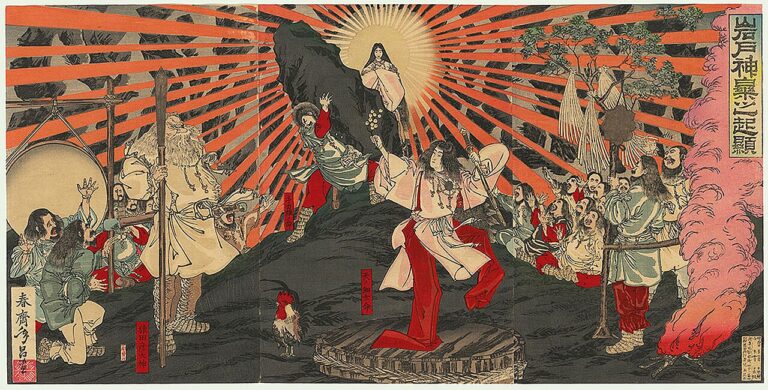
Enma and Hachiman survive in modern visual culture through different channels. Enma travels as a face, the red faced king in Tang court dress glaring out of hell scrolls and temple halls, and he is one of the most recognisable characters in Japanese religious art precisely because artists were allowed to make him frightening. Hachiman travels through objects instead: the bow and arrow, the dove, the vermilion shrine gate.
That difference explains why the two look so unalike on a print or a garment. Anyone reading about Hachiman alongside the rest of Japanese folklore will notice how much of Japan’s warrior iconography is really shrine iconography, carried by architecture and weapons rather than by a face.
At Kamicrew we design around exactly that kind of material, so if the ukiyo-e side of Japanese mythology is what pulled you into this article, our ukiyo-e inspired shirts are a good place to start.
FAQs
Who is the Japanese god of death?
Enma Daio, known also as Great King Enma, is the ruler of hell and the judge who decides where each soul goes after death. He is a Buddhist figure descended from the Vedic god Yama, and he keeps a scroll recording every good and evil deed of every person.
Who is the Japanese god of war?
Hachiman is the Japanese god of war. Britannica describes him as the patron deity of the Minamoto clan and of warriors in general, and he is commonly regarded as the deification of Emperor Ojin. Symbol Sage frames his domain as warriors and archery rather than warfare itself, and lists samurai, archers, farmers and fishermen among those he protects.
Is Enma the Japanese grim reaper?
No. Enma does not kill anyone and does not collect souls. He judges the dead after they arrive, reading their good and evil deeds out of a scroll kept while they were alive and assigning them a destination. In Japanese Buddhist tradition his true form is Jizo Bosatsu, guardian of the underworld and protector of children.
What is the difference between Enma and Izanami?
Izanami belongs to native Japanese myth and rules Yomi, the polluted land of the dead. Enma belongs to imported Buddhist cosmology and presides over Jigoku and Meido, a judicial afterlife with a courtroom, a ledger and a sentence. Both are linked to death, but they come from different religious systems.
How many judges of the dead are there in Japanese Buddhism?
The references count them differently. Yokai.com calls Enma the foremost of thirteen judges of the dead. The scheme most often pictured in Japanese temple art is the Ten Kings of Hell, and the Japan Tourism Agency records that the dead are judged over a period of 49 days by those ten kings, led by Enma, who pass judgment in turn on sins such as killing, theft and lying. The hearings fall at seven-day intervals, and Enma, the fifth king, gives the decisive ruling on the thirty-fifth day. Both counts treat Enma as the most powerful of them.
What does the name Hachiman mean?
Hachiman, also written Yahata no Kami, means the God of the Eight Banners. The name refers to the eight heavenly banners that are said to have appeared at the birth of Emperor Ojin, the emperor with whom Hachiman came to be identified.
Is Hachiman a deified emperor or a nature kami?
He is commonly regarded as the deification of Emperor Ojin, but that identification took centuries to form. Ancient Origins notes that during the Nara period Hachiman was already a protector of the imperial family without being identified with Ojin, and the two were only merged during the Heian period that followed.
Why did samurai worship Hachiman?
The Minamoto samurai clan claimed descent from Emperor Ojin, so Hachiman was both their ancestral kami and a fitting patron for a warrior house. Minamoto no Yoshiie took the name Hachiman Taro, and after the clan won the Genpei Wars and founded the Kamakura shogunate, the god’s protection was credited with part of that victory.
Where is the main Hachiman shrine in Japan?
The head shrine, or sohonsha, is Usa Jingu in the city of Usa, Oita prefecture, on Kyushu. Estimates of the number of branch Hachiman shrines range from over 25,000 per Symbol Sage to between 30,000 and 44,000 per Ancient Origins. Only Inari has more shrines in Japan.
Kamicrew Best Seller

Dont Touch Me Yokai Ukiyo-E Japanese T-Shirt
$25.49+
$29.99
(15% off)


Summer Vibes Salty Kawaii Japanese Hoodie
$44.99+
$49.99
(10% off)


Japanese Pin Horror 80s Retro Aesthetics T-Shirt
$25.49+
$29.99
(15% off)


El Gran Maja Japanese Kaiju T-Shirt
$25.49+
$29.99
(15% off)


Who Wants The Perfect Body Japan Capybara Kawaii Japanese Unisex Shirt
$25.49+
$29.99
(15% off)


Monster 8 Mask Vintage Animal Hoodie
$44.99+
$49.99
(10% off)


I Hate People Japanese Opossum Vintage Animal Hoodie
$44.99+
$49.99
(10% off)


I Got That Dog In Me Small Turtle Vintage Animal T-Shirt
$25.49+
$29.99
(15% off)

The Creation Of Cat Ukiyo-E Japanese T-Shirt
$25.49+
$29.99
(15% off)