
Izanagi is the Shinto creator god whose name means “He-who-Invites”, and who, with his sister and wife Izanami, drew the islands of Japan out of the sea. He fathered Amaterasu the sun goddess, Tsukuyomi the moon god and Susanoo the storm god in a single act of purification after escaping Yomi, the land of the dead. He is the patriarch of the Japanese pantheon in the literal sense, because most of the pantheon descends from him. He founded the heavenly bureaucracy those three came to head, then stepped back from the throne he had built.
Two things separate Izanagi from Izanami inside the same myth. He is the one who survives it, and he is the one whose rituals outlast it. The marriage rite and the water purification called misogi both trace back to episodes in his story, which is why a god of the oldest chronicles still turns up at the water basin of a working shrine.
What the Name Izanagi Means
Izanagi means “He-who-Invites”. The two chronicles that preserve him do not spell the name the same way: the Nihon Shoki writes 伊弉諾尊 and the Kojiki writes 伊邪那岐神, and the difference is orthographic rather than semantic, since both carry the identical meaning.
The pairing with Izanami is built into the names themselves, one the male who invites and one the female who invites, and the invitation in question is the courtship exchange that opens the creation myth.
What Izanagi Rules and Carries
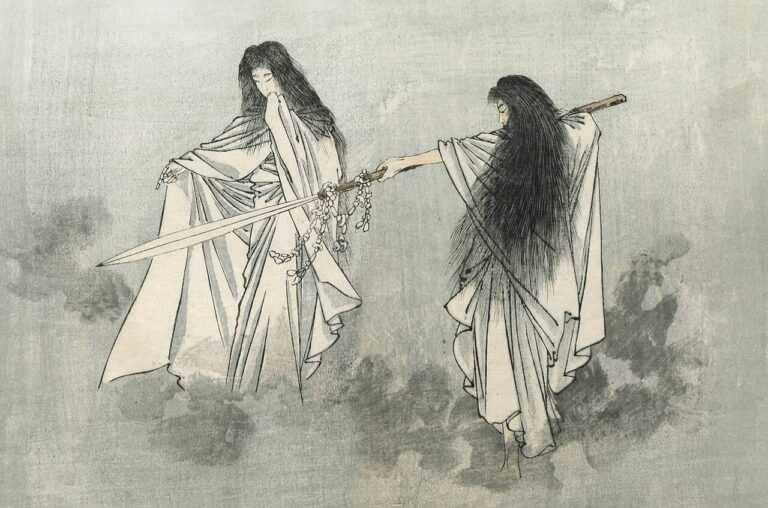
Izanagi is the Shinto god of creation, of marriage and of purification, and the guardian who holds the forces of Yomi away from the living world. His signature object is Ame-no-nuboko, the heavenly jeweled spear he used to churn the primordial seas, and it is the one attribute that painters reliably give him. The common label creator deity is imprecise: he made comparatively little, and what he did at enormous scale was father kami.
His other functions are custodial. Izanagi keeps the rate of births above the rate of deaths, which is a duty rather than a power, and it exists because of an argument he lost at the entrance to the underworld. He also established two foundational Shinto rites, the marriage ceremony and misogi, the water purification that removes spiritual contamination. Originally the ruler of Heaven, he trained Amaterasu to take the throne and kept an advisory role after handing it over, which makes him one of the few high gods in any tradition to abdicate rather than be overthrown.
Izanagi’s Family and Where He Sits in the Genealogy
Izanagi and Izanami are the seventh generation of the Kamiyonanayo, the seven generations of primordial deities, and they are the children of Omodaru and Kashiko-ne. They are siblings and consorts at once, a doubling the chronicles state without apology. Everything below them in the genealogy descends from that union or from Izanagi alone, and through Amaterasu the line runs down to the Japanese imperial family.
The children credited to him span geography, weather and the underworld in roughly equal measure:
- Amaterasu, the sun goddess
- Tsukuyomi, the moon god
- Susanoo, the storm god
- Kagutsuchi, the fire god
- Ebisu
- Fujin and Raijin, the wind and thunder pair
The islands belong on that list too. Kyushu, Shikoku, Honshu and the smaller islands around them were not built by Izanagi and Izanami so much as borne by them, drawn from the sea and counted as kami children rather than as terrain.
The Birth of Japan and the Kami
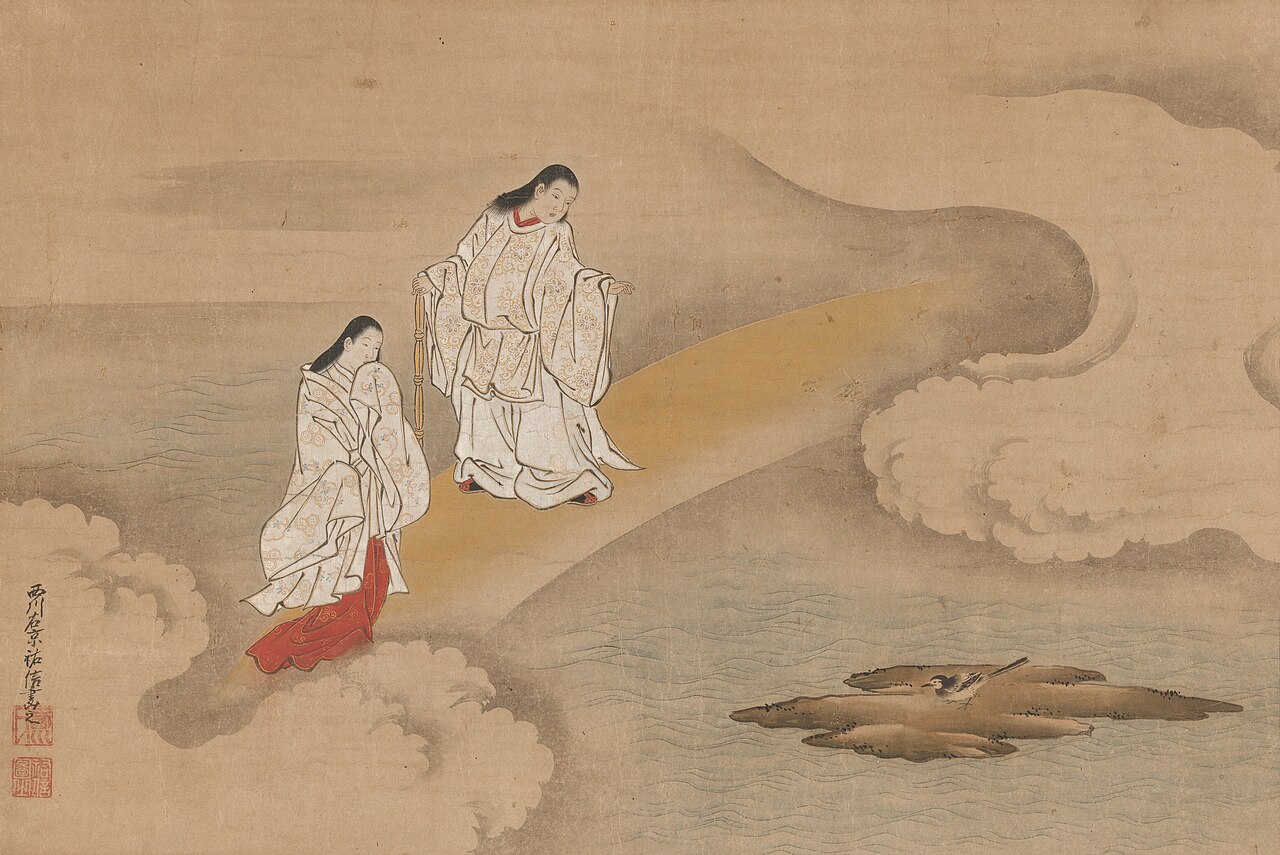
Izanagi and Izanami created the Japanese islands by standing at the pillars of heaven and churning the sea below with Ame-no-nuboko, the heavenly jeweled spear. The first island formed where the spear had disturbed the water, and the earliest of them was Onogoro. They then performed the first marriage ceremony around a pillar of heaven, and from that union came the rest of the islands and a long generation of kami.
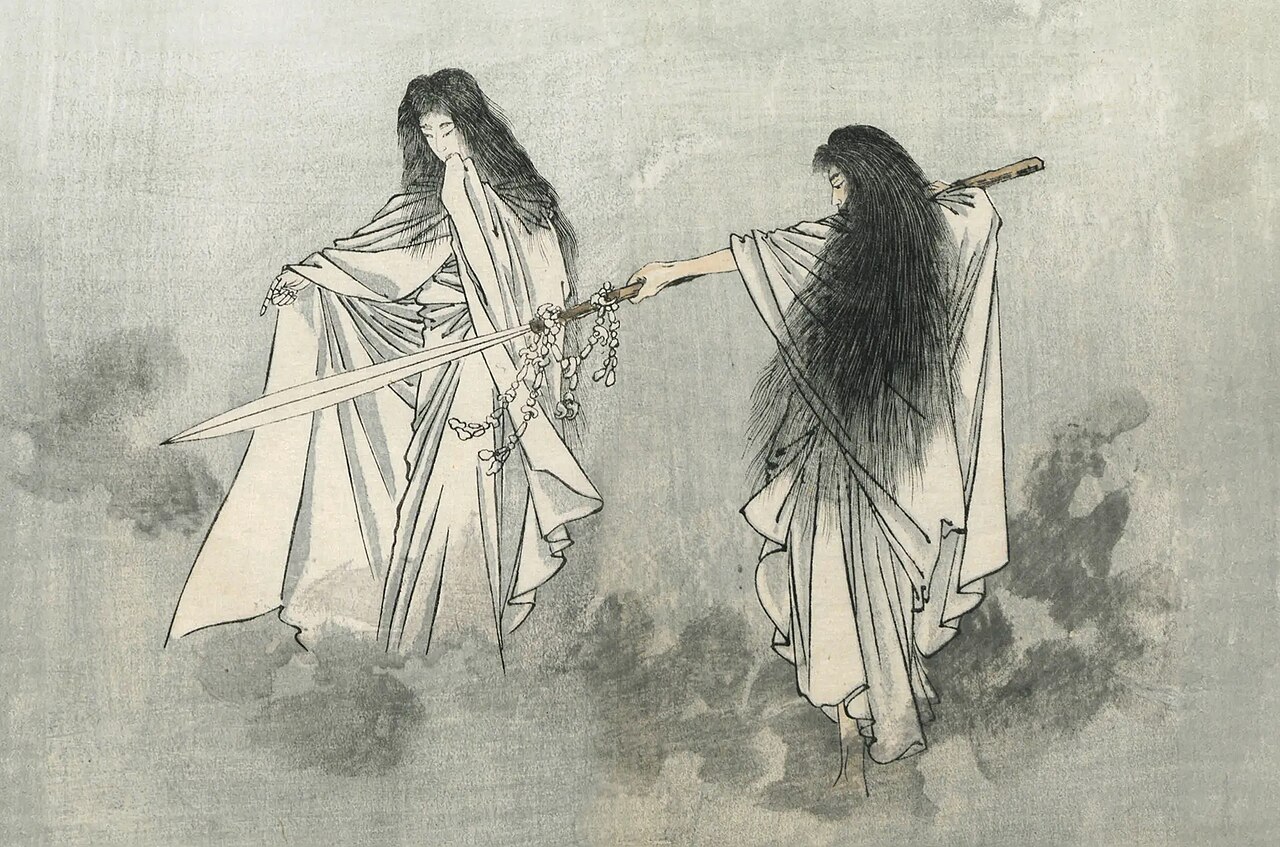
Heaven and Earth emerged from a void, and at first only Heaven had inhabitants. The primordial deities, looking down at a barren Earth, blessed Izanagi and Izanami and charged them with populating it. This episode is the opening of the creation myth that anchors Japanese folklore, and every later kami in the cycle depends on it having happened.
What follows is a courtship, and the Kojiki records the exchange with a bluntness later retellings tend to soften:
How has your body been made? My body is fully formed, except for a part which has not quite grown.
Recognising that their bodies were complementary, Izanagi proposed marriage and Izanami accepted. They performed the ceremony by circling a pillar of heaven from opposite directions and meeting in the middle, and on the first attempt Izanami spoke the greeting first. That was a procedural error, and the union produced children the account treats as illegitimate and deformed. The pair repeated the ceremony with Izanagi speaking first, the marriage took, and from it came the rest of the Japanese islands and the legitimate kami. Among them is the sea kami Owatatsumi, whom the Kojiki names as a child of the pair and whom later tradition remembers under the name Ryujin.
Kagutsuchi, and the Sword That Made More Gods
Kagutsuchi, the fire god, was the last child of the marriage and the one who ended it. He burned his mother as he was born, and Izanami suffered mortal injuries from the birth and died of them. Izanagi drew his sword and killed the newborn, and the killing generated more deities rather than fewer.
Izanagi’s response was not grief first but rage, and the result turned out to be generative in a way the myth seems to find unremarkable: fresh deities formed from the blood on the blade, Takemikazuchi among them, and further kami came out of Kagutsuchi’s body itself, their names carrying the element yamatsumi that marks them as deities of mountains, as the Encyclopedia of Shinto entry on Kagutsuchi sets out. Izanagi had emptied one family and started another with the same stroke.
The Descent to Yomi
Izanagi walked into Yomi-no-Kuni, the land of the dead, to bring Izanami home, and failed. She met him and appeared unchanged, because the palace interior was dark, but when he lit the tooth of his comb to see her properly the light showed decomposing flesh with creatures like maggots running over it. She had already eaten the food of Yomi, which bound her to the realm permanently.
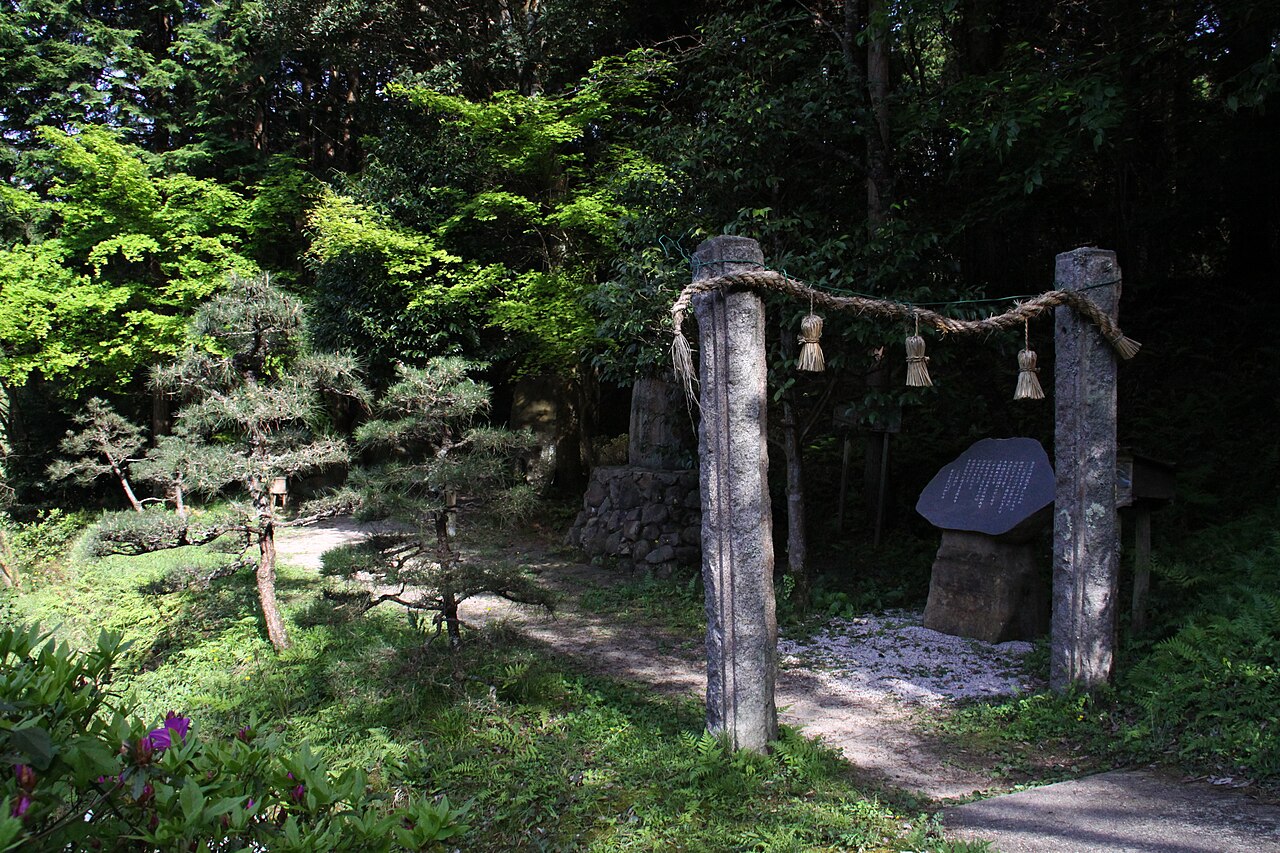
Yomi is a defiled and impure realm that the account fills with oni and other monsters, and Izanagi had gone in anyway. Then he ran. Izanami pursued him and loosed the demons of the underworld behind her, and Izanagi understood that if she reached the surface the living world would be consumed. He sealed the pass with an enormous boulder, and the Encyclopedia of Shinto entry on Yomi records that the obstruction closed the route between Yomi and both Takama no hara, the plain of high heaven, and Ashihara no nakatsukuni, the human world. From the far side Izanami swore to kill a thousand people every day. Izanagi answered that he would give life to fifteen hundred. The exchange reads as a divorce and functions as demography, and it is the reason his custodial duty exists at all.
The Three Noble Children
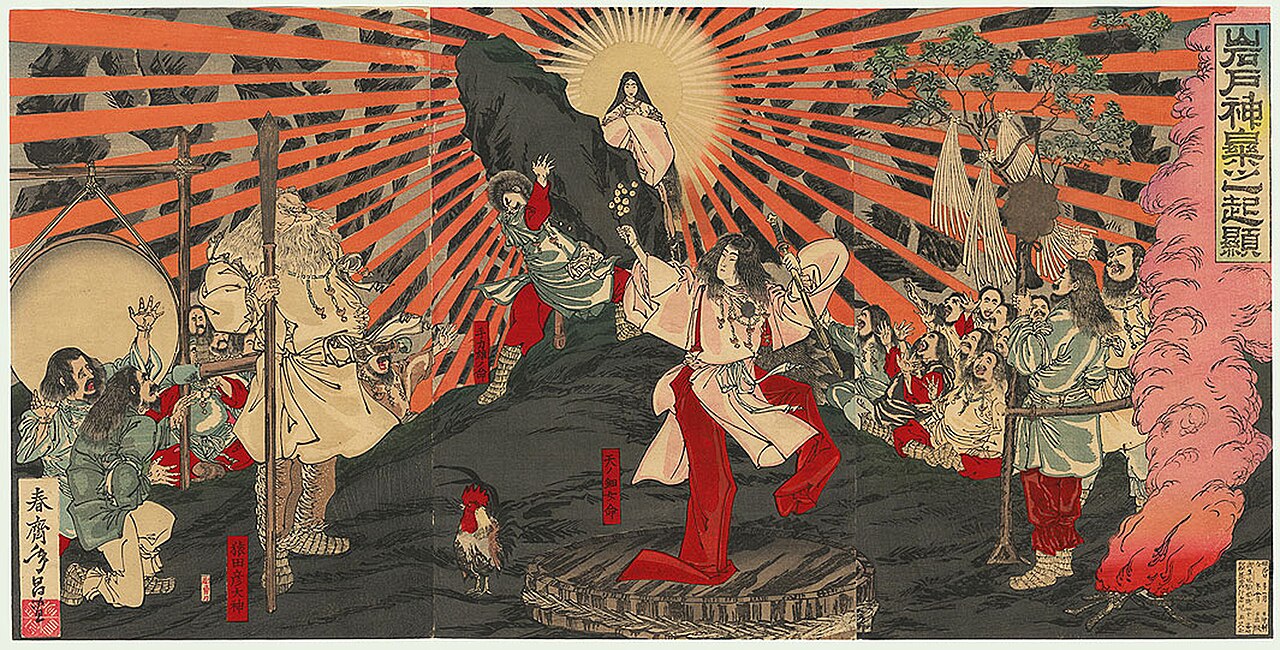
The Three Noble Children are Amaterasu, Tsukuyomi and Susanoo, born when Izanagi washed the impurity of Yomi from his left eye, his right eye and his nose in the water of a hot spring. Collectively they are the Mihashira no Uzu no Miko (三貴子), also called the Sankishin (三貴神), and their portfolios divide the visible world between them.
| Deity | Born from | Rules |
|---|---|---|
| Amaterasu | left eye | the sun, and the day |
| Tsukuyomi | right eye | the moon, and the night |
| Susanoo | nose | the sea, and the tides |
The impurity of death had still been on him when the washing began, and the Wikipedia account of the group describes the three as gods created when Izanagi, having returned from Yomi, washed away the filth of the other world. He declared that each of the three would rule Heaven and built the celestial kami bureaucracy around them, with the three at its head. It did not hold. Tsukuyomi and Susanoo both behaved in ways he judged disrespectful and both were punished and banished, which leaves Amaterasu alone in the position she still holds, with Izanagi advising rather than ruling.
Misogi, and the Ritual Izanagi Left Behind
Misogi is Shinto water purification for the removal of spiritual contamination, and Izanagi is credited with establishing it along with the marriage ceremony. The rite originates in the same bath that produced Amaterasu, Tsukuyomi and Susanoo, so the washing anyone does at a shrine water basin is a scaled-down version of what Izanagi did after Yomi.
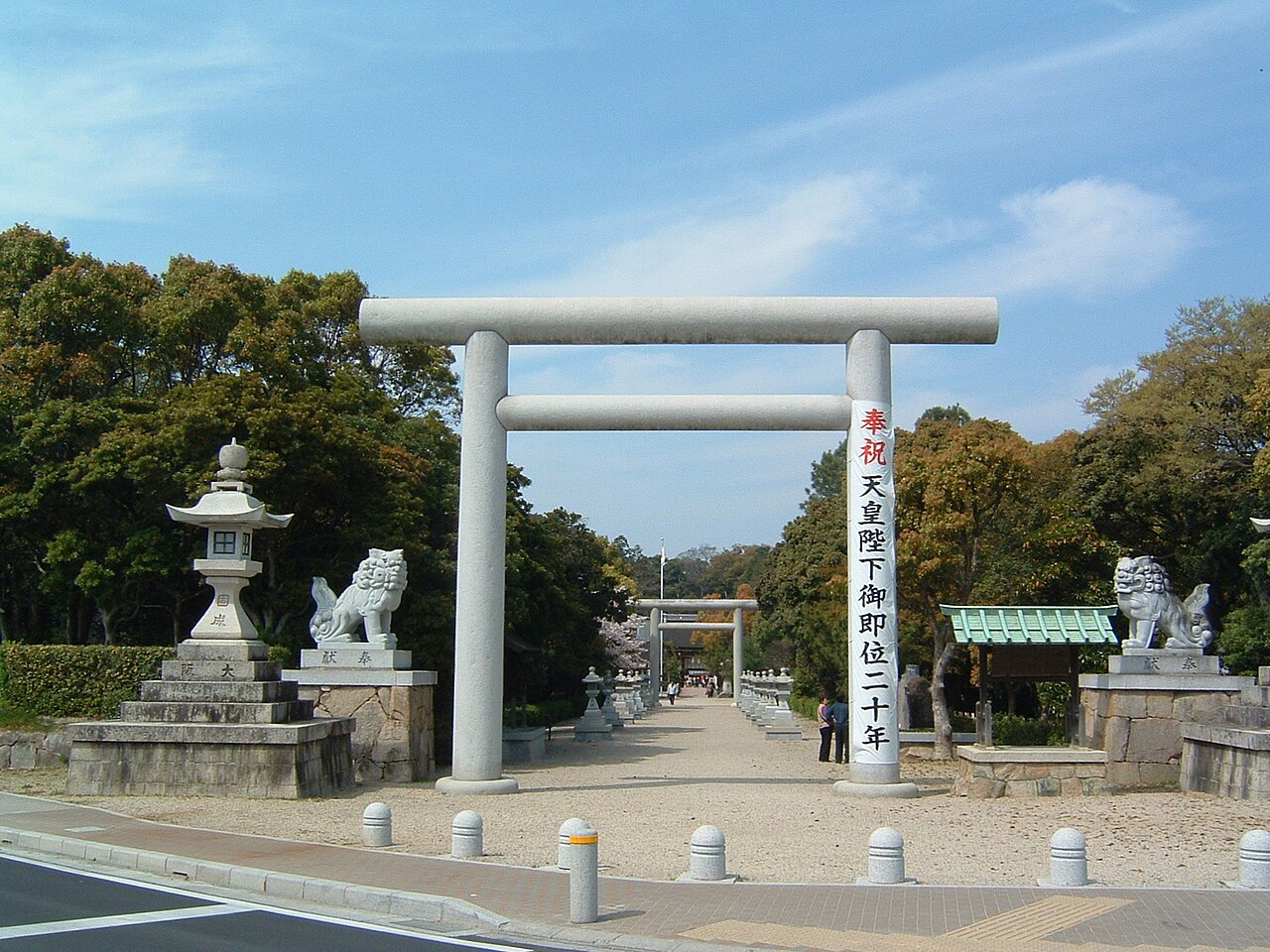
Not everything the water produced was benign. The same act of rinsing away Yomi’s pollution generated deities associated with disorder in the world, which the Encyclopedia of Shinto notes alongside the Edo period argument, pressed hardest by Hirata Atsutane, over where Yomi actually was.
Scholars have long read the descent against the Greek material, since Izanagi walking into the underworld for a dead wife and losing her by looking is close enough to Orpheus and Eurydice to invite the comparison, while Izanami’s eating of the food of the dead belongs with Hades and Persephone instead. As a heavenly ruler Izanagi also resembles other East Asian divine creators and first emperors, and what distinguishes him from them is the abdication and the apparent immortality that let him stay on afterwards.
Izanagi in Modern Culture and Design
Izanagi’s name has travelled further than his myth, and it now attaches to a tectonic plate, a Naruto genjutsu, a Marvel character, a Persona 4 persona and a Destiny 2 sniper rifle. The five share almost nothing with each other:
- An ancient Pacific tectonic plate, the Izanagi Plate, replaced roughly sixty million years ago
- A genjutsu in the Naruto manga and anime that prevents injury, and whose misuse devastated the Uchiha clan
- A Marvel Comics character kept largely unchanged from the mythic original
- A recurring persona in Persona 4 and the wider Megami Tensei series
- Izanagi’s Burden, a sniper rifle in Destiny 2
For anyone working with Japanese mythology as visual design, Izanagi poses the opposite problem to a yokai. A yokai arrives with a face already fixed by centuries of prints. Izanagi arrives with objects instead: the jeweled spear held over open water, the burning comb tooth, the sealed boulder, the three deities coming out of a wash. Painters from Nishikawa Sukenobu onward solved it by putting the spear in his hands and letting the sea and the cloud bank do the rest, which is why the spear reads instantly on a garment while the god himself does not.
If the creation myth is the corner of Japanese mythology you keep returning to, Kamicrew’s mythology apparel range is where those motifs end up on jackets, tees and hoodies.
FAQs
Who is Izanagi in Japanese mythology?
Izanagi is the Shinto creator god and patriarch of the Japanese pantheon, whose name means “He-who-Invites”. With his sister and wife Izanami he drew the islands of Japan from the sea and fathered a large part of the pantheon. He is written 伊邪那岐神 in the Kojiki and 伊弉諾尊 in the Nihon Shoki.
What is Izanagi the god of?
Izanagi is the god of creation, of marriage and of purification, and the guardian who keeps the forces of Yomi away from the living world. He established two foundational Shinto rites, the marriage ceremony and misogi water purification, and he keeps the rate of births above the rate of deaths. He was originally the ruler of Heaven and handed the throne to Amaterasu.
Who are the children of Izanagi?
Izanagi fathered Amaterasu, Tsukuyomi and Susanoo during the purification after Yomi, and with Izanami he produced the Japanese islands and many other kami, among them the fire god Kagutsuchi, Ebisu, and the wind and thunder pair Fujin and Raijin. Amaterasu, Tsukuyomi and Susanoo are known collectively as the Three Noble Children. Through Amaterasu his line reaches the Japanese imperial family.
How are Izanagi and Izanami related?
Izanagi and Izanami are siblings and consorts at the same time, the seventh generation of the Kamiyonanayo and children of Omodaru and Kashiko-ne. Their marriage rite around the pillar of heaven failed on the first attempt because Izanami spoke the greeting first, and succeeded when they repeated it with Izanagi speaking first. Their separation at the sealed entrance to Yomi is what divides the living world from the dead one.
What happened to Izanagi in Yomi?
Izanagi went into Yomi to bring Izanami back, lit the tooth of his comb for light, and saw that her body had decomposed. He fled with Izanami and the demons of the underworld behind him and blocked the pass with a boulder. She vowed to kill a thousand people a day and he answered that he would give life to fifteen hundred, and he then purified himself of the realm’s impurity in water.
Kamicrew Best Seller

Dont Touch Me Yokai Ukiyo-E Japanese T-Shirt
$25.49+
$29.99
(15% off)


Summer Vibes Salty Kawaii Japanese Hoodie
$44.99+
$49.99
(10% off)


Japanese Pin Horror 80s Retro Aesthetics T-Shirt
$25.49+
$29.99
(15% off)


El Gran Maja Japanese Kaiju T-Shirt
$25.49+
$29.99
(15% off)


Who Wants The Perfect Body Japan Capybara Kawaii Japanese Unisex Shirt
$25.49+
$29.99
(15% off)


Monster 8 Mask Vintage Animal Hoodie
$44.99+
$49.99
(10% off)


I Hate People Japanese Opossum Vintage Animal Hoodie
$44.99+
$49.99
(10% off)


I Got That Dog In Me Small Turtle Vintage Animal T-Shirt
$25.49+
$29.99
(15% off)

The Creation Of Cat Ukiyo-E Japanese T-Shirt
$25.49+
$29.99
(15% off)