
The word for god in Japanese is kami, written with the single character 神. The same character is read shin or jin when it sits inside a compound, and the polite everyday form is kami-sama (神さま). None of those words carries the meaning English speakers usually attach to “God.” A single transcendent creator who made the world does not exist in Shinto, so 神 names something closer to a spirit or divine presence, and the traditional phrase for them, 八百万の神 (yaoyorozu no kami), reads literally as “eight million kami” and means countless.
The Word for God in Japanese: 神
Japanese has no single word that matches the English “God.” 神 is the character at the heart of the question: read kami it names a deity or divine spirit, read shin or jin it builds compounds such as 神道 (Shinto), and 神さま (kami-sama) is the polite everyday form. Christian translation added 天主 (tenshu) and 上帝 (jotei).
Shinto is animist and polytheist, and it speaks of divine beings in many forms rather than one supreme being. That is why a straight substitution of “God” for 神 misleads in both directions. Anyone translating the English word is really choosing between several Japanese terms, each carrying its own history.
| Form | Reading | Sense | Where it is used |
|---|---|---|---|
| 神 | kami | deity, divine spirit | Shinto deities, nature spirits, deified people |
| 神 | shin, jin | divine, spirit | Compounds, as in 神道 (Shinto) |
| 神さま | kami-sama | honorific god | The standard polite term since the nineteenth century |
| 天主 | tenshu | master of the heavens | Used by Japanese Catholics |
| 上帝 | jotei | ruler above | A competing translation through the nineteenth century |
Kami and Shin: Two Readings of One Character
神 carries two readings. Kami is the native Japanese reading and names the deities themselves. Shin, or jin, is the Sino-Japanese reading borrowed from Chinese shen, and it appears inside compounds: 神道 reads as Shinto, “the way of the spirits.” Deities take kami, while the words for religions, doctrines and divine things take shin or jin.
Like other kanji, 神 has a native Japanese reading and a Sino-Japanese one inherited from Chinese. Read shin or jin, it descends from the Chinese shen, which in traditional Chinese religion refers to the spirits of nature. Read kami, the character applies to the many deities and supernatural beings of the Shinto pantheon. Divine names carry the same double-reading logic, which is why Ryujin’s name breaks into 龍 for dragon and 神 in its jin reading.
How Far the Word Kami Reaches
As a word, 神 stretches far wider than the English “god,” and that width is the real translation problem. Japanese carries vocabulary for its internal divisions: amatsukami for the heavenly kami, kunitsukami for the terrestrial ones. Which beings actually hold those titles, and how they rank against each other, belongs to the Shinto pantheon rather than to the word; what matters for the word is that a kami qualifies by power, not by goodness.
Reviewing how the concept developed, ITÔ Mikiharu’s study of the evolution of the kami concept for Kokugakuin University’s Institute for Japanese Culture and Classics cites Motoori Norinaga’s definition, which stretches to mountains, seas, winds, trees and rocks, to dragons, foxes, snakes and boars, and to emperors and other people raised to divine status. What unites them is not goodness but “superlative awe-provoking power,” noble or base, good or evil alike.
That power has two faces. Each kami is animated by beneficial powers, a spirit of violence, or both, and the violent side wakes if someone encroaches on the kami’s domain or commits a fault within its field of action. Three terms describe that sequence:
- Tsumi, the fault or encroachment committed within a kami’s field of action.
- Tatari, the punishment that follows from it.
- Harau, the act of purifying oneself, which wards the punishment off.
The relationship this creates is almost material and causal, far less hierarchical than the Western one, with humans and supernatural beings interacting on terms that look recognizably human.
Why “God” Does Not Translate Cleanly Into Japanese
Missionaries translated “God” as kami, but the two ideas overlap in almost nothing beyond both being non-human. Shinto has no single transcendent creator, kami are feared for their powers as much as revered, they can carry human faults, and the tradition assumes no personal relationship between a deity and an individual. That last gap is where an English speaker’s assumptions fail hardest.
When Christianity reached Japan, that choice attached the English word to a term which already belonged to the Shinto deities. The consequence still shows up in conversation: a sentence like “God loves you” makes little sense to many Japanese listeners until someone explains which god is meant.
Part of the gap is emotional. Kami are feared for their supernatural powers without necessarily being revered, and a Japanese saying holds that untouched gods can do no harm, close in force to letting sleeping dogs lie. Under that logic the main reason to deal with a kami at all is to keep it quiet.
Japanese practice also made gods out of people. Certain humans were raised to divine status after death, usually to soothe spirits that were thought to be angry and causing misfortune. Tenjin, the kami of scholarship, began as the Heian-period scholar and politician Sugawara-no-Michizane, whose banishment and lonely death were followed by floods, lightning, drought and plague that the court attributed to his vengeful spirit. Naming him a deity and building him a shrine was the remedy. That impulse to name, appease and contain a powerful presence runs through much of Japanese folklore.
Other Japanese Words for God
Kami is the default word, and three alternatives sit beside it. Japanese Catholics adopted 天主 (tenshu), a rival term 上帝 (jotei) competed with it through the nineteenth century, and 神さま (kami-sama) became the standard polite form from the nineteenth century onward. Kami has since recovered its dominance, with kami-sama the form to use when politeness is expected.
Contact with monotheistic religions produced those alternatives, and each carries its own gloss:
- Tenshu (天主), “master of the heavens,” the term Japanese Catholics adopted.
- Jotei (上帝), “ruler above,” a rival term still competing through the nineteenth century.
- Kami-sama (神さま), which became the standard term from the nineteenth century onward.
Kami itself has been enriched by new meanings and outside influences along the way. For most purposes today, kami is the noun and kami-sama the polite form.
What “Eight Million Kami” Actually Says
The traditional phrase is 八百万の神, yaoyorozu no kami, which translates literally as “eight million kami.” It is an idiom for countless, not a census, and it works in Japanese roughly the way “a thousand and one” works in English. The number is a figure of speech about scale.
This is why “how many” resists a clean answer in Japanese in a way it does not in Greek or Norse mythology. Motoori Norinaga’s definition, cited above, is deliberately open-ended, and the grammar of the phrase points at a myriad rather than a set. A count becomes possible only once the question narrows to the named deities who carry individual myths and shrines, and then the tally depends entirely on which catalogue is being read, a reckoning worked out across the named Shinto deities and their roster rather than settled by any figure here.
Kami Imagery in Japanese Art and Design
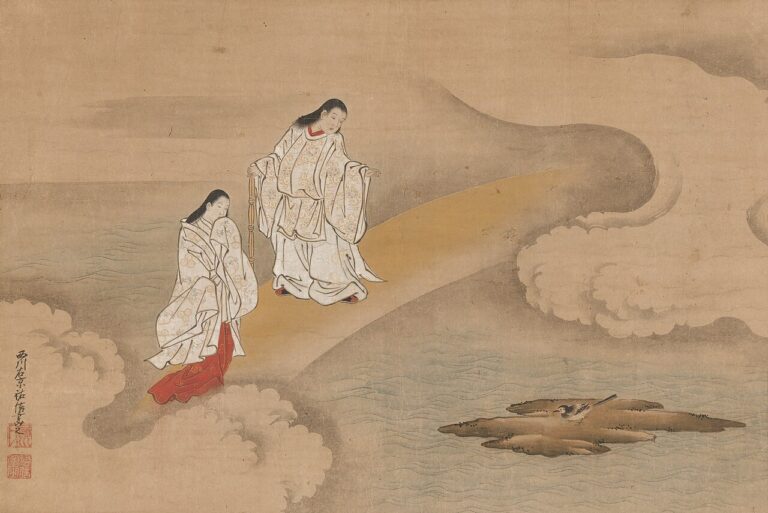
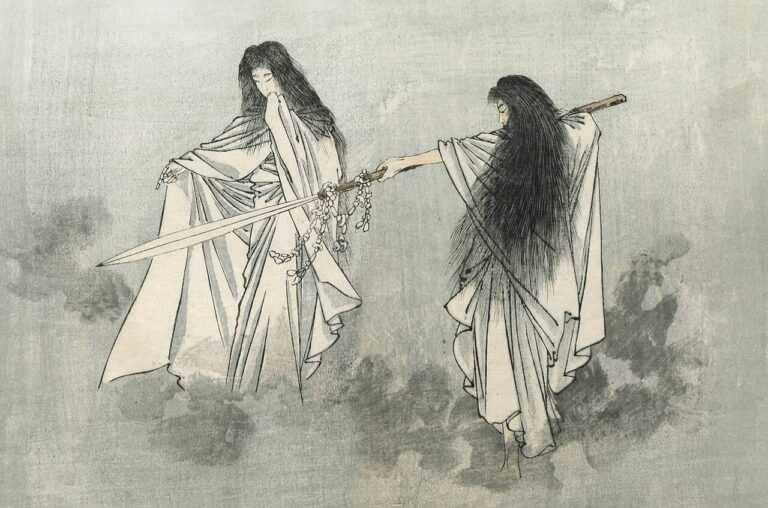
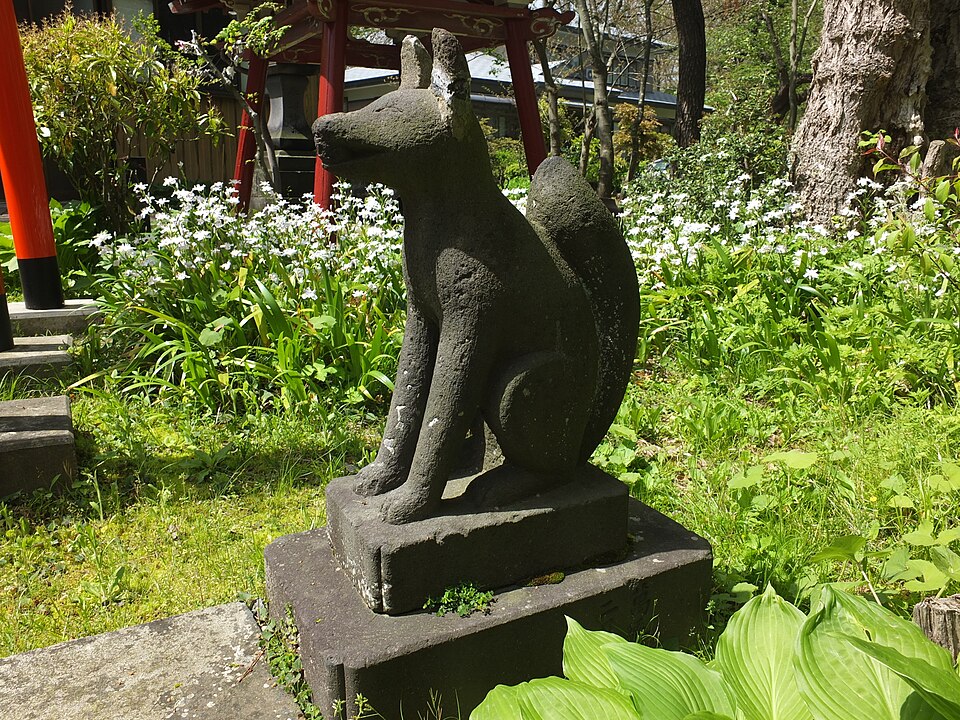
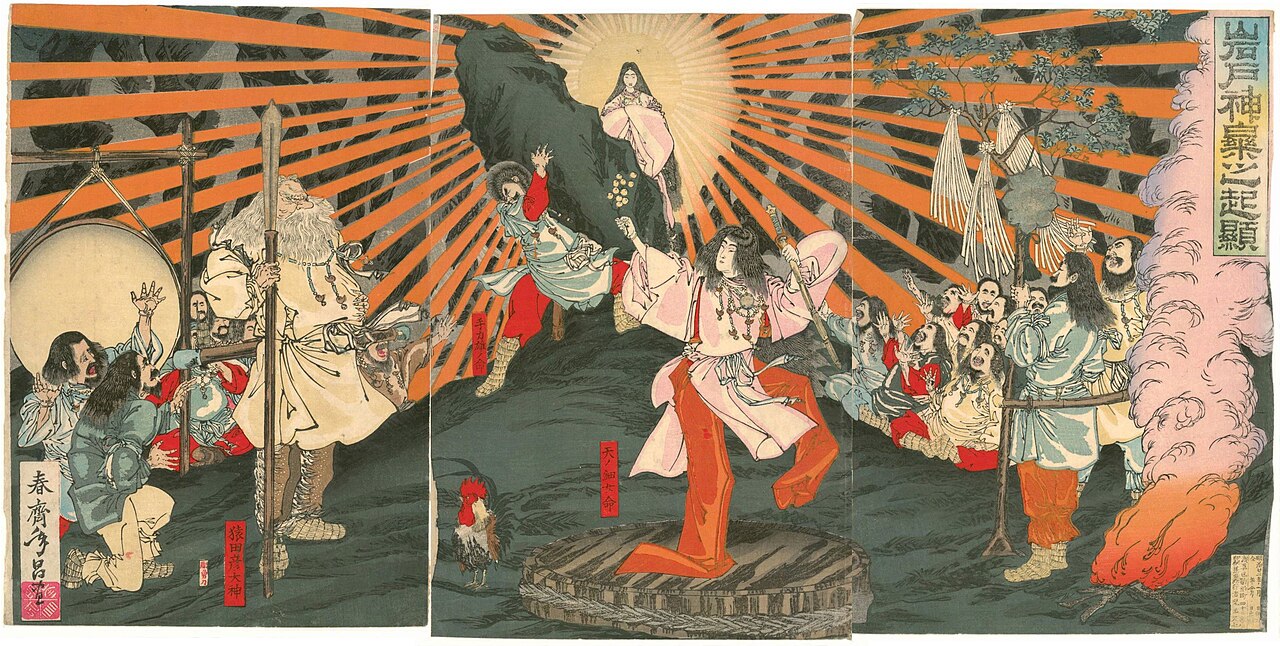
Shinto deities are rarely depicted. Carvings of the kami barely exist, Inari being the notable exception, and images of Amaterasu, the sun goddess, in human form appeared late and remain few. What became visual is the attribute rather than the face: Inari’s foxes, Raijin’s drums, Fujin’s wind pouch, and for Amaterasu a metal mirror rather than a portrait.
The scarcity of images surprises anyone arriving from Buddhist art, where deities are sculpted and painted in abundance. Where Amaterasu is drawn, she has long black hair and a long white garment lined with red, but her traditional emblem is not a figure at all: it is a metal mirror.
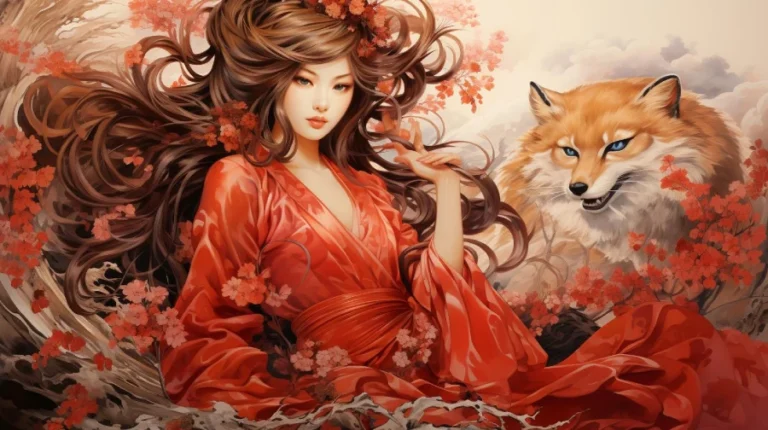
Inari’s stone foxes stand guard at shrine approaches and receive offerings of aburaage. Raijin’s drums and Fujin’s wind pouch identify them on sight, and both appear at shrine and temple entrances as guardians whose gaze every visitor passes under. Those attributes are what carry over into modern graphic design, because a drum, a pouch, a fox or a mirror reads instantly where a portrait of a deity never quite settled into convention.
Kamicrew’s mythology tees and hoodies work from the same vocabulary of attributes and kanji, for anyone who would rather wear 神 than only read about it.
FAQs
How do you say god in Japanese?
Say kami, written 神. In polite speech the usual form is kami-sama (神さま), which has been the standard term since the nineteenth century. Inside compound words the same character is read shin or jin, as in 神道, Shinto.
What is the difference between kami and shin?
They are two readings of the same character, 神. Kami is the native Japanese reading and names the deities themselves. Shin (or jin) is the Sino-Japanese reading, taken from Chinese shen, and appears inside compounds such as 神道, Shinto.
Is kami the same as the Christian God?
No. Missionaries borrowed kami to translate “God,” but the two ideas share little beyond both being non-human. Shinto has no single transcendent creator, and kami are not assumed to have a personal relationship with any individual. Japanese Catholics used 天主 (tenshu) instead.
What does yaoyorozu no kami mean?
八百万の神 (yaoyorozu no kami) reads literally as “eight million kami” and is used to mean countless rather than as a count. The phrase describes kami as a myriad, which is why no text fixes their number.
What does kami mean literally?
It names a being of awe-provoking power. Motoori Norinaga’s definition, cited in Kokugakuin University’s survey of the concept, covers mountains, seas, winds, trees and rocks, animals such as dragons and foxes, and people raised to divine status, whether their power is used for good or ill.
Kamicrew Best Seller

Dont Touch Me Yokai Ukiyo-E Japanese T-Shirt
$25.49+
$29.99
(15% off)


Summer Vibes Salty Kawaii Japanese Hoodie
$44.99+
$49.99
(10% off)


Japanese Pin Horror 80s Retro Aesthetics T-Shirt
$25.49+
$29.99
(15% off)


El Gran Maja Japanese Kaiju T-Shirt
$25.49+
$29.99
(15% off)


Who Wants The Perfect Body Japan Capybara Kawaii Japanese Unisex Shirt
$25.49+
$29.99
(15% off)


Monster 8 Mask Vintage Animal Hoodie
$44.99+
$49.99
(10% off)


I Hate People Japanese Opossum Vintage Animal Hoodie
$44.99+
$49.99
(10% off)


I Got That Dog In Me Small Turtle Vintage Animal T-Shirt
$25.49+
$29.99
(15% off)

The Creation Of Cat Ukiyo-E Japanese T-Shirt
$25.49+
$29.99
(15% off)