
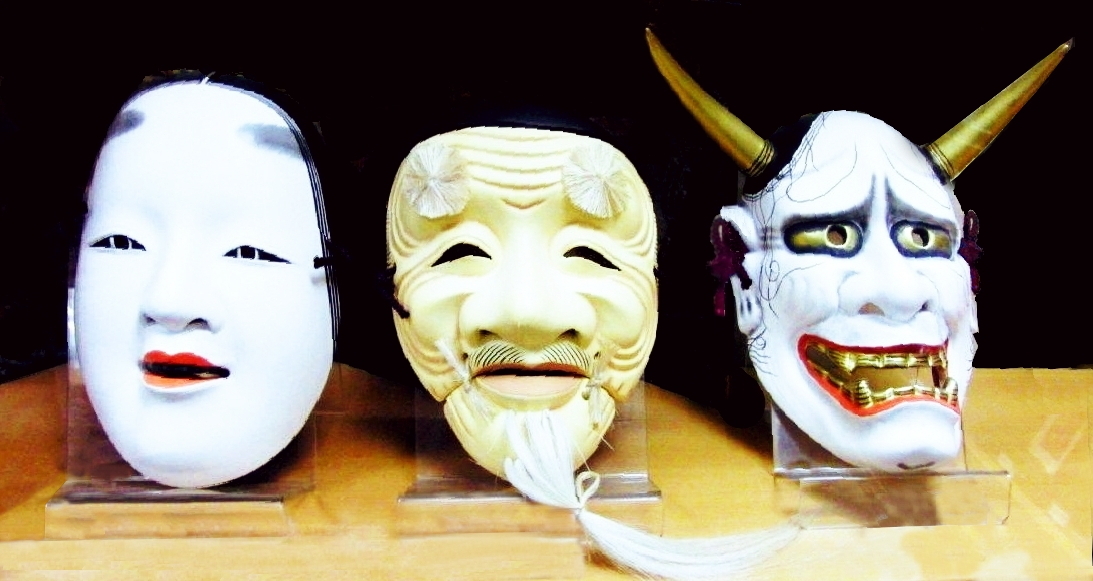
A Japanese mask tattoo means whatever the mask on it means, so the reading changes with the face you choose rather than with the style or the placement. A hannya reads as feminine rage, jealousy and grief hardened into something demonic. An oni reads as raw supernatural force, punishment, and, less obviously, protection. Tengu, kitsune, hyottoko and okame each arrive with their own history. Nearly every one of these faces reached tattooing by the same route, out of noh theatre and kyogen, then through Edo woodblock prints, and the reading a tattooer gives you today still traces back to the stage.
What a Japanese Mask Tattoo Actually Means
There is no single symbol to decode here, because the category is a cast of characters. Six faces account for almost every Japanese mask tattoo: hannya (betrayal, wisdom, warding off evil), oni (strength, punishment, protection), tengu (guardianship and discipline), kitsune (cunning and transformation), and the paired comic masks hyottoko and okame (humour and warmth).
Masks in Japan are mostly decorative now, sold at shrine festivals and worn during Shinto dances or by noh actors. Almost all of them derive from myth, ancient dance, or noh theatre, and Japanese tattooers folded them into clients’ work as a way of expressing that culture on skin. Each face was already carrying a story before anyone put it in ink. Anyone weighing up a design is really choosing between Japanese folklore masks with very different reputations.
| Mask | What it depicts | What the tattoo usually carries |
|---|---|---|
| Hannya | Woman transfigured by jealousy and grief | Betrayal, wisdom, warding off evil |
| Oni | Horned demon or ogre of folklore | Strength, punishment, protection |
| Tengu | Red-faced, long-nosed mountain demi-god | Guardianship, pride, discipline |
| Kitsune | Shapeshifting fox, messenger of Inari | Cunning, transformation, wisdom |
| Hyottoko | Comic fire-blower with a skewed mouth | Humour, the festival clown |
| Okame | Round-cheeked woman, hyottoko’s counterpart | Good humour, warmth |
Hannya Mask Tattoo Meaning
A hannya mask tattoo carries two readings at once. The face depicts a woman whose jealousy, sorrow and rage turn her into a demon, so it stands for betrayal and feminine anguish. The word hannya also means wisdom in Japanese Buddhism, which is why the same mask gets worn for clarity, good fortune and protection rather than for anger alone.
That double meaning sits inside the name. Hannya points to wisdom, or higher levels of consciousness, in Japanese Buddhism, and the word is also believed to have come from Hannyabo, the artist who carved the original mask. The face itself first appeared in noh, and it was used in both noh and kyogen plays as well as Shinto Kagura ritual dances. What it depicts is a woman overwhelmed by sorrow, envy or rage who becomes a demon, a dragon, or a serpent, which is why the carving pairs a leering mouth and metal eyes with sharp fangs and devil-style horns. The Nohgaku Performers’ Association lists the mask among its standard character types as a female demon or a woman transfigured by resentment.
The best-known story behind the mask draws on the tale of Prince Genji. A mistress becomes overwhelmed with rage and jealousy, transforms into a demon, possesses Genji’s wife, and eventually kills her. That plot is doing a lot of work in how people read the tattoo, because it frames the demon as something a person becomes rather than something she was.
Which is why the same face gets worn for very different reasons:
- Betrayal and jealousy: the core reading, standing for feminine anguish and rage.
- Good luck: worn as a symbol to promote good fortune and ward off evil.
- Wisdom: chosen by people hoping to reach a higher perspective in matters of love and the heart.
- Protection from the past: protection against the past repeating itself.
- An unforgiving nature: a statement that the wearer is unforgiving and without mercy.
- A passionate lover: a woman with an all or nothing attitude in romantic relationships.
- Tormented souls: a marker of unresolved pain or emotional instability.
- Noh itself: plain affection for the traditional theatre the mask came from.
Oni Mask Tattoo Meaning
An oni mask tattoo reads as strength, menace and punishment, with protection attached to the same face. Oni are the horned demons of Japanese folklore, and Buddhist accounts place them in hell as the violent servants of Enma. Unlike a hannya, the mask records no transformation, because an oni was never anything else.
Oni translates loosely as demon or ogre, but the word has covered several roles at once: threat, punishment, guardian, and general force of misfortune. The character 鬼 entered Japanese from Chinese, where it may have meant spirits of the dead. One historical proposal links the word to onu, meaning to hide, though that is a hypothesis rather than a settled origin. The Nihon Shoki of 720 uses the term loosely, and later texts describe one-eyed creatures alongside human outsiders.
The horns have a source too. The north-east direction was called kimon, the demon gate, and it sits between the Ox and the Tiger in the directional zodiac, which is where both the horns and the tiger-skin loincloth come from. Those horns were not consistently shown until twelfth-century Konjaku Monogatari texts, and the iron club, the kanabo, became a standard attribute during the Edo period, replacing the hammers of older imagery.
Buddhism supplies the harsher reading. In that account, oni are created when purely evil men die and enter the realms of Buddhist hell, where they serve as violent and monstrous servants of Lord Enma, its ruler. Only the most sadistic souls are born as oni. Carried on skin, the face reads as strength and menace, and sometimes as a claim to judge good and evil rather than simply to embody one of them. The mask is also the one you see most during Setsubun, which gives it a second, friendlier life.
Hannya vs Oni: Where the Two Faces Split
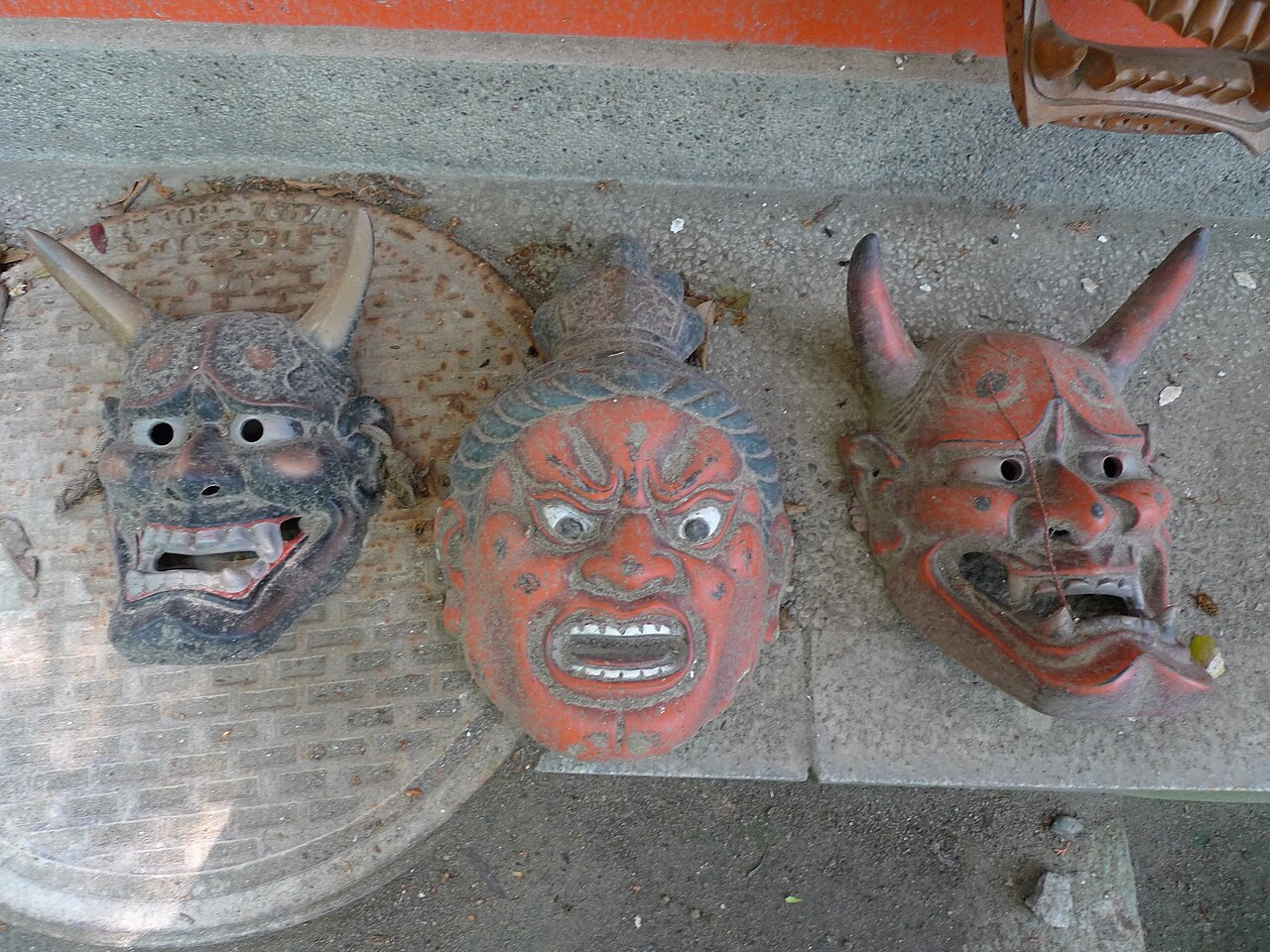
Hannya represents female demons in Japanese storytelling and oni masks represent masculine ones, and that is only the first of the splits. A hannya forms when a woman is betrayed and overcome by jealousy, obsession and sadness, so the mask records an event. An oni is a category of being, populated by evil men after death. Hannya belongs to the noh stage, oni to folklore, festival and temple architecture.
| Hannya | Oni | |
|---|---|---|
| Gender in the source story | Female | Male |
| What it is | A woman transfigured by jealousy, obsession and grief | A class of being, evil men reborn in Buddhist hell |
| Home tradition | Noh theatre, a fixed repertoire of masks | Folklore, festival, temple architecture |
| Carving | A woman’s brows and eyes above metal eyes, fangs and horns | Typically a broad red face with long sharp teeth |
| What the tattoo says | A personal story about grief and betrayal | A statement about force |
People swap the two constantly, and the tell on a carving is the eyes. A hannya keeps the brow and gaze of the woman she was, which is what makes the fangs and horns read as loss rather than as threat. An oni turns up in far more everyday contexts than a hannya ever does, from festival stalls to roof tiles, and it never asks to be read as a loss.
The Other Faces You See in Mask Tattoos
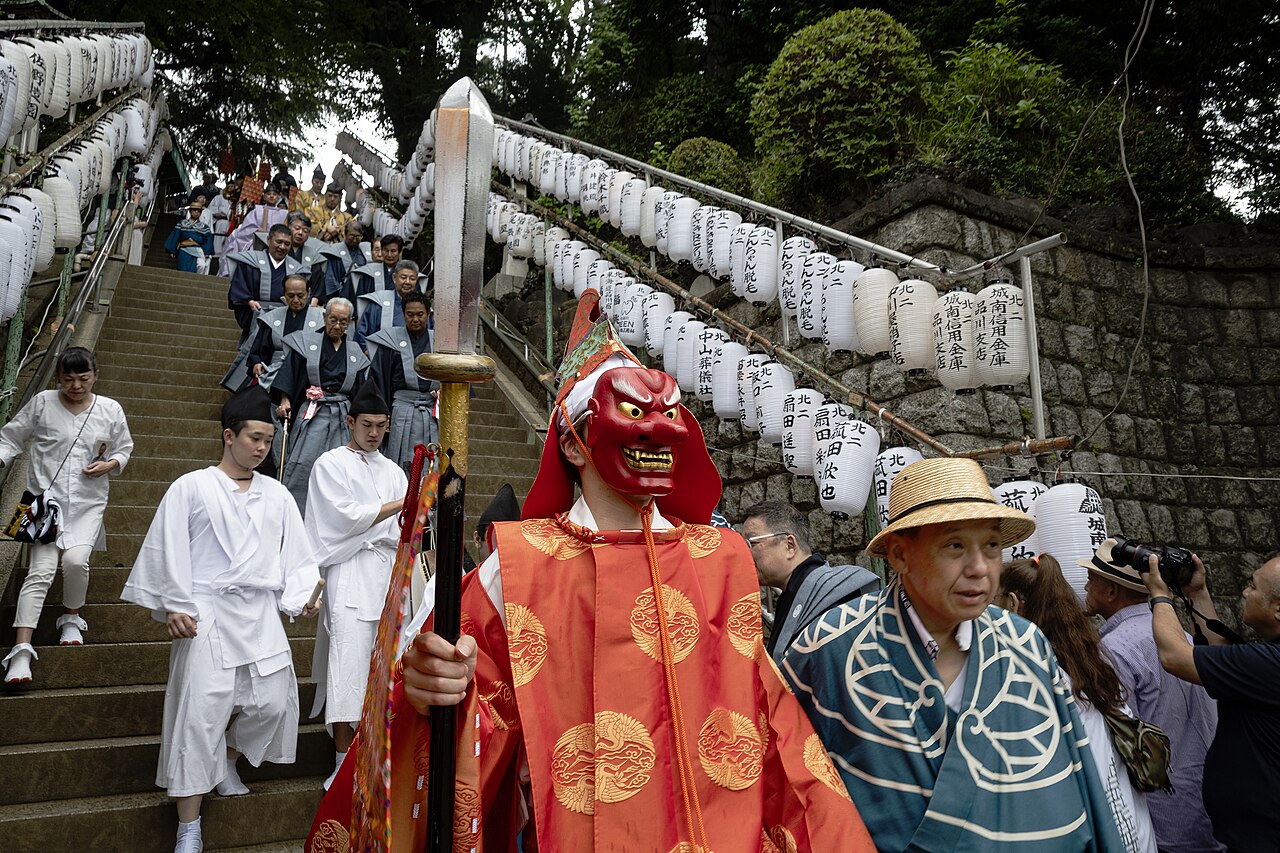
Hannya and oni dominate the category, but four more faces show up often enough that any tattooer working in the style will have drawn them. Tengu and kitsune are the magical pair, protective and shapeshifting. Hyottoko and okame are the comic pair, and neither carries any of the demonic weight of the first two masks.
- Tengu are fearsome demi-gods who protect mountains, with red faces and long red noses. The name derives from the Chinese Tiangou, meaning heaven dog, and Chinese depictions show a dog where Japanese ones are crow-like. They hold magical powers including shapeshifting and dreamwalking, and folklore casts them as shapeshifting protectors who transform corrupt monks, which is why a tengu tattoo tends to read as discipline rather than menace.
- Kitsune are foxes whose paranormal abilities increase with age and wisdom. In yokai folklore every fox can shapeshift into human form, and kitsune served as messengers of Inari, the Shinto god of rice, commerce and prosperity.
- Hyottoko (火男) is a comical character with a puckered, skewed mouth. The name comes from fire (火, hi) and man (男, otoko), and the mouth is shaped that way because he blows fire through a bamboo pipe.
- Okame is portrayed as a woman with a short nose and swollen round cheeks. The name traces to those cheeks resembling a vase, kame in Japanese, and she works as the female counterpart to hyottoko.
From Noh Stage to Edo Skin
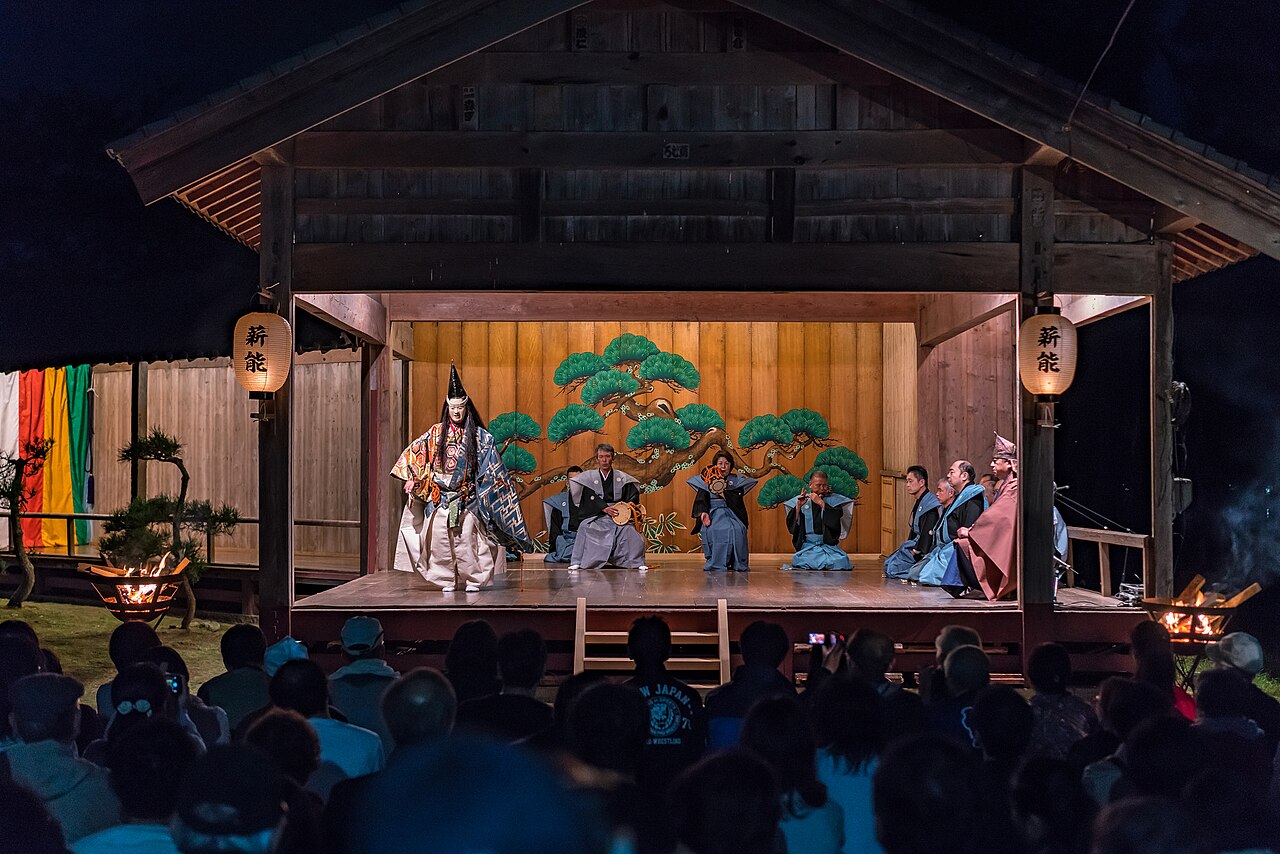
The masks reached skin along a traceable route: noh theatre from the fourteenth century, then ukiyo-e woodblock prints during the Edo period of 1603 to 1868, then irezumi. That puts demon mask imagery on a lineage that starts in the fourteenth century, and it is why the readings a tattooer gives you still match the stage characters.
Print did the carrying. Ukiyo-e woodblocks and paintings of the Edo period put the faces into wide circulation, and Utagawa Kuniyoshi’s illustrated designs of kabuki actors, myths and samurai heroes were among the most widely copied of them.
Irezumi, the traditional Japanese art of tattooing, picked the imagery up from there. It matters who was wearing it. Edo-era tattoos belonged largely to three groups: the hikeshi, firefighters who were folk heroes of the period and wore protective symbols; the bakuto, professional gamblers and outlaws who used tattoos as identity; and the kyoukaku, chivalrous commoners known as street knights who set themselves against rogue samurai. A demon face on any of those men was not decoration. It was armour and a signature at once.
What the Colours Mean
Two separate colour systems get mixed together in tattoo discussions, and separating them clears up most of the confusion. The theatrical code grades social status: white for aristocratic, red for lower class or evil, black for a demon outright. The Setsubun code is doctrinal instead, tying five oni colours to five Buddhist hindrances. Neither one is universal.
The first system, the theatrical status code, is about who the character is:
- White: denoted aristocratic status.
- Red: marked a lower-class person, or evil.
- Black or very dark shades: signified a demon outright.
Applied to a hannya, that grades into a sequence tattooers use directly. A white hannya indicates a woman of noble status still fighting her own jealousy. Light colours, yellow or flesh tones, show a woman on the edge of losing her humanity. Red or deep red means the transformation finished, and she has given in fully to the dark side.
The second system belongs to oni. In some Setsubun traditions five oni colours are linked to five Buddhist hindrances:
- Red: greed and desire.
- Blue: anger.
- Black: doubt.
- Yellow: restlessness and regret.
- Green: torpor and inertia.
The red and blue skin tones themselves trace back further, to Buddhist gaki, the hungry ghosts, and to yaksha guardian figures. One caution before anyone treats any of this as a rulebook: a 2003 study published by the Color Science Association of Japan documented real regional variation in these combinations, which contradicts the idea of a single universal colour code. Meanings shift by region and by context.
Protection, Good Luck, and the Demon With Two Faces
A frightening face works as a protective one because Japanese practice has used it that way for centuries. Onigawara, demon-faced roof tiles, sit on temples and traditional buildings precisely to guard them. A hannya is used the same way, as a symbol to promote good luck and ward off evil, and specifically as protection against the past repeating itself.
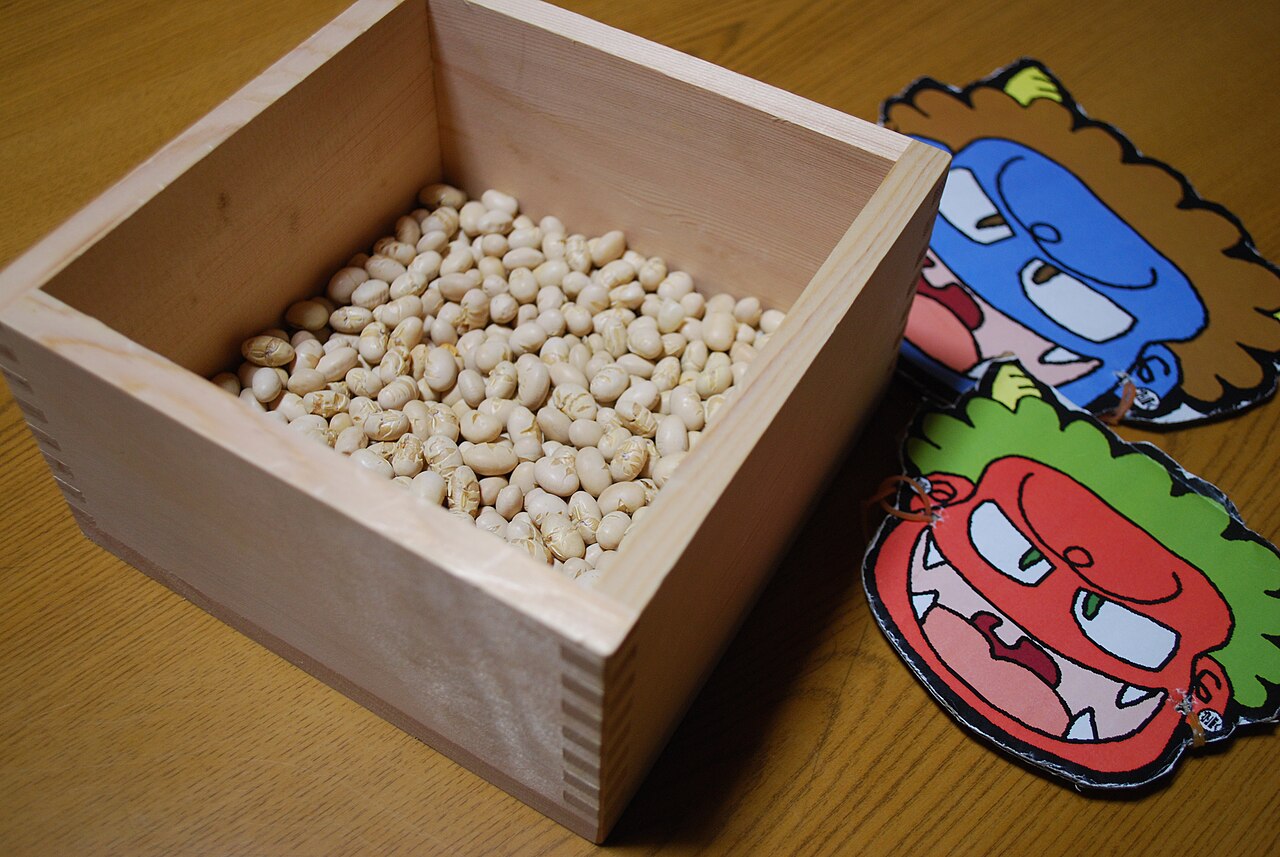
Setsubun makes the logic visible. On the day before the traditional start of spring, households scatter roasted soybeans in the mamemaki ritual while calling “Oni wa soto, fuku wa uchi”, oni out and fortune in. The National Diet Library of Japan documents the rite and its older form, tsuina, in its image collections. The demon is driven out, but it has to be summoned into the room first, usually by a parent in a paper mask. An oni is not always evil, and the same face that frightens is the one posted at the gate.
One thing worth knowing before committing any of this to skin: the term oni was also applied historically as a prejudicial label to outsiders, to disabled children, and to women. The word has a harder history than its festival version suggests.
How Mask Tattoos Are Drawn
A hannya does not have to be executed in Japanese style, and plenty are not. Mask tattoos are drawn in traditional irezumi, black and grey, blackwork, neo-traditional and minimalist styles, and the rendering does not change what the mask means. What does add meaning is the background work around it, called gakubori.
The usual style options:
- Traditional irezumi: full colour, bold outlines, the mask set into a larger scene.
- Black and grey: the same composition rendered tonally.
- Blackwork: heavy solid black, graphic rather than shaded.
- Neo-traditional: traditional shapes with modern colour and line weight.
- Minimalist: the mask reduced to its outline and a few marks.
The recurring gakubori elements each have a reading of their own. A snake, hebi, stands for protection, wisdom, transformation and jealousy, which is why hannya and snake is one of the most common pairings of all. Waves, nami, stand for the uncontrollable forces of life. Maple leaves, momiji, mark the passage of time and the cycles of life. Chrysanthemums, kiku, carry the emperor and longevity. Japanese lettering, smoke, clouds and flowers round out the set.
Placement and Size
Placement follows composition more than anything else. Hands and forearms suit a single mask, and a forearm piece often becomes the start of a Japanese sleeve. The back and the chest are where large-scale, detail-heavy compositions go, and the legs cover everything in between. The standard choices for a mask piece:
- Hands, for a powerful and high-visibility piece.
- Forearms, which work as stand-alone pieces or as the beginning of a Japanese sleeve.
- Legs, including the hip, thigh, calf and ankle.
- Back, for large-scale designs.
- Chest, for a large-scale, detail-oriented piece.
A full back piece is a project measured in sittings rather than hours, so match the canvas to the composition before the first line goes down. A minimalist hannya on a forearm and a full-colour oni across a back are different commitments in every sense.
Wearing the Mask Without the Needle
Not everyone drawn to these faces wants them permanently. The masks were circulating on printed paper and festival stalls long before they were on skin, and wearing one on fabric sits comfortably inside that history rather than outside it. If a hannya or an oni is the face you keep coming back to, Kamicrew’s yokai ukiyo-e shirts put the same woodblock lineage on a tee, which is a reasonable place to live with a design before deciding whether it belongs on your arm.
FAQs
What does a Japanese mask tattoo mean?
The meaning comes from the specific mask, not from the category. A hannya mask means jealousy, grief and betrayal, and also wisdom. An oni mask means strength, punishment and protection. Tengu means guardianship, kitsune means transformation, and hyottoko and okame mean festival humour. All six faces come out of noh theatre, kyogen or folklore, and the tattoo inherits the character’s story.
Is it cultural appropriation to get a Japanese mask tattoo?
These masks are widely sold at shrine festivals in Japan, and Japanese tattooers themselves incorporated them into clients’ work as a form of cultural expression, so the imagery was never sealed off. What separates respect from carelessness is knowing which face you are wearing. A hannya is a specific story about a woman’s grief and betrayal, not generic demon decoration, and having it drawn by an artist who actually works in the tradition matters more than any rule about who may wear it.
What does an oni mask tattoo symbolize?
Strength and supernatural force first, since oni in Buddhist accounts are the violent servants of Enma in hell, born only from the most sadistic souls. Alongside that it carries punishment, judgement between good and evil, and protection, the same protective role onigawara roof tiles play on temples.
Does a hannya tattoo have to be in traditional Japanese style?
No. Hannya masks are tattooed in traditional irezumi, black and grey, blackwork, neo-traditional and minimalist styles, and the meaning of the mask does not change with the rendering. The style choice is about how the piece sits with the rest of your work.
Do the mask colours mean the same thing everywhere in Japan?
No. A 2003 study published by the Color Science Association of Japan recorded genuine regional variation in oni colour combinations, which argues against treating any colour list as a universal code. Use the colours as a well-documented tradition and check what they mean in the specific context you are drawing on.
Kamicrew Best Seller

Dont Touch Me Yokai Ukiyo-E Japanese T-Shirt
$25.49+
$29.99
(15% off)


Summer Vibes Salty Kawaii Japanese Hoodie
$44.99+
$49.99
(10% off)


Japanese Pin Horror 80s Retro Aesthetics T-Shirt
$25.49+
$29.99
(15% off)


El Gran Maja Japanese Kaiju T-Shirt
$25.49+
$29.99
(15% off)


Who Wants The Perfect Body Japan Capybara Kawaii Japanese Unisex Shirt
$25.49+
$29.99
(15% off)


Monster 8 Mask Vintage Animal Hoodie
$44.99+
$49.99
(10% off)


I Hate People Japanese Opossum Vintage Animal Hoodie
$44.99+
$49.99
(10% off)


I Got That Dog In Me Small Turtle Vintage Animal T-Shirt
$25.49+
$29.99
(15% off)

The Creation Of Cat Ukiyo-E Japanese T-Shirt
$25.49+
$29.99
(15% off)