
Traditional Japanese wedding clothes are formal kimono. The bride wears the all-white shiromuku for the Shinto ceremony and changes into the heavily embroidered iro-uchikake for the reception, while the groom wears a black montsuki haori hakama carrying five family crests. A third bridal option, the long-sleeved hikifurisode with its trailing hem, is offered alongside those two at Japanese studios. All of them sit at the top of the kimono formality scale, and in most Japanese weddings today they share the day with a Western dress and suit rather than replacing them.
What Traditional Japanese Wedding Clothes Are
Traditional Japanese wedding clothes are kimono: T-shaped robes that wrap around the body and are held closed at the waist with a sash instead of buttons. Wedding kimono are traditionally silk. What separates them from everyday kimono is the number of layers, the trailing hem, the density of auspicious embroidery, and, on the groom’s side, family crests dyed into the cloth.
The silhouette is rectangular, the sleeves are wide, and the neckline crosses over into a V.
Not every kimono is bridal. There are many types of kimono, each carrying a distinct meaning, and some are reserved for the groom or for wedding guests rather than the bride. Four garments do the work at a Japanese wedding, three of them the bride’s and one the groom’s.
| Garment | Worn by | When | Defining feature |
|---|---|---|---|
| Shiromuku | Bride | Shinto ceremony | All white, every layer and accessory |
| Iro-uchikake | Bride | Reception | Embroidered outer robe, red and gold |
| Hikifurisode | Bride | Ceremony or reception | Long sleeves and a trailing train |
| Montsuki haori hakama | Groom | Ceremony and reception | Crested haori over pleated hakama |
Color follows the schedule of the day more than personal preference. Brides traditionally begin in white and change into red, orange, gold, or a multicolored kimono for the reception. According to Chika Murano, creative director of the Japanese wedding dress company DRESSMORE, the bride may change once or even twice over the course of the event. That is also why guests at a Japanese wedding are advised not to turn up in red: the bride may be wearing it.
White was not always the obvious choice. Wedding kimono were once made up as three layers in white, red, and black with the black outermost, a custom the Sainsbury Institute for the Study of Japanese Arts and Cultures records as fading during the Meiji period because preparing three elaborate kimono was too costly. Black stayed common enough that Uemura Shoen’s 1899 painting Jinsei no Hana, held by the Kyoto City KYOCERA Museum of Art, shows a bride in a black wedding furisode. White carried a second and darker meaning, since a white kimono was traditionally what a person was dressed in for a funeral. A 1904 book on Japanese wedding ceremonies explained the white bridal kimono in exactly those terms: after the marriage the bride is dead to her old life and begins a new one in a new home.
The Bride’s Traditional Wedding Kimono
A Japanese bride wears one of three garments: the shiromuku, all white and worn for the ceremony; the iro-uchikake, colored and embroidered and worn at the reception; or the hikifurisode, long-sleeved with a train. Each is an assembly of layered pieces rather than a single dress, and getting a bride into one requires a trained kimono dresser.
An outer robe carries the color and pattern, a kakeshita sits beneath it, and the collar and chest accessories tie the whole thing together. That dependence on a specialist is one reason studios and venues handle the process as a package.
Shiromuku
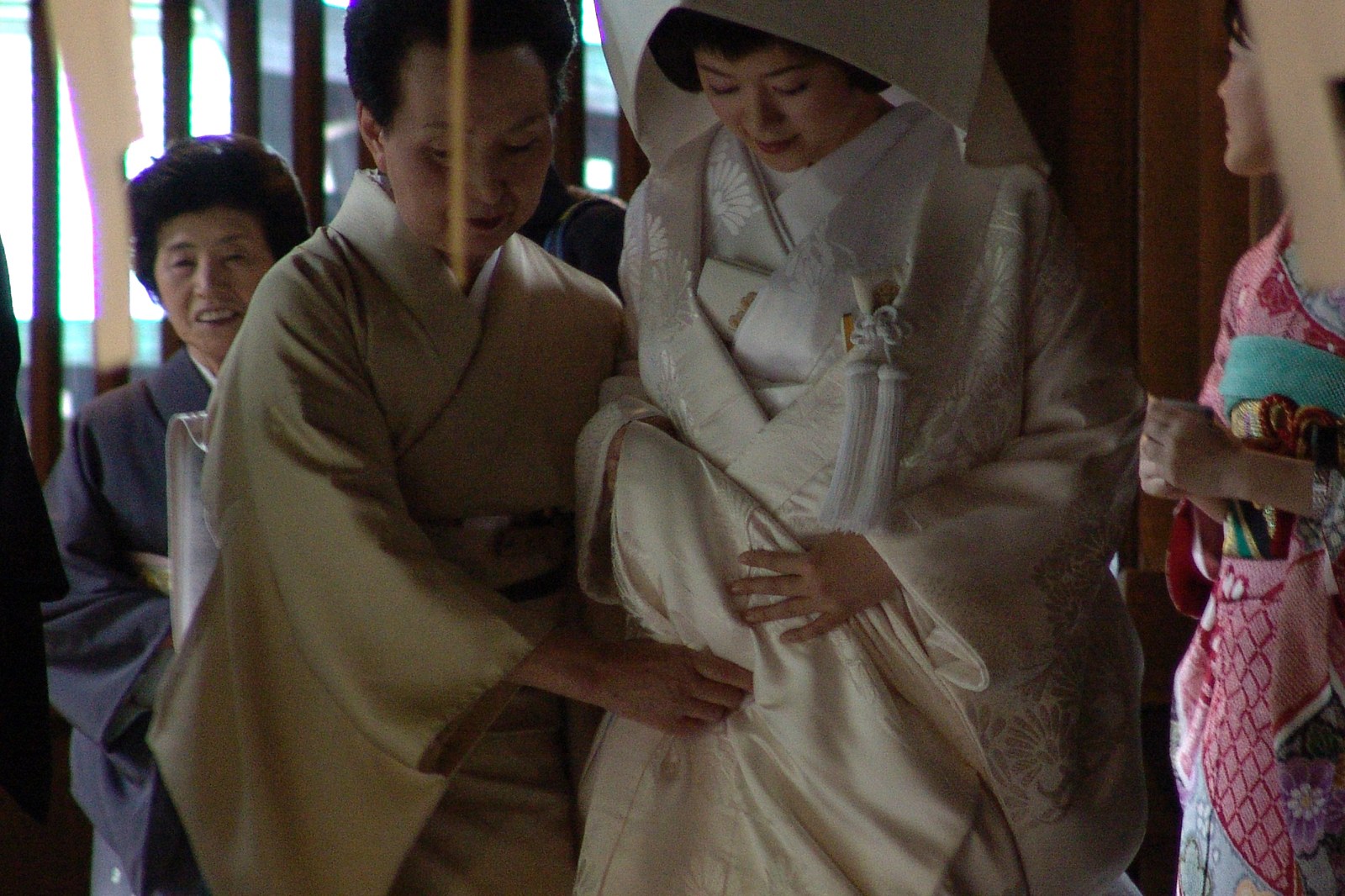
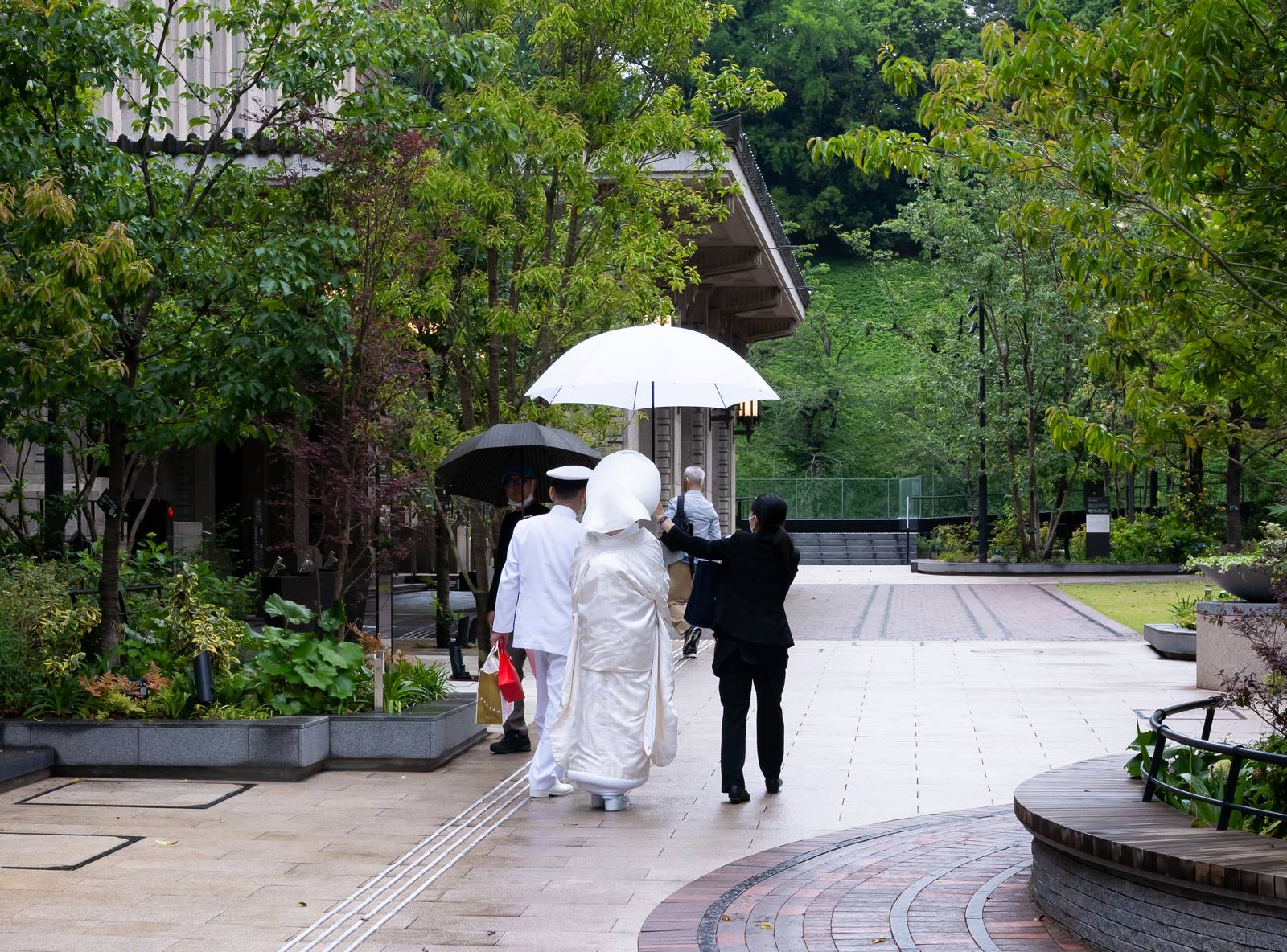
The shiromuku is the all-white bridal ensemble worn for the ceremony itself. The name means pure white clothing, and every element obeys it: inner layers, outer robe, obi, and accessories are all white. Ayuka Matsumoto, a luxury bridal curator and editor of EDIT FOR JAM, describes the shiromuku as the most formal and sacred of the bridal garments, and the one typically worn in Shinto ceremonies.
Two explanations for the color stand side by side. White has stood for the rays of the sun since ancient times, and pure white bridal kimono were prized from the Heian period onward. The second reading is that a blank white garment lets the bride take on the colors of the family she is marrying into. The shiromuku came out of samurai family weddings before it spread more widely.
Because everything is one color, the interest comes from texture and motif. Auspicious patterns woven or embroidered into the white silk include cranes, phoenixes, and the pine, bamboo, and plum grouping. Collar color and the placement of accessories do most of the remaining work on the overall impression.
Iro-uchikake
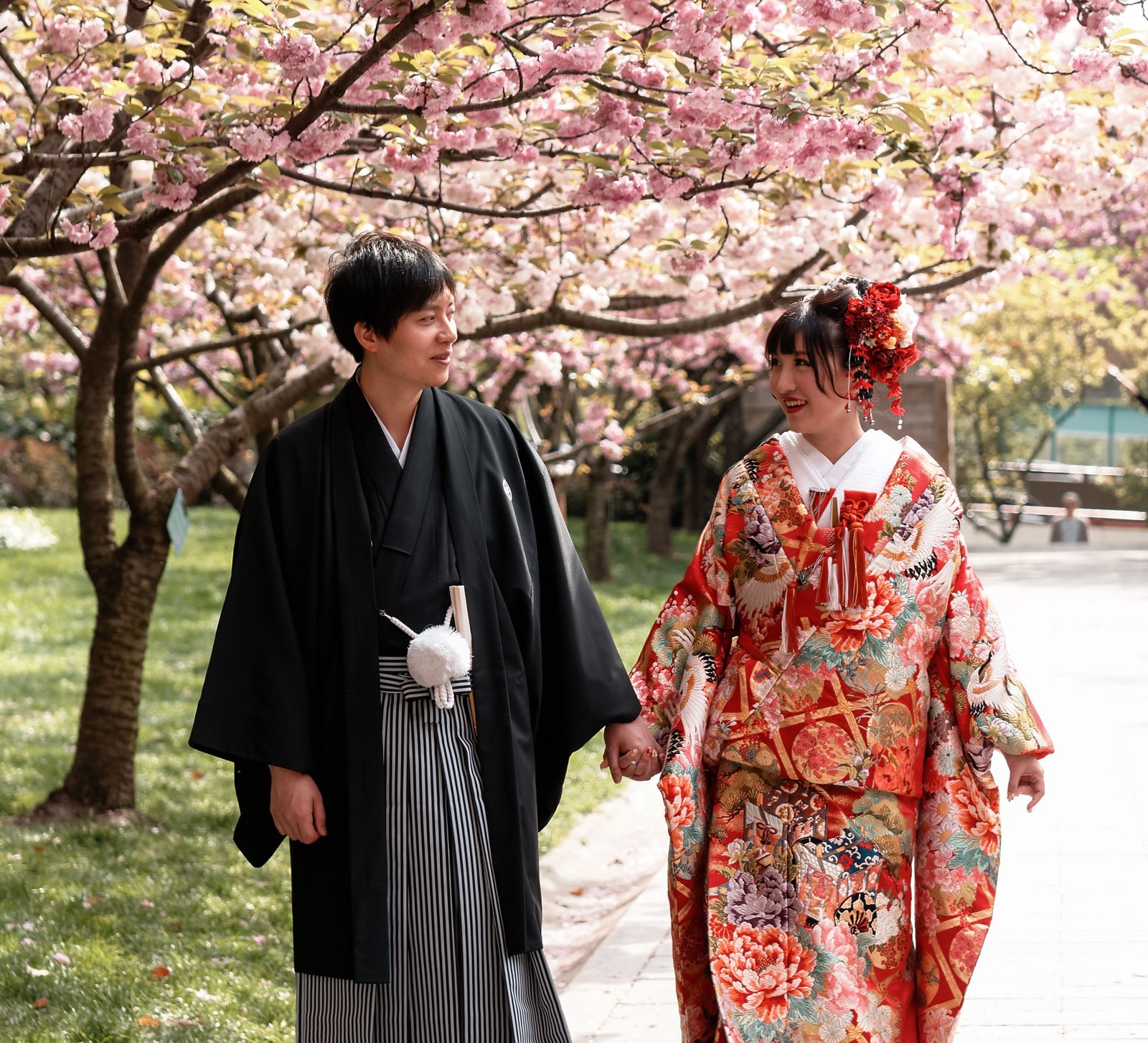
The iro-uchikake is the richly embroidered outer robe a bride wears at the reception, layered over the shiromuku once the formal ceremonies are finished. Matsumoto describes it as typically decorated in auspicious colors such as red and gold, with motifs like cranes or cherry blossoms standing for longevity and happiness.
Historically that change of robe was the point. Moving out of white and into color signaled the bride’s welcome into her new family. The garment descends from the opulent outer robes of the Edo period, which is where the lavish embroidery and the gold and silver foil come from.
The palette is read rather than just admired. Red conveys protection and joy, while gold and silver stand for abundance. Auspicious patterns run to cranes, turtles, the pine, bamboo, and plum trio, and imperial carts. Modern colorways and motifs are widely available for brides who want something outside the classic red.
Hikifurisode
The hikifurisode is a long-sleeved kimono with an extended train, and it is the trailing bridal form of the furisode. Matsumoto notes that it was once reserved for unmarried women, and that some brides now choose it as a symbolic final appearance in that style before marriage. Alongside shiromuku and iro-uchikake it is one of the three bridal styles studios in Japan most often offer.
Wataboshi and Tsunokakushi
Two traditional headpieces go with the bridal kimono: the wataboshi, a large rounded white hood worn outdoors with the shiromuku only, and the tsunokakushi, a flat band worn over Shimada-styled hair with either shiromuku or iro-uchikake.
The wataboshi descends from the katsuki, a hood married women in samurai families wore outdoors from the Muromachi through the Momoyama periods, taken up by younger women from the Edo period. It began as protection against dust and cold and now functions as the Japanese equivalent of a bridal veil, hiding the bride’s face from everyone except the groom until the ceremony ends. It is never worn with a colored kimono or at an indoor reception.
The tsunokakushi name translates as hiding horns, from the folk belief that a woman grows horns and turns into a demon when jealousy takes hold, so the covering stands for a bride who will be gentle toward her husband. Many brides now skip both headpieces and choose Western-style hair with floral headpieces instead, though a Japanese-style wig called nihongami remains the traditional option.
What the Bride Carries
Murano describes a set of five items carried with traditional bridal kimono, which may include a decorative pouch, a small dagger, a folding fan, and cords used to fasten the kimono and obi. These are color-coordinated with the outfit rather than chosen individually.
The pouch is the hakoseko, a small case in gold brocade or embroidered cloth that samurai brides used in the Edo period and the ancestor of the modern Japanese cosmetic case. Its original contents were lucky charms of a practical sort: incense, lip crimson, and a mirror. The obi holding the whole outfit together has no fastenings at all and is tied into a bow or knot, at the back or the front depending on the bride’s preference.
The Groom’s Montsuki Haori Hakama
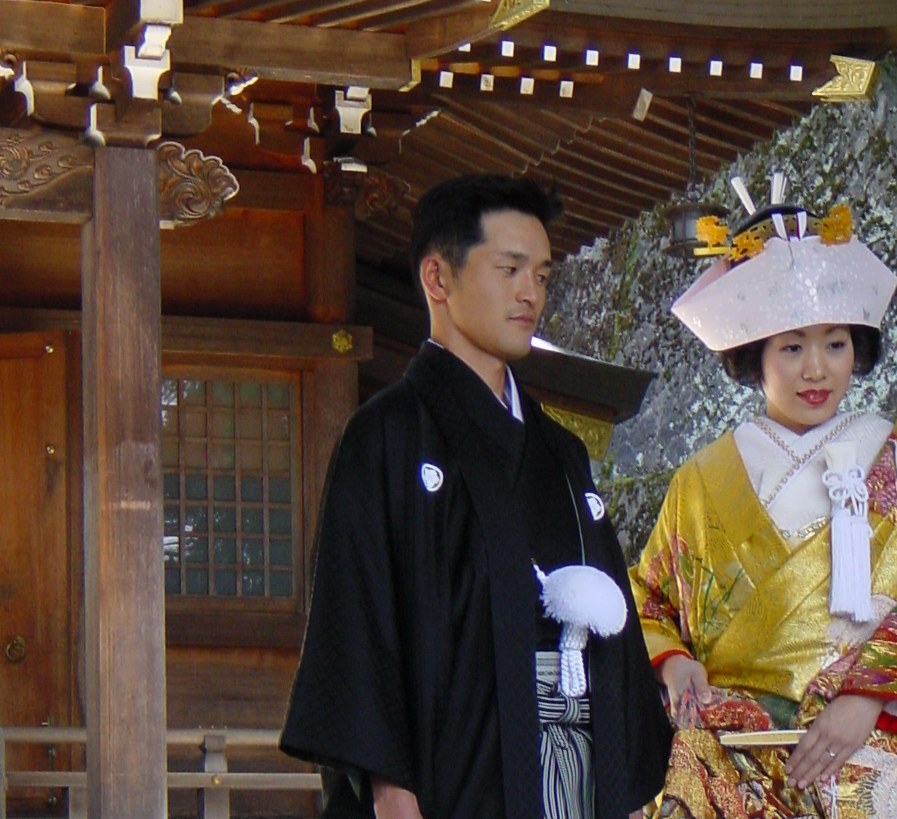
The montsuki haori hakama is the groom’s most formal traditional attire and the counterpart to the bride’s shiromuku. It is three garments: the haori jacket, the nagagi kimono worn beneath it, and the pleated hakama from the waist down. Family crests sit on the back, the chest, and the sleeves. The form traces back to samurai formal dress, where wearing the family crest was a matter of honor and courtesy, and the ensemble still reads as a statement of sincerity and respect.
Crest count and color set the rank. A black montsuki haori hakama with five crests is the highest formal style and the one traditionally paired with a bride in shiromuku, iro-uchikake, or hikifurisode. Colored versions in white, gray, navy, or green read as semi-formal and belong at receptions, after-parties, and photo sessions. Patterned or subtly lustrous fabrics sit in the same semi-formal territory for grooms who want more room to move stylistically.
The individual pieces are specific. For a formal black five-crest outfit, the nagagi is glossy habutae silk with the crests dyed directly into the cloth, the nagajuban underneath is white habutae, and the hakama is Sendaihira striped silk, the most prestigious choice. A silk kaku-obi secures the hakama, a white haori-himo cord closes the jacket, and the look finishes with zori sandals on tatami-style soles with white straps, white tabi socks, and a white folding fan.
Fit is checked closely at the fitting. The haori should fall just past the hip bones and the hakama should be long enough to show the ankles slightly, since too long makes the hem ripple and too short unsettles the posture. Rental fittings usually check height, yukitake sleeve length, hakama length, and sandal size, and raising your arms and sitting down while wearing the haori is the fastest way to catch a problem.
One practical point about the crests: rental garments generally carry tsumon, a generic crest rather than the groom’s own family crest. Grooms who want their own family crest can apply custom crest stickers sold at specialty stores.
Matching the Bride’s and Groom’s Formality
When both people wear kimono, the two outfits are kept at the same level of formality so neither outranks the other. A bride in shiromuku pairs with a black five-crest montsuki haori hakama. A bride in a modern kimono with Western elements pairs with a colored montsuki in subdued tones.
| Bride’s kimono | Formality | Groom’s matching attire |
|---|---|---|
| Shiromuku | Most formal bridal attire | Black montsuki haori hakama, five crests |
| Iro-uchikake | Equal to shiromuku, richly decorated | Black or colored montsuki haori hakama |
| Hikifurisode | Formal, lighter impression | Black for the ceremony, colored for the reception |
| Modern kimono with Western elements | Semi-formal | Colored montsuki in subdued tones |
The white bridal kimono with a black montsuki hakama beside it has long been treated as the most formal and most timeless combination a Japanese wedding can produce.
Modern and Mixed Western-Japanese Ceremonies
Traditional Japanese wedding clothes are optional. Matsumoto states that many brides in Japan choose Western-style wedding dresses rather than traditional kimono, and the common middle path is kimono for the ceremony and a Western dress for the reception. Matsumoto also puts the share of Japanese wedding attire that is rented rather than bought at about 90 percent.
The kimono-then-dress sequence fits the existing habit of changing outfits partway through the day anyway. Rental is how most couples reach garments at this level of craftsmanship at all. Buying still makes sense for anyone who wants to pass a wedding kimono down.
Where the two traditions meet most visibly is in what studios call new-wafuku, kimono styling that borrows Western elements, balanced on the groom’s side by a colored montsuki in subdued tones. Contemporary bridal kimono also turn up in pastels, jewel tones, and metallics, well outside the classic white and red. That flexibility is part of why kimono keeps a place in traditional Japanese clothing for women at a moment when almost nothing else in the wardrobe is worn daily.
Photo weddings sit slightly apart. Couples who want the garments and the images without a full ceremony book kimono shoots at shrines, temples, gardens, and historic districts, most often in Kyoto, where the traditional textile industry that produces bridal kimono is still concentrated. Formality rules relax there: three crests or a colored montsuki are acceptable where five crests would be expected at a Shinto ceremony.
FAQs
What are traditional Japanese wedding clothes called?
The bride’s garments are the shiromuku, an all-white kimono worn for the Shinto ceremony, the iro-uchikake, an embroidered colored outer robe worn at the reception, and the hikifurisode, a long-sleeved kimono with a train. The groom wears a montsuki haori hakama, a crested haori jacket over pleated hakama. Shiromuku and iro-uchikake are the two mainstream bridal choices today.
Can anyone wear an iro-uchikake?
The iro-uchikake is a formal bridal outer robe rather than everyday wear, and it is worn by the bride at her wedding or reception. Since roughly 90 percent of Japanese wedding attire is rented, most people who wear one are renting it for the day rather than owning it.
How many family crests should a groom’s montsuki have?
Five crests are standard for Shinto ceremonies and highly formal receptions, and a black five-crest montsuki haori hakama is the correct pairing for a bride in shiromuku. Three crests or a colored montsuki are acceptable for casual gatherings, after-parties, and photo weddings.
Why does the bride change outfits during a Japanese wedding?
The color sequence carries meaning. The bride wears white for the ceremony and changes into a colored robe afterward, historically to mark her welcome into her new family. According to Chika Murano of DRESSMORE, the bride may change once or twice in total over the course of the event.
How far in advance should wedding kimono be arranged?
Roughly three to four months before the wedding for a groom’s montsuki hakama rental. Dressing on the day takes about two hours before the ceremony starts, which is why venues and studios handle the fitting and dressing as a package.
Kamicrew does not make bridal kimono, but the crane, pine, and phoenix motifs that carry all this meaning show up across our Japanese-motif shirts if you want to wear that symbolism somewhere other than a wedding.
Kamicrew Best Seller

Dont Touch Me Yokai Ukiyo-E Japanese T-Shirt
$25.49+
$29.99
(15% off)


Summer Vibes Salty Kawaii Japanese Hoodie
$44.99+
$49.99
(10% off)


Japanese Pin Horror 80s Retro Aesthetics T-Shirt
$25.49+
$29.99
(15% off)


El Gran Maja Japanese Kaiju T-Shirt
$25.49+
$29.99
(15% off)


Who Wants The Perfect Body Japan Capybara Kawaii Japanese Unisex Shirt
$25.49+
$29.99
(15% off)


Monster 8 Mask Vintage Animal Hoodie
$44.99+
$49.99
(10% off)


I Hate People Japanese Opossum Vintage Animal Hoodie
$44.99+
$49.99
(10% off)


I Got That Dog In Me Small Turtle Vintage Animal T-Shirt
$25.49+
$29.99
(15% off)

The Creation Of Cat Ukiyo-E Japanese T-Shirt
$25.49+
$29.99
(15% off)