
The types of kimono are ranked by formality, not by cut. For women the ladder runs from bridal shiromuku and uchikake at the ceremonial top, through furisode for young unmarried women and kurotomesode for married women, down through semi-formal houmongi and tsukesage, single-colour iromuji, casual komon, and finally yukata at the bottom, with mofuku standing apart as mourning dress. The men’s range is shorter, running from kuromontsuki haori hakama down to kinagashi.
Almost every kimono is built on the same T-shaped body, and traditionally the type a woman wore also signalled whether she was married. This guide takes each type in turn, from ceremonial down to everyday, for women and for men, with the occasions each one belongs to.
How Kimono Formality Works
Kimono formality is set by four signals: pattern placement, sleeve length, the number of family crests, and fabric. Pattern placement leads for women and fabric leads for men. A design confined below the waist reads as highly formal, a design flowing continuously over the shoulders and seams reads as semi-formal, and a small repeating print reads as casual.
Japan’s traditional clothing descends from the kosode, which the Tokyo National Museum describes as the outer wear of the Edo period, worn from about the 15th century by samurai as daily outer clothing and adopted across all classes by the 17th century. The modern ranking system grew out of that shared shape, which is why the differences between types are decorative rather than structural.
Sleeve length is the second signal, tied to age and marital status: long hanging sleeves belong to young unmarried women and shorter sleeves to married women. The kamon, the family crests, form the third signal, with five crests outranking three and three outranking one. Fabric is the fourth signal, and it carries the most weight in the plain and summer types, where there is no pattern to read.
All kimono also split into awase and hitoe. Awase are lined, made by sewing two pieces of fabric together, and are the usual choice from October through May. Hitoe have no lining, so they are lighter and suit June through September.
| Type | Formality | Worn by | Typical occasion |
|---|---|---|---|
| Shiromuku, uchikake | Ceremonial | Brides | Shinto wedding |
| Furisode | Most formal | Young unmarried women | Coming of age, weddings |
| Kurotomesode | Most formal | Married women | Close relatives at weddings |
| Irotomesode | Formal to semi-formal | Any adult woman | Weddings, honours, parties |
| Houmongi | Semi-formal | Any adult woman | Tea ceremony, theatre, shichigosan |
| Tsukesage | Semi-formal | Any adult woman | School ceremonies, reunions |
| Iromuji | Varies by crests | Any adult woman | Tea ceremony, funerals |
| Mofuku | Ceremonial mourning | Closest family | Funerals |
| Komon | Casual | Any adult woman | Lessons, town, small parties |
| Yukata | Most casual | Women and men | Festivals, ryokan, onsen |
| Kuromontsuki haori hakama | Most formal | Men | Weddings, funerals, ceremonies |
| Kinagashi | Casual | Men | Relaxed everyday wear |
Furisode (振袖): The Formal Kimono for Young Women
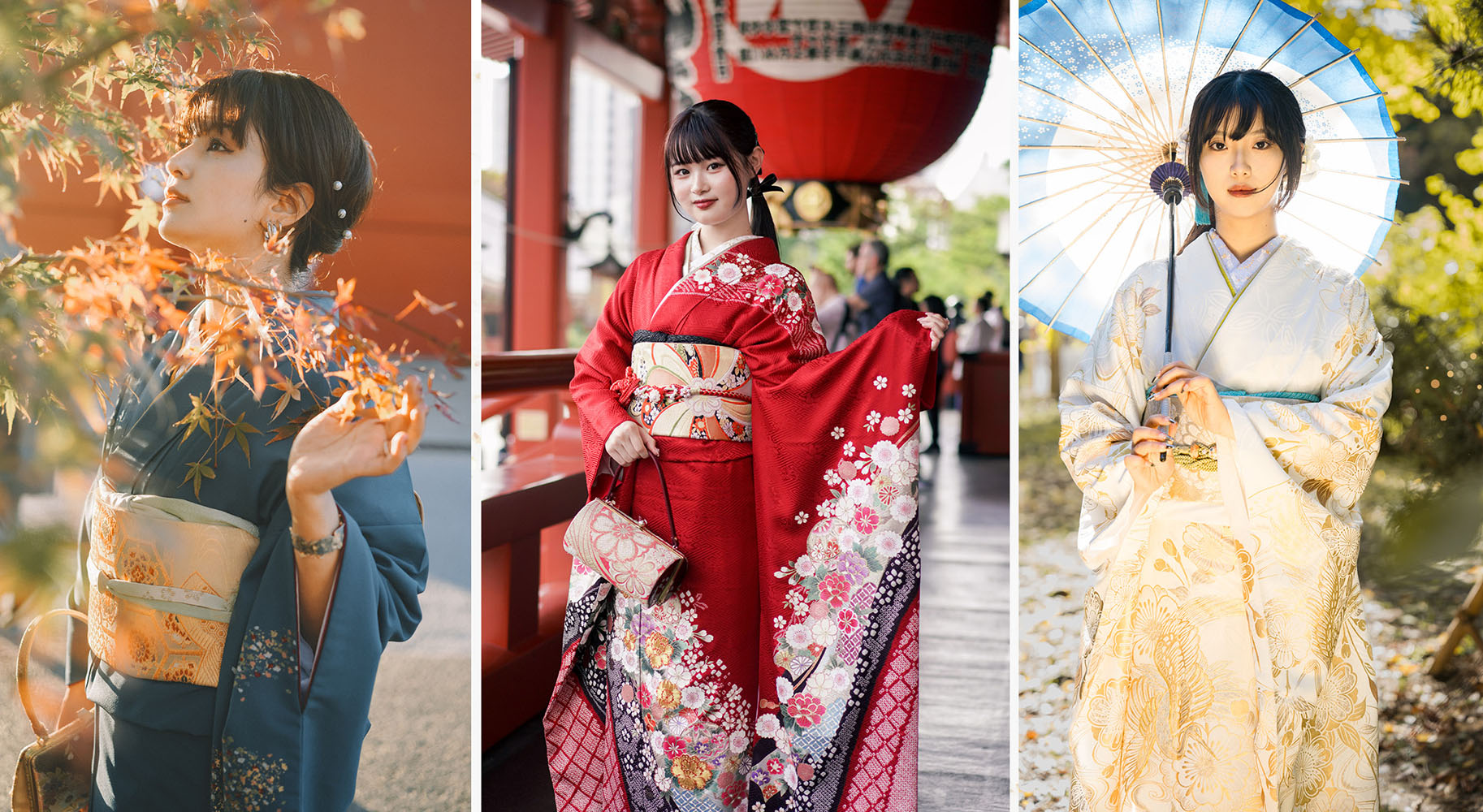
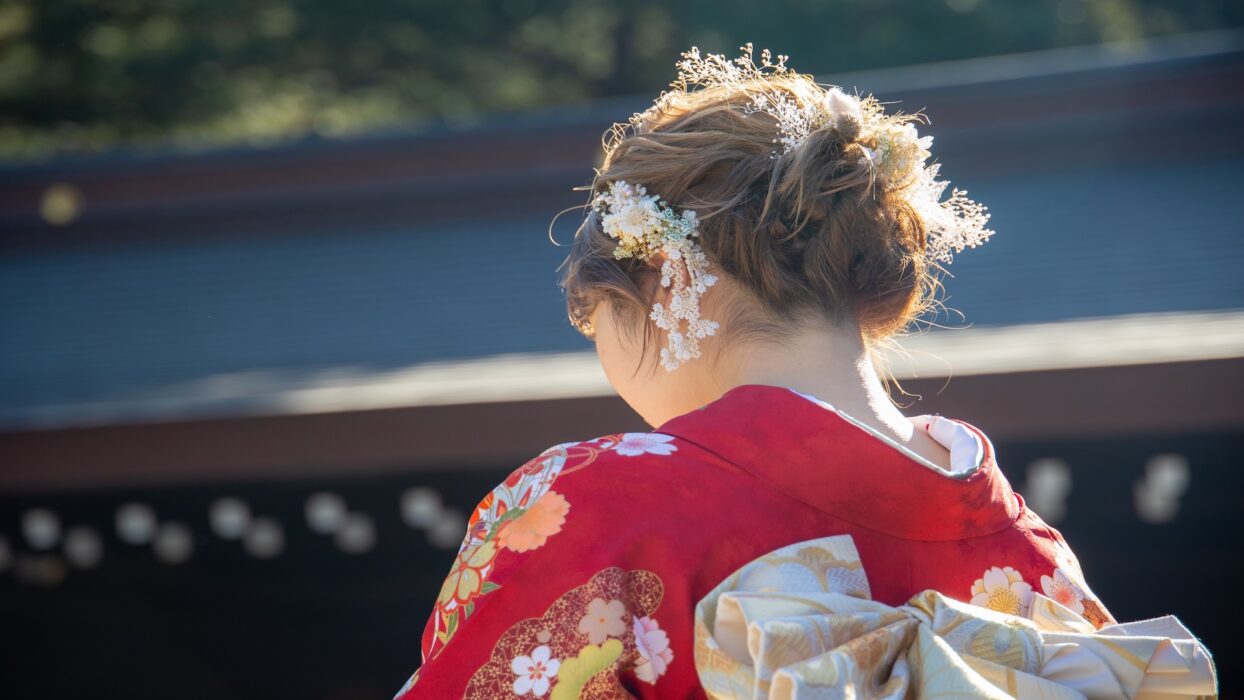
Furisode is the most formal kimono type worn by young, usually unmarried women. Its sleeves hang far below the waist, the name means “swinging sleeves” after the way that length moves, and the pattern runs across the whole garment in colours meant to express hopes for happiness, luck, and long life. Furisode belongs to milestones: the coming-of-age ceremony above all, plus graduations, formal parties, and weddings where the guest is unmarried.
A Meiji-period example, a furisode patterned with hydrangeas and cherry blossoms, is held in The Metropolitan Museum of Art’s collection.
Sleeve length splits the furisode into three grades: ofurisode has the longest sleeves and is the most formal, chufurisode is the middle length and the common choice for young women, and kofurisode is the shortest and is usually paired with hakama for graduation ceremonies.
Tomesode (留袖): The Formal Kimono for Married Women
A married woman’s formal wear is tomesode, and it is read from the placement rather than the amount of decoration. The sleeves are short, and a sophisticated eba moyo pattern sits diagonally across the lower part of the garment along the hem, ignoring the seams. Gold leaf and embroidery are common.
Kurotomesode is the black version, reserved for close relatives of the couple at wedding ceremonies and receptions, and it always carries five crests. Irotomesode is the same garment in any other base colour, and its formality slides with the crest count instead: five crests reach the same formality as kurotomesode, three suits semi-formal occasions, and one is fine for entrance and graduation ceremonies. Unlike the black version, irotomesode is not restricted to married women.
Houmongi (訪問着) and Tsukesage (付け下げ): Semi-Formal Visiting Wear
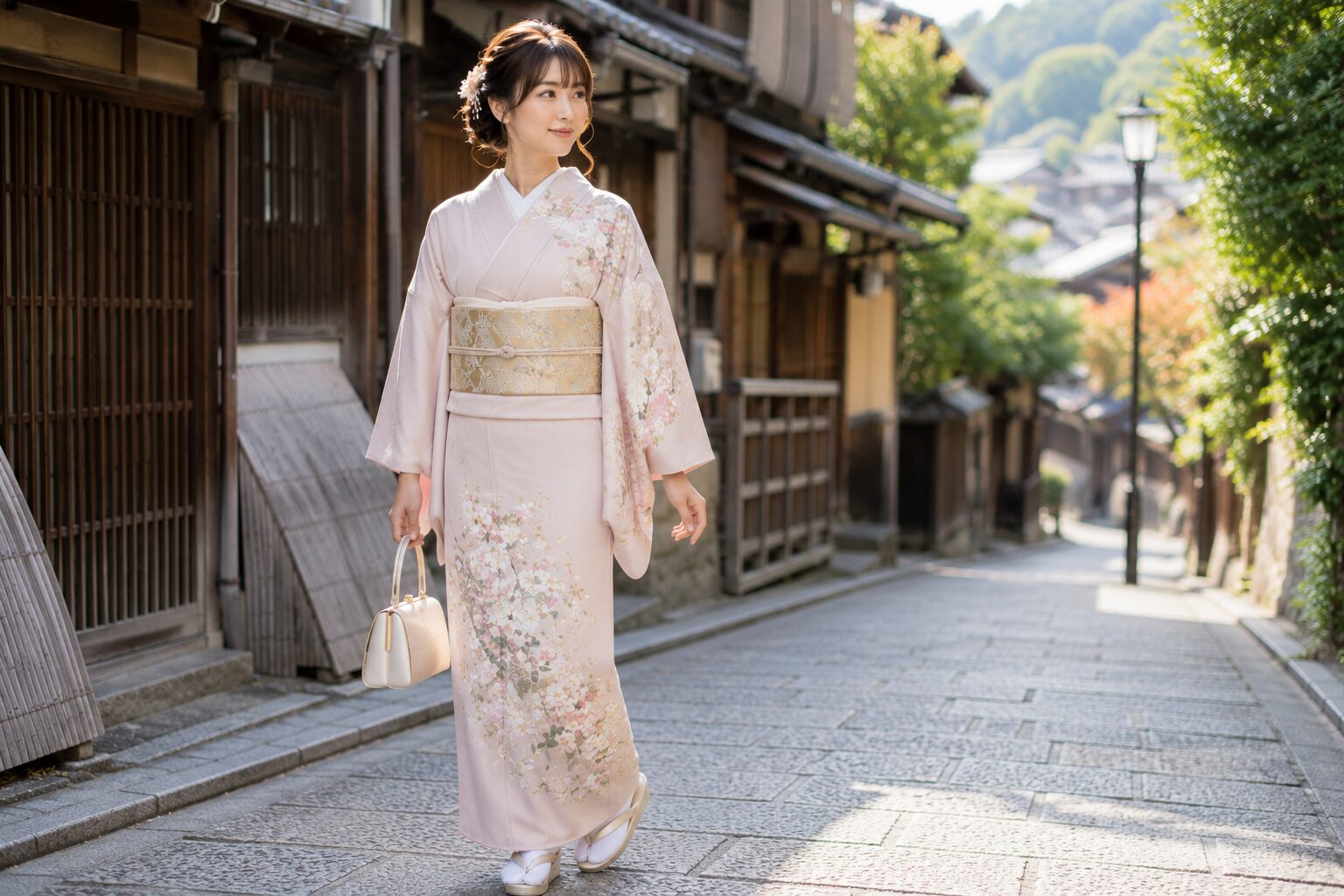
Houmongi and tsukesage both sit at semi-formal, separated by how their patterns meet the seams. Houmongi means “visiting wear,” carries one crest or none, and its pattern crosses the seams so the whole garment reads as a single continuous painting. Tsukesage sits one step below, with smaller and more modest patterns that normally avoid the seams.
Both married and unmarried women wear houmongi to tea ceremonies, theatre performances, class reunions, shrine visits, children’s entrance and graduation ceremonies, shichigosan rites, and dinner or New Year parties. Friends and acquaintances also wear it to weddings. The type was created as a kimono appropriate for calling on someone’s house, and its versatility made it popular.
There is a production difference too: tsukesage are dyed and sold as tanmono, narrow-loomed cloth, then tailored, while houmongi are dyed after the pieces are cut. Tsukesage suits school ceremonies, small parties and reunions, semi-formal tea parties, and kabuki outings. It was introduced as a cheaper alternative to the houmongi.
Iromuji (色無地) and Komon (小紋): Plain and Everyday Kimono
Iromuji is a kimono dyed a single colour other than black or white, with no printed pattern or embroidery, and its formality moves with crest count, colour, and accessories. Komon is the casual type, covered in a small repeating stencil-dyed pattern, and it is the kimono Japanese people treat as ordinary clothing.
Some iromuji are entirely solid; others carry a jimon, a pattern woven into the fabric itself. Because iromuji does not draw attention it works at solemn occasions without disrupting them. Bright pinks and yellows with auspicious jimon go to weddings, tea ceremonies, shichigosan, and school ceremonies, while dark blue or grey goes to wakes and funerals. There is even a specific kind of iromuji intended for tea ceremony.
Mofuku is the mourning kimono, and it is the one type tied to a single occasion: plain black, unpatterned, worn with a black obi and black accessories by the closest family at a funeral. Relatives and guests further out wear a dark iromuji instead.
Komon means “small pattern,” and the print sometimes runs edge to edge and sometimes leaves negative space between the motifs. Komon was the normal way to dress before Western clothes took over, and it suits a walk around town, small celebrations, casual parties, and lessons in dance, music, tea, or flower arrangement, but not a formal event.
Edo komon is the exception, dyed in one colour with a pattern so fine that the kimono looks plain from a few steps away. It came from the formal dress of daimyo samurai families, and that pedigree is why an edo komon carrying a crest can pass as semi-formal wear.
Uchikake (打掛) and Shiromuku (白無垢): Bridal Kimono
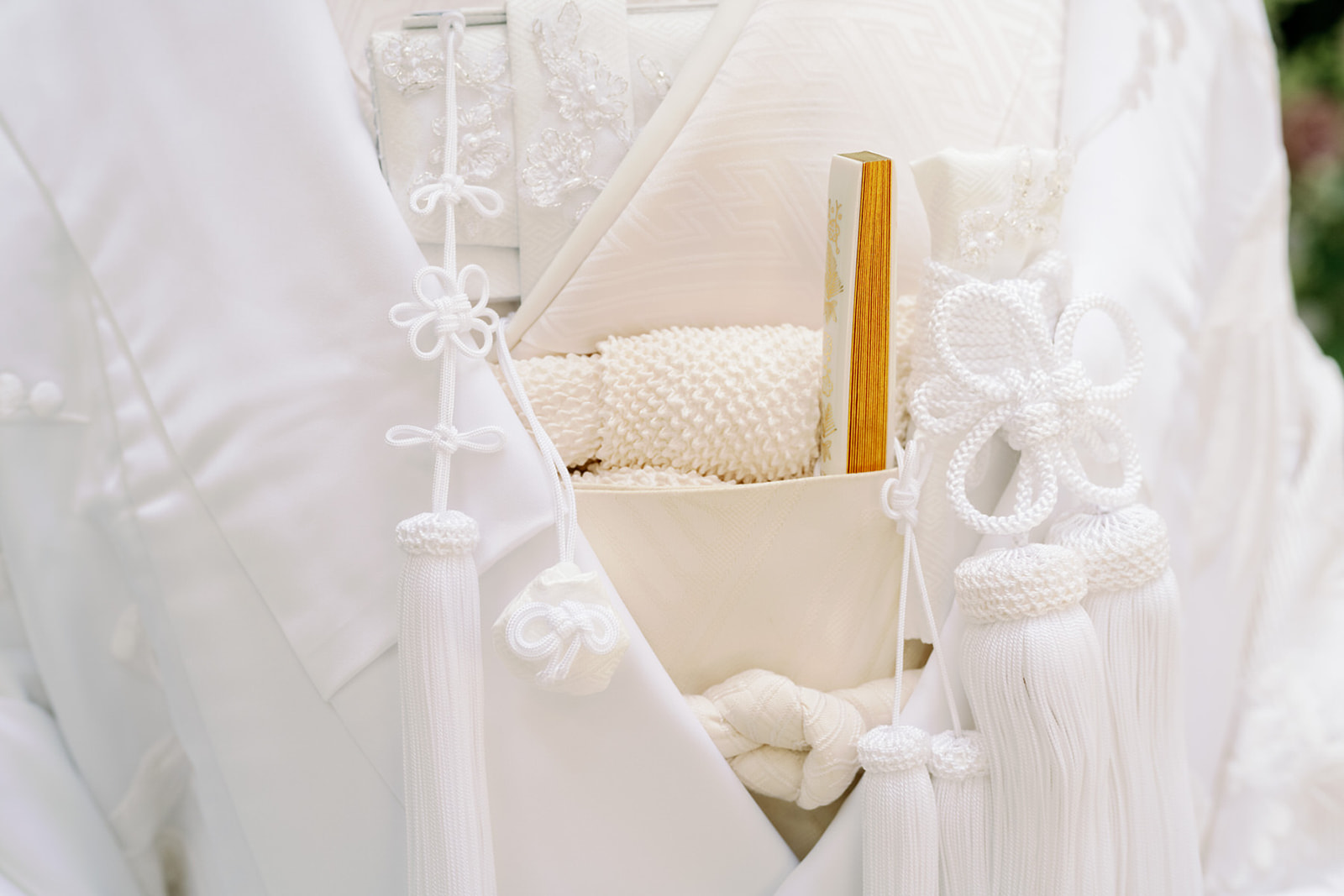
Uchikake and shiromuku top the formality ladder as ceremonial, bridal-only wear rather than everyday clothing. Uchikake is a heavily patterned outer robe worn over the kimono without an obi and cut long enough to trail on the floor. Shiromuku is the white-on-white version worn for Shinto ceremonies.
Uchikake is worn only as bridalwear or on stage in kabuki. Its motifs are auspicious ones: cranes, turtles, phoenixes, pine, bamboo, plum blossom, ox carts. The trailing hem is padded thickly with wadding to stop it wearing through. Bright red and white grounds are common on the coloured version.
The kanji of shiromuku read as “white pure-innocence,” and the garment stands for purity and gentleness of heart. It comes with a full set of accessories drawn from the wider range of traditional Japanese clothing for women: the katsura bridal wig, kanzashi hair ornaments, a suehiro folding fan, a hakoseko pouch, a kaiken dagger, and either a tsunokakushi headpiece or the wataboshi hood that only pairs with shiromuku. Many brides wear shiromuku for the ceremony itself and change into a coloured iro uchikake for the reception, the two centerpieces of traditional Japanese wedding clothes.
Yukata (浴衣): The Most Casual Member of the Family
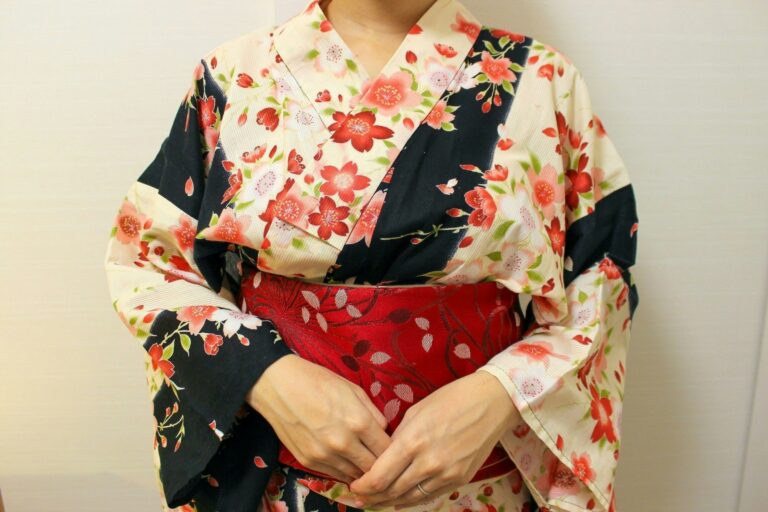
At the bottom of the ladder sits the yukata: unlined, short-sleeved, usually cotton, linen, or hemp, worn without the usual undergarments and tied with a simple obi. It belongs to summer festivals, fireworks displays, hot spring towns, and evenings at a ryokan.
Yukata literally means “bath clothes.” Geta, the raised wooden sandals, go with it. Those choices are what separate a yukata from a kimono, and they are also why nobody wears one to a formal event.
Its history is a slide down the class system. The yukata developed from a single-layered silk kimono the upper class wore in the bath. Silk was unsuited to getting wet, so as the custom spread the cloth changed to cotton and linen. Once the custom reached the middle and lower classes and public bathhouses became common, walkers to and from the bathhouse wanted something presentable in public view, and the modern yukata emerged.
Men’s Kimono: Montsuki (紋付), Haori and Hakama
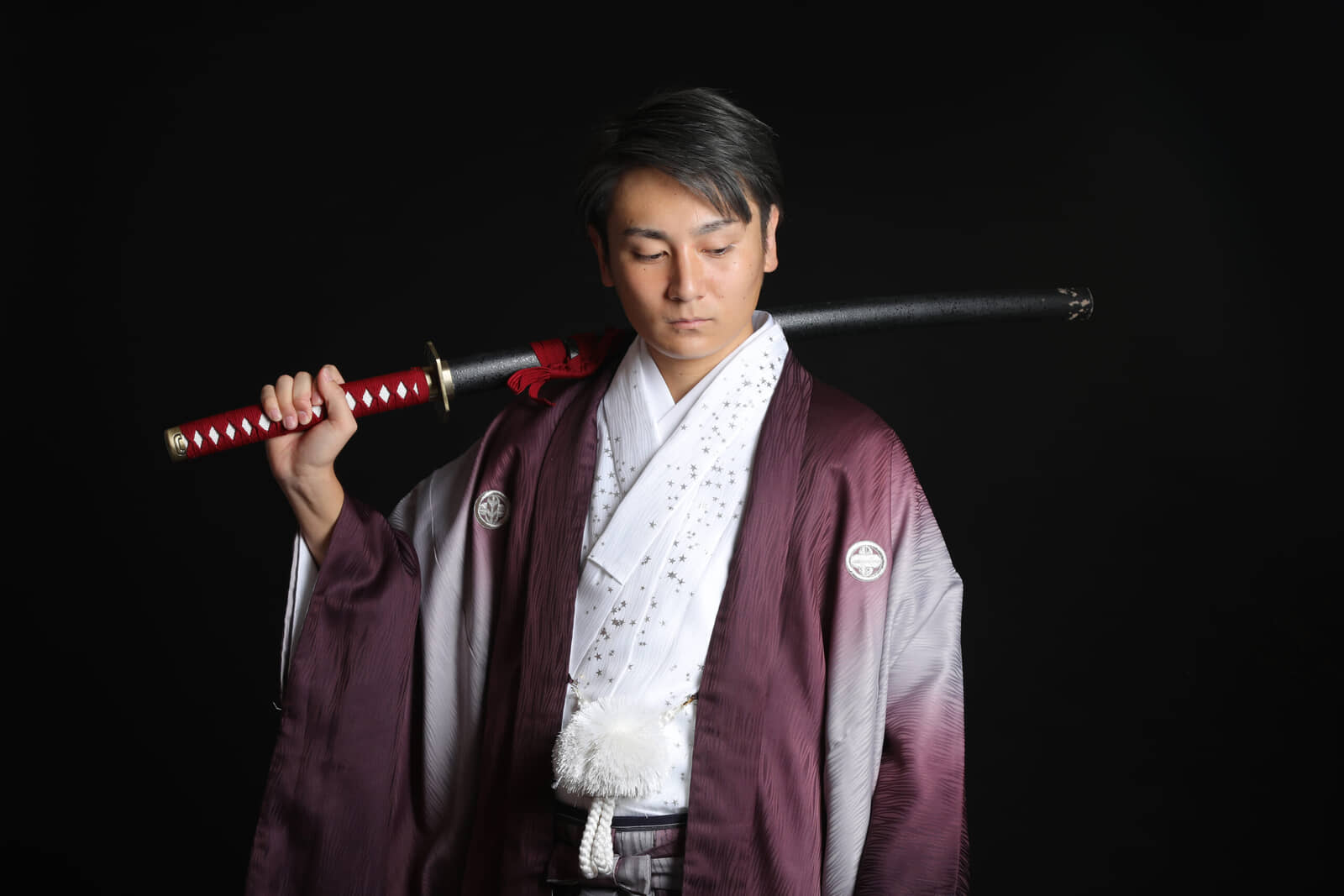
Men’s kimono come in subdued colours and simpler construction than women’s. Three combinations cover almost every occasion: kuromontsuki haori hakama at the ceremonial top, iromontsuki haori hakama below it, and plain crested haori hakama as everyday formal wear. Each pairs a haori coat with hakama, the pleated trousers at the formal end of traditional Japanese clothing for men.
Kuromontsuki haori hakama is the highest rank, worn to weddings, coming-of-age ceremonies, and funerals: a black haori carrying five kamon over hakama. Iromontsuki haori hakama is the same idea in a coloured haori worn over a nagagi, suitable for weddings and age ceremonies but generally not funerals, and it comes with five, three, or one crest, with fewer crests reading more casual. Haori hakama with three crests or one is the everyday formal option, a step below either montsuki set.
Below that, a nagagi worn without hakama is more casual and mixes freely with either fabric. Dropping the haori coat entirely leaves kinagashi, which is the kimono held closed with an obi and the most relaxed way a man wears one. Historically men wore kimono daily, and the modern kuromontsuki descends from that habit even though the garment now appears mostly at ceremonies.
Kimono You Rarely See in Public
Two types of kimono survive as performance and ceremonial dress rather than as clothing. Hikizuri is the trailing-skirt kimono worn today by geisha, maiko, and performers of traditional Japanese dance. Junihitoe is the layered court robe of Heian-period noblewomen and ladies-in-waiting, still used by the Imperial House of Japan for coronations and weddings.
Hikizuri means “trailing skirt,” and it earned the name from its length: the extra fabric flows behind the wearer instead of being folded up at the waist the way modern kimono do. Before the Meiji era wealthy high-ranking women wore it. Outside Kyoto or the Asakusa district of Tokyo the chance of seeing one is slim.
Junihitoe means “twelve layers,” though the count varied in practice. Outer robes are cut to expose the layers beneath at the sleeves, hem, and neck, and Heian aristocrats treated the layered colour combinations, kasane no irome, as a statement of taste and rank because each combination represented a season.
Summer Kimono: Usumono
Usumono, meaning “thin clothing,” is the summer kimono, also called natsu no kimono. It has no lining and is sheer enough to look almost see-through. Convention limits it to July and August.
The cloth is chosen for airflow. Ro and sha silk gauzes are the dressier options, and hemp and linen are the everyday ones, popular partly because they wash at home.
FAQs
What are the main types of kimono?
They sort into five groups rather than one flat list: bridal kimono, formal kimono, semi-formal visiting wear, casual kimono, and mofuku for mourning. A woman’s wardrobe draws on all five, a man’s on the montsuki combinations and kinagashi, and hikizuri and junihitoe sit outside the wardrobe altogether as stage and court dress.
What is the fanciest type of kimono?
It depends on the occasion. Bridal kimono outrank everything else, and the uchikake is the most heavily decorated garment in the family. Among kimono worn as clothing rather than bridalwear, furisode tops the scale for unmarried women and kurotomesode with five crests for married women.
Is it disrespectful for a foreigner to wear a kimono?
Wearing one respectfully is welcomed, and rental shops across Tokyo and Kyoto exist specifically so visitors can dress properly and walk through cultural sites. The more common mistake is wearing the wrong formality level for the occasion, which is the kind of faux pas the categories above are designed to prevent.
If this formality ladder has you noticing traditional motifs everywhere, Kamicrew’s ukiyo-e print shirts carry that same imagery into everyday streetwear.
Kamicrew Best Seller

Dont Touch Me Yokai Ukiyo-E Japanese T-Shirt
$25.49+
$29.99
(15% off)


Summer Vibes Salty Kawaii Japanese Hoodie
$44.99+
$49.99
(10% off)


Japanese Pin Horror 80s Retro Aesthetics T-Shirt
$25.49+
$29.99
(15% off)


El Gran Maja Japanese Kaiju T-Shirt
$25.49+
$29.99
(15% off)


Who Wants The Perfect Body Japan Capybara Kawaii Japanese Unisex Shirt
$25.49+
$29.99
(15% off)


Monster 8 Mask Vintage Animal Hoodie
$44.99+
$49.99
(10% off)


I Hate People Japanese Opossum Vintage Animal Hoodie
$44.99+
$49.99
(10% off)


I Got That Dog In Me Small Turtle Vintage Animal T-Shirt
$25.49+
$29.99
(15% off)

The Creation Of Cat Ukiyo-E Japanese T-Shirt
$25.49+
$29.99
(15% off)