
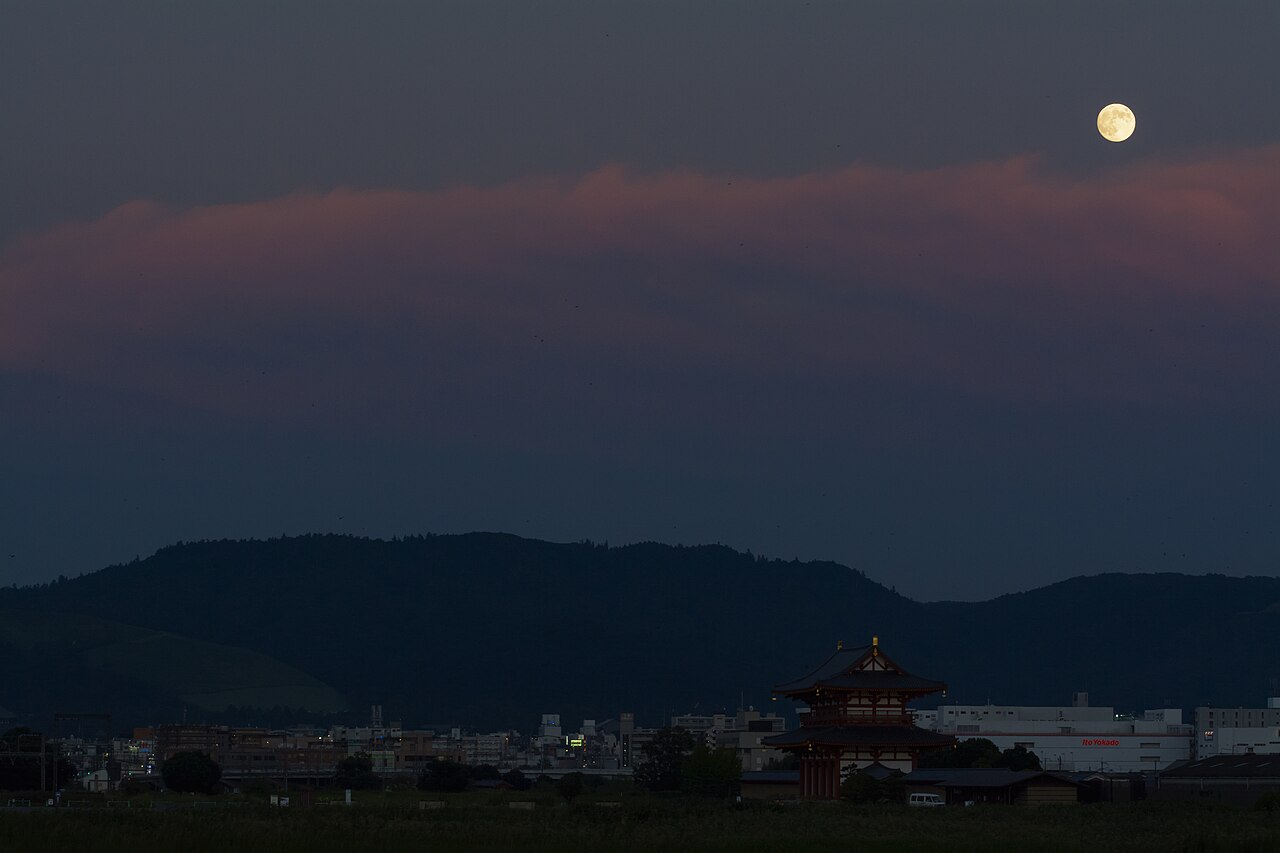
Tsukuyomi is the Japanese god of the moon, born from the right eye of the creator kami Izanagi and counted, with the sun goddess Amaterasu and the storm god Susanoo, among the three noble children of the creation myth. His name is written 月読 and reads as moon plus reading, a reference to counting the phases of the moon. He is generally treated as male, and he rules the night.
Tsukuyomi’s story survives in two eighth century chronicles. The Kojiki, compiled in the early 710s, mentions him at his birth and then drops him entirely. The Nihon Shoki, finished in 720, gives three further accounts of his birth and the one narrative he is remembered for: he killed a food goddess, and his sister stopped speaking to him. That quarrel is the reason the sun and the moon are never in the sky at the same time.
Who Tsukuyomi Is in Japanese Mythology
Tsukuyomi is the moon kami of Shinto and the second of the three noble children, the Mihashira no Uzu no Miko, produced when Izanagi purified himself after escaping the land of the dead. His domain is the moon, the night, and time. Kokugakuin University’s Encyclopedia of Shinto lists him as usually male, with rule over the night, and notes that the name is thought to be tied originally to the lunar calendar.
Tsukuyomi is a kami, not a monster, which places him in the god tier of Japanese folklore rather than the creature bestiary, and specifically in the small group at the very top of the pantheon. He is also called Tsuki no kami, the moon kami, and Tsukiyomi no mikoto. The moon in a lunar calendar is a clock, which is why the counting sense in his name is not decorative.
Tsukuyomi is not a busy god. Compared with Amaterasu, who anchors the imperial line, or Susanoo, who fills chapters, Tsukuyomi carries almost no narrative. What he has is one violent episode and a permanent job.
How Tsukuyomi Was Born
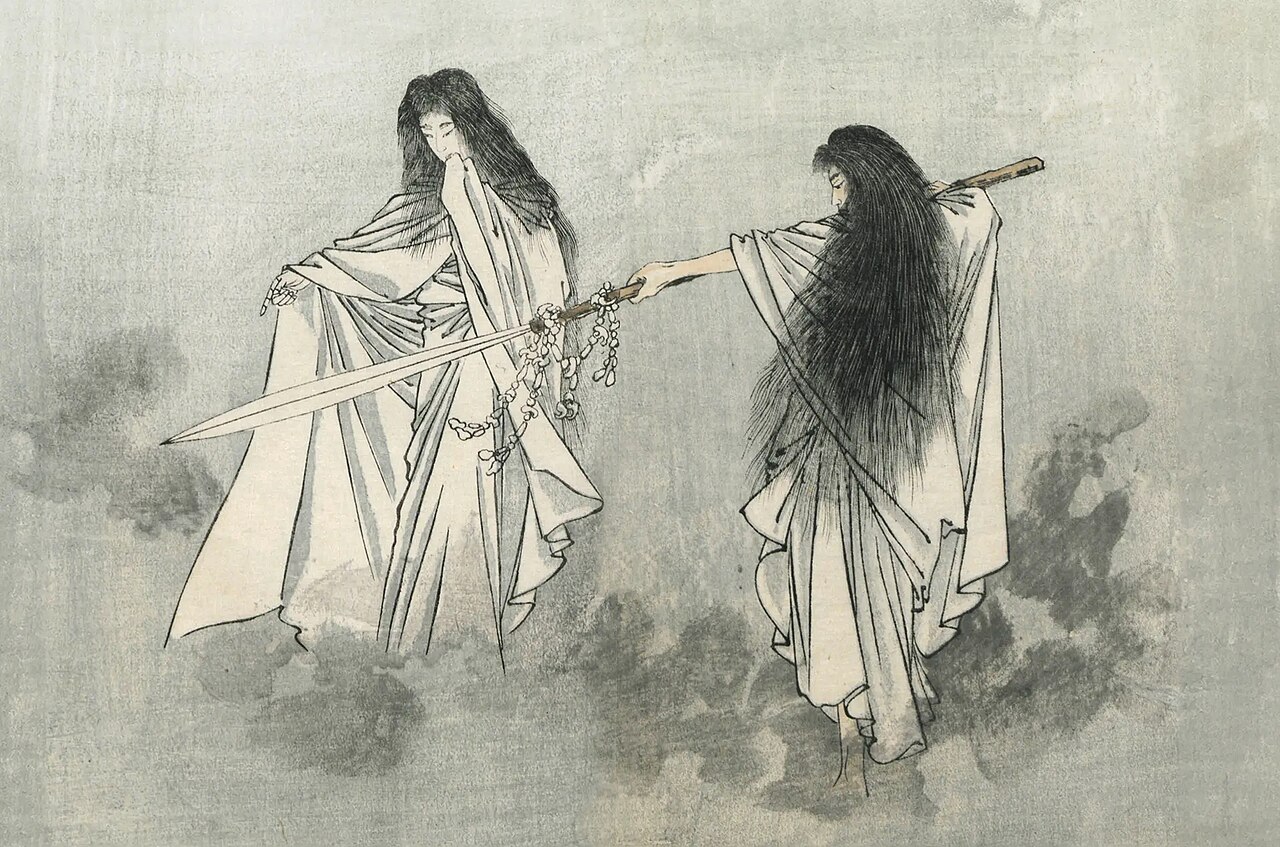
Tsukuyomi was born from the right eye of Izanagi. Izanagi came back from Yomi, the land of the dead, contaminated, and washed himself at a place the Nihon Shoki names Awagihara in Hyuga province, in what is now Miyazaki City. Amaterasu came out of his left eye, Tsukuyomi came out of his right, and Susanoo came out of his nose.
That is the Kojiki version. The Nihon Shoki does not settle on it. Across its main text and its variant accounts the moon god arrives three other ways, and the compilers recorded the disagreements instead of resolving them.
| Source | How Tsukuyomi comes into being |
|---|---|
| Kojiki | From Izanagi’s right eye, washed during purification |
| Nihon Shoki, main account | Produced jointly by Izanagi and Izanami |
| Nihon Shoki, first variant | From a white bronze mirror held in Izanagi’s right hand |
| Nihon Shoki, sixth variant | From Izanagi washing his right eye at Awagihara |
Notice what every version keeps: the right side. Right eye against left eye, right hand against left hand, moon against sun. The pairing is deliberate, and it is one of the reasons Tsukuyomi is read as the male counterpart to a female Amaterasu.
What the Name Tsukuyomi Means
Tsukuyomi means reading or counting the moon. The name splits into tsuku, an old form of 月, moon or month, and yomi, from 読み, reading or counting. The sense is calendrical: the same counting verb sits inside koyomi, the ordinary Japanese word for calendar, which literally counts the days. A moon god whose name is a bookkeeping term tells you what the moon was for.
Japanese deity names usually resolve into ordinary words once the kanji are split, the same way the kanji behind Ryujin resolve into dragon and god. Tsukuyomi is written several ways, and each spelling pushes the meaning somewhere slightly different.
| Written form | Reading | Literal sense |
|---|---|---|
| 月読 / 月讀尊 | Tsukuyomi | Moon reading, moon counting |
| 月弓尊 | Tsukuyumi | Moon bow |
| 月夜見尊 | Tsukiyomi | Watching the moonlit night |
| 月讀壮士 | Tsukuyomi Otoko | Moon reading man |
The moon bow spelling is a Nihon Shoki variant. The moonlit night spelling supports a second etymology built from tsukiyo, moonlit night, plus mi, looking or watching. The Man’yoshu form adds a man to the end of it, which is the closest the early sources come to stating his gender outright.
Tsukuyomi, Ukemochi, and the Origin of Rice
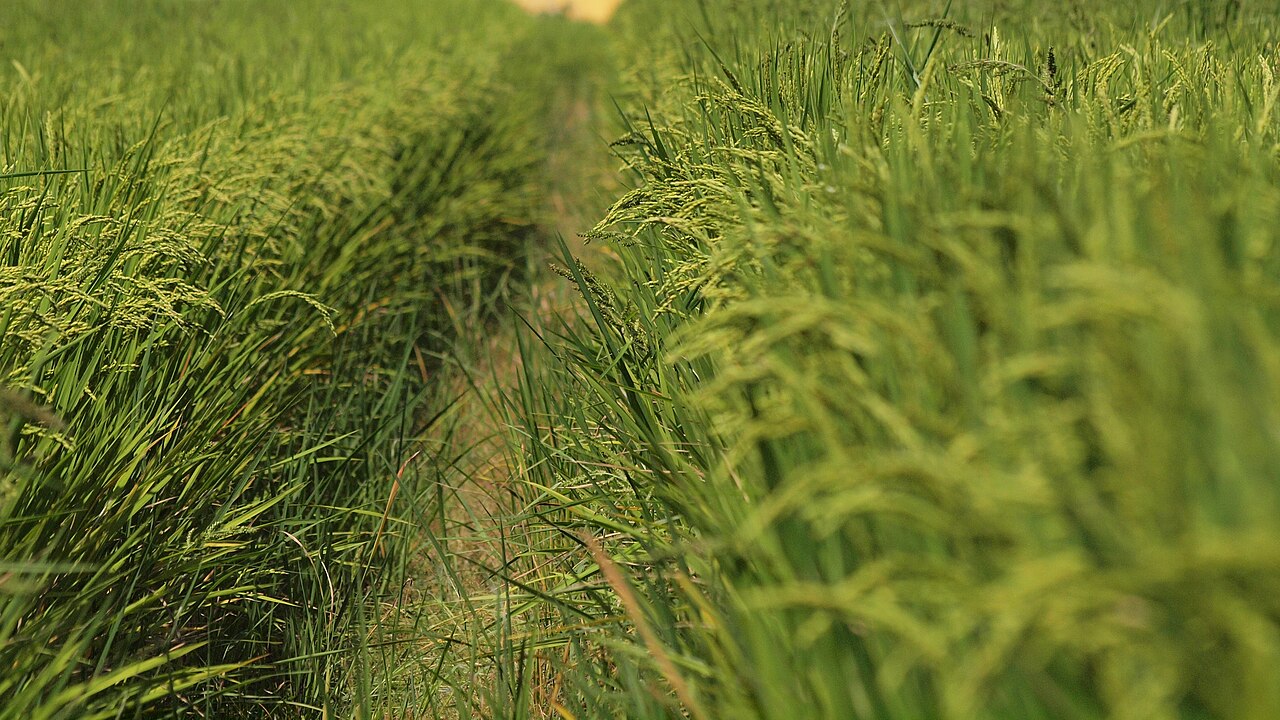
Tsukuyomi killed Ukemochi, the kami of food, and her body then produced the things Japan eats and works with: cattle, horses, silkworms, rice and other crops. Amaterasu had sent him down from heaven to meet her, and he found the manner of her hospitality disgusting and drew his sword.
Ukemochi provided. Facing inland she spat out rice, facing the sea she spat out fish, facing the mountains she spat out wild game, and she laid the whole spread in front of her guest. That is what Tsukuyomi killed her for.
The killing is horrifying and generative at once, which is a shape Japanese myth uses more than once. In the Kojiki the same story is told with different actors, Susanoo killing the food goddess Ogetsuhime, and the parallel is close enough that some readers treat the two episodes as one story preserved twice.
This is also the only scene in which Tsukuyomi does anything. Everything else attached to him is either a birth account, a job description, or a shrine.
Why Amaterasu Never Sees Her Brother Again
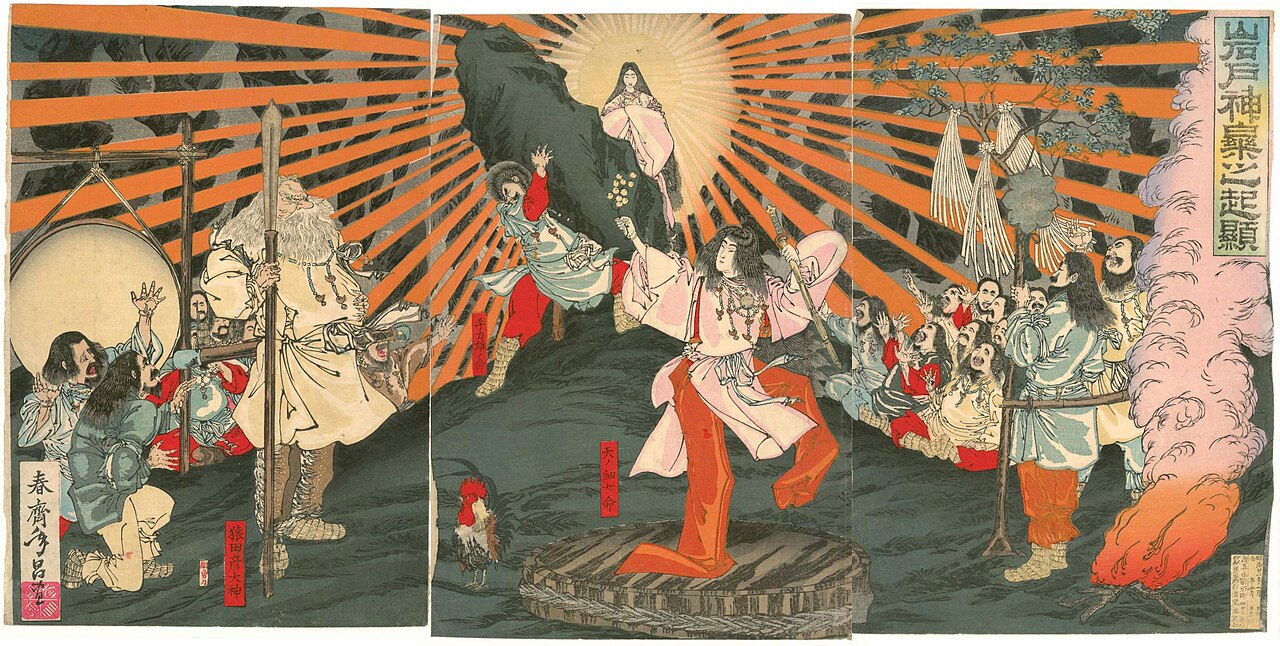
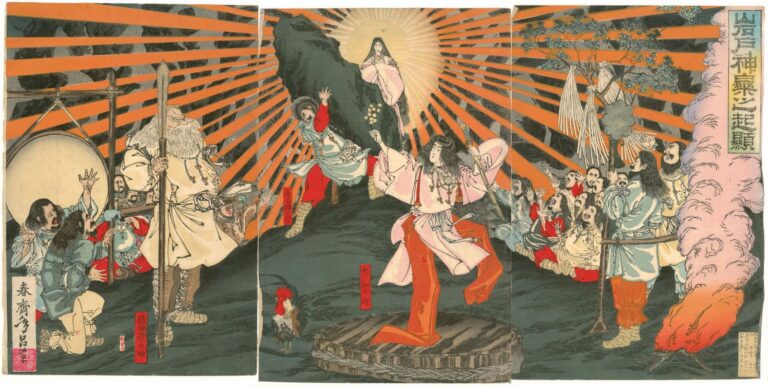
Amaterasu never sees Tsukuyomi again because he killed Ukemochi. When she heard what he had done, Amaterasu called him a wicked god and swore she would never look at him again, and she kept to it. The sun and the moon have occupied the sky in shifts ever since, she by day and he by night.
That is the whole mechanism of the myth. Japanese mythology does not explain the alternation of day and night with astronomy or with a chariot crossing the sky. It explains it with a family falling out and neither party backing down.
Tsukuyomi and Amaterasu lived in the sky together before the killing, and their relationship in the texts is not fixed either. They are siblings in every account, and in some they are also husband and wife, which makes the estrangement read less like a quarrel between siblings and more like a separation.
What Tsukuyomi Was Given to Rule
Tsukuyomi was given three different domains depending on which text you open. The Kojiki hands him Yoru no Oshikuni, the realm of night. The Nihon Shoki, in one variant, gives him the many tides of the blue sea. A third account puts him in the sky to assist the sun and manage heavenly affairs.
Those three assignments are less contradictory than they look. The moon governs the night, the moon moves the tides, and the moon counts the months. A deity who reads the moon ends up holding the night, the water, and the calendar, and the chronicles simply emphasise different parts of that portfolio.
The sea assignment is described elsewhere as the eightfold tides of the vast sea plain, the same water later ruled by Ryujin the dragon god. Beyond the texts, worship attached Tsukuyomi to nature, agriculture, and social order, and to the Yutsu Katsura tree.
Where Tsukuyomi Is Worshipped
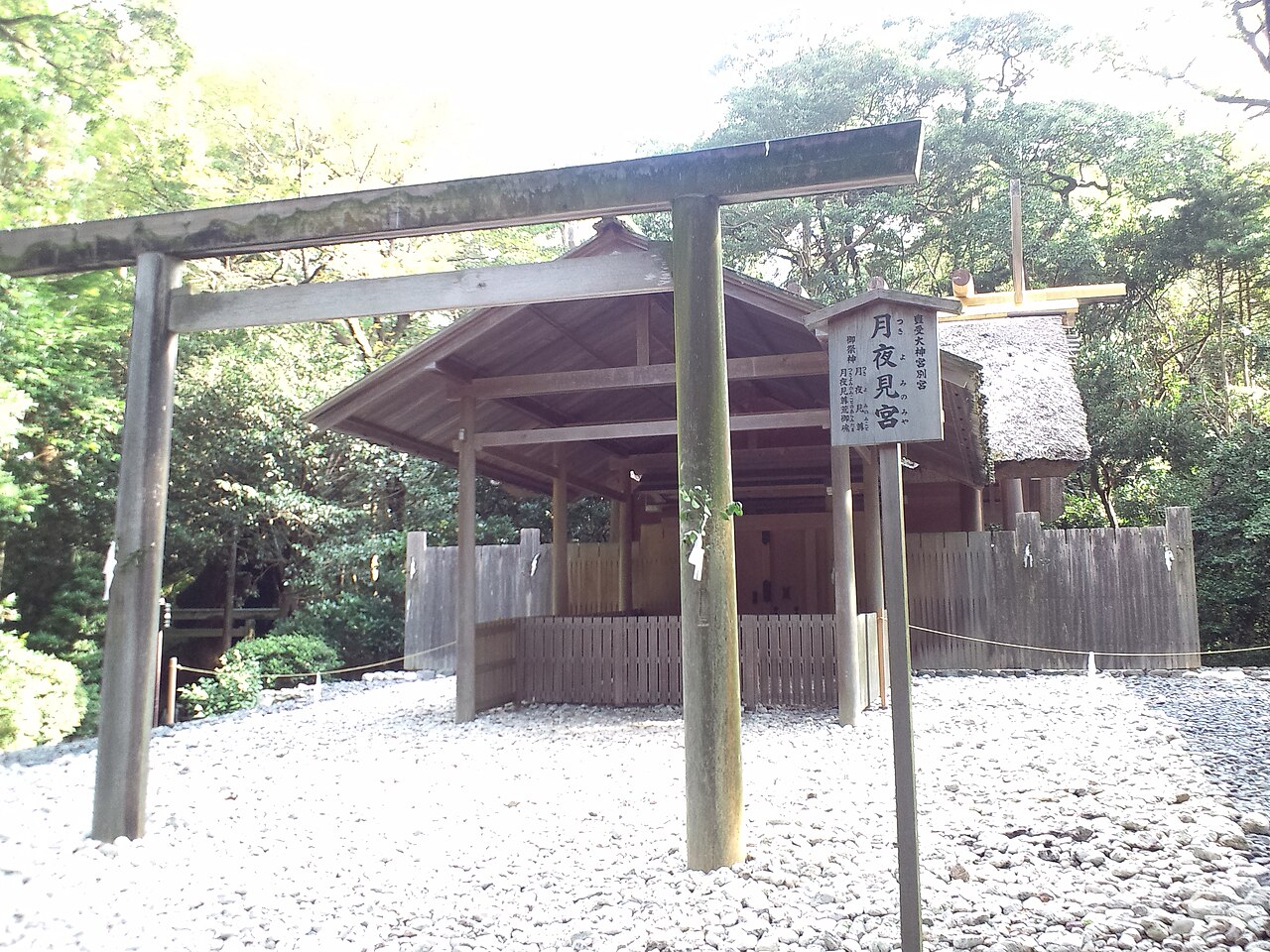
Tsukuyomi is worshipped at Ise Grand Shrine, the shrine complex of Amaterasu, and the shrine’s own listing of the auxiliary sanctuaries outside its main precincts records a moon-god betsugu on each side: Tsukiyomi no miya, written 月読宮, as an auxiliary of the Inner Shrine, and Tsukiyomi no miya, written 月夜見宮, as an auxiliary of the Outer Shrine. The moon god sits one step from the sun goddess he refuses to face. He also holds shrines on Iki Island, in Kyoto, and in Yamagata.
| Shrine | Where | Relation to Tsukuyomi |
|---|---|---|
| Tsukiyomi no miya (月読宮) | Ise, outside the Inner Shrine precinct | Auxiliary shrine (betsugu) of the Inner Shrine |
| Tsukiyomi no miya (月夜見宮) | Ise, outside the Outer Shrine precinct | Auxiliary shrine (betsugu) of the Outer Shrine |
| Tsukuyomi Shrine | Iki Island | The original site, which holds an oracle spot |
| Tsukuyomi Shrine | Kyoto | Auxiliary of Matsunoo taisha, founded by transferring the deity from the Iki shrine |
| Gassan Shrine | Yamagata, on a summit just under 2,000 metres | One of the Three Mountains of Dewa, named for his enshrinement there |
Shrines to Tsukuyomi tend to hold a mirror, the object through which the deity is understood to manifest. Given that one of his birth accounts has him emerge from a white bronze mirror in Izanagi’s hand, the choice of object is not an accident.
Tsukuyomi Beyond the Two Chronicles
Tsukuyomi appears outside the Kojiki and Nihon Shoki in two further early sources. The Fudoki, the provincial gazetteers compiled between 713 and 723, record him in Yamashiro and Izumo. The Man’yoshu, assembled around 759, personifies the moon repeatedly and makes Tsukuyomi the custodian of Wochimizu, the Water of Rejuvenation.
That custodianship is the closest the early poetry comes to giving him a treasure of his own.
The Nihon Shoki also brings him back long after the age of the gods. In its fifteenth book, during the reign of Emperor Kenzo, an official named Ahe no Omi Kotoshiro was dispatched to Mimana and became possessed by the moon god, who announced that whoever worshipped him would receive joy. A shrine went up in the Kadono district of Yamashiro province and a ritualist named Oshimi no Sukune was appointed to serve it.
Later texts give Tsukuyomi a face. The Kotai Jingu Gishikicho describes him as a man riding a horse, dressed in purple robes and carrying a golden sword. Two temple records instead make his sacred body a white hare guiding Amaterasu, which is a strange image to place beside the estrangement and a reminder that the tradition never fully agreed on him.
Tsukuyomi in Anime, Manga, and Games
Tsukuyomi appears in modern Japanese media mainly as a name attached to the moon, a sword, or an illusion of night. Naruto uses it for a genjutsu, My Hero Academia gives it to a Class A student, Final Fantasy XIV makes it a divine antagonist, and Yu-Gi-Oh and Cardfight Vanguard print it on cards. Ukemochi is usually left out.
- Naruto uses Infinite Tsukuyomi as a genjutsu that rewrites how everyone caught in it perceives reality and time
- My Hero Academia has a Tsukuyomi, a bird headed Class A student whose power splits away from him
- Final Fantasy XIV casts a Tsukuyomi as a divine antagonist
- Okami places an evil sword in a moon cave
- Chrono Cross gives its moon aligned character Harle the association
- Kamigami no Asobi puts him in a school setting alongside other deities
- Card games including Yu-Gi-Oh and Cardfight Vanguard print him as a card
Anyone arriving at the name from Naruto is meeting an eighth century calendar term that got repurposed as an illusion technique. The link is the night, and not much else.
Wearing the Moon: Tsukuyomi Motifs in Japanese Fashion
The visual vocabulary for Tsukuyomi is small: a crescent or full moon, a sword, purple, a white hare, a mirror. The sources hand over so few attributes that the whole set is easy to design with, and small enough to survive being printed at the size of a chest graphic.
The moon does most of the work on its own. Japanese streetwear leans on it constantly, partly because a single pale disc reads instantly against black and partly because it carries the night without needing a caption. Set a sword or a hare beside it and the reference sharpens from generic lunar imagery to this specific kami. Purple is the underused option: the Kotai Jingu Gishikicho already dresses him in it, so a purple and silver palette is closer to the sources than the black and white most moon graphics default to.
Placed against a sun motif the pairing does something no single graphic can, since the two were designed by the myth never to appear together. If a moon kami is closer to what you would rather wear than read about, Kamicrew’s mythology range works from exactly these motifs.
FAQs
Is Tsukuyomi male or female?
Tsukuyomi is generally considered male, though the two chronicles never state it outright. The usual arguments are that he carried a sword when he killed the food goddess, that the Man’yoshu calls him Tsukuyomi Otoko, moon reading man, and that the myth positions him as the counterpart to a female Amaterasu.
Are Tsukuyomi and Susanoo the same god?
Some scholars have proposed it, because the stories overlap. In the Nihon Shoki, Tsukuyomi kills the food kami Ukemochi. In the Kojiki, Susanoo kills the food kami Ogetsuhime. The pattern of a sun deity, a moon deity and a troublesome sibling also recurs across other mythologies, which keeps the comparison alive. It remains a proposal, not the standard reading.
Does Tsukuyomi appear in the Kojiki after his birth?
No. The Kojiki names him among the three noble children born from Izanagi’s purification, assigns him the realm of night, and never returns to him. Everything narrative about Tsukuyomi, including the killing of Ukemochi and the break with Amaterasu, comes from the Nihon Shoki and later texts.
Is Tsukuyomi worshipped in Tenrikyo?
Yes. Tenrikyo recognises Tsukiyomi no Mikoto as one of the Ten Aspects of God’s Providence, the jūzen no shugo, which is a different framework from the Shinto shrine tradition but keeps the same name in use.
Kamicrew Best Seller

Dont Touch Me Yokai Ukiyo-E Japanese T-Shirt
$25.49+
$29.99
(15% off)


Summer Vibes Salty Kawaii Japanese Hoodie
$44.99+
$49.99
(10% off)


Japanese Pin Horror 80s Retro Aesthetics T-Shirt
$25.49+
$29.99
(15% off)


El Gran Maja Japanese Kaiju T-Shirt
$25.49+
$29.99
(15% off)


Who Wants The Perfect Body Japan Capybara Kawaii Japanese Unisex Shirt
$25.49+
$29.99
(15% off)


Monster 8 Mask Vintage Animal Hoodie
$44.99+
$49.99
(10% off)


I Hate People Japanese Opossum Vintage Animal Hoodie
$44.99+
$49.99
(10% off)


I Got That Dog In Me Small Turtle Vintage Animal T-Shirt
$25.49+
$29.99
(15% off)

The Creation Of Cat Ukiyo-E Japanese T-Shirt
$25.49+
$29.99
(15% off)