
Amaterasu Omikami is the sun goddess of Shinto and the most important deity in the Japanese pantheon. Her name is usually read as the great divinity illuminating heaven, she rules Takama no Hara, the High Celestial Plain where the kami live, and the most important Shinto shrine in Japan, Ise Jingu, is dedicated to her. Her best known myth is the one in which she shuts herself inside a cave and leaves the whole world in darkness.
Amaterasu is also the reason Japanese emperors could once claim divine descent. The three objects she handed to her grandson became the imperial regalia, and her sacred mirror still sits in the innermost sanctuary at Ise. She sits at the top of the hierarchy of gods and spirits that runs through Japanese folklore, which is why her name turns up in creation myths, shrine ritual, ukiyo-e prints and modern games alike.
What Amaterasu Is the Goddess Of
Amaterasu is the goddess of the sun and of the light it casts on the world, and she rules the celestial plain where the kami live. Her name combines the characters for heaven and for shining, which is why it gets translated as shining in heaven or the one who illuminates heaven, and the honorific Omikami added to it means great august kami. Older texts also call her Oho-hir-me-no-muchi and Amaterasu-oho-hiru-me.
Her authority is not limited to daylight. She is the ruler of the celestial plain, the domain of the spirits, and her descendants were held to rule the earth below it. The administration of Ise Jingu describes her plainly as the ancestral kami of the Imperial family and a guardian of Japan, which is a good summary of the two roles she carries at once: a natural force, and a royal ancestor.
How Amaterasu Was Born and Who Her Siblings Are
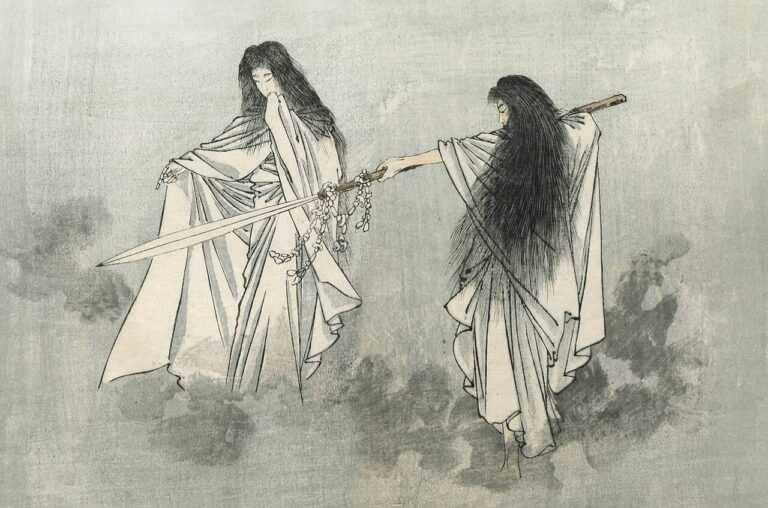
Amaterasu is named as the daughter of Izanagi and Izanami, the pair who made her ruler of the sky, though the birth scene most often retold is stranger than that. After Izanagi escaped from his visit to the underworld he had to perform a cleansing ritual in the river Woto, and Amaterasu was born from his left eye during that washing. The moon god Tsukuyomi came from his right eye and the storm god Susanoo from his nose, which is why the three of them are treated as a set.
Susanoo is Amaterasu’s mischievous younger brother, and the quarrelling between them is constant enough that she eventually exiles him from heaven altogether. A younger sister, Waka-hiru-me, weaves beside her in the palace and matters mostly because of what happens to her later. Other major kami hold domains of their own outside the family, among them the sea god Ryujin, who rules the tides from a palace on the ocean floor.
The Cave Myth: Why Amaterasu Hid
Amaterasu hid inside the heavenly rock cave, Ama-no-Iwato, because her brother Susanoo pushed a running feud too far. He had already damaged her rice fields and defiled sacred spaces, and the final insult was a monstrous flayed horse thrown into the weaving hall where she sat quietly working with Waka-hiru-me, a shock that in one telling kills a weaver outright. Amaterasu withdrew into the cave, sealed the entrance, and the world went completely dark while evil spirits ran riot across the earth.
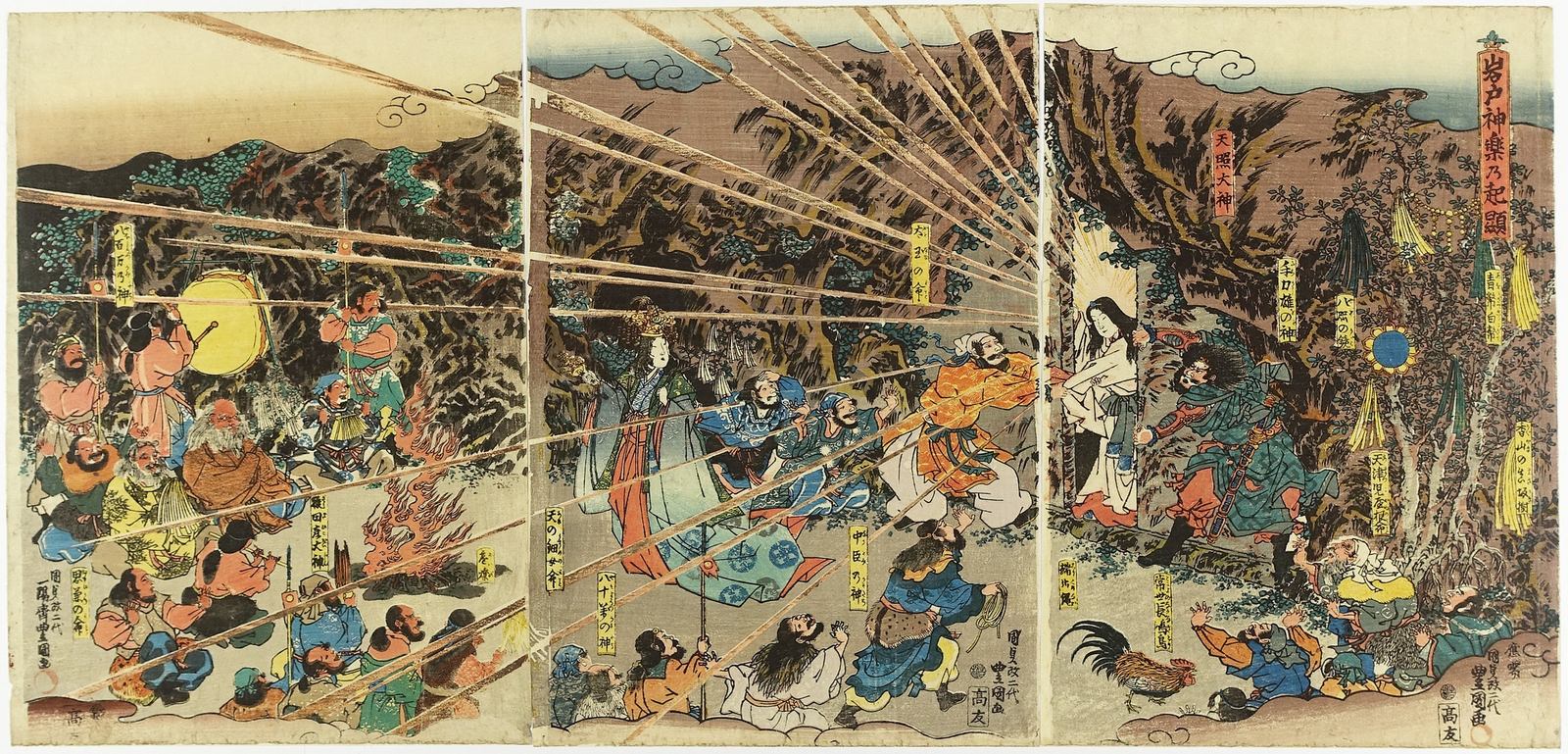
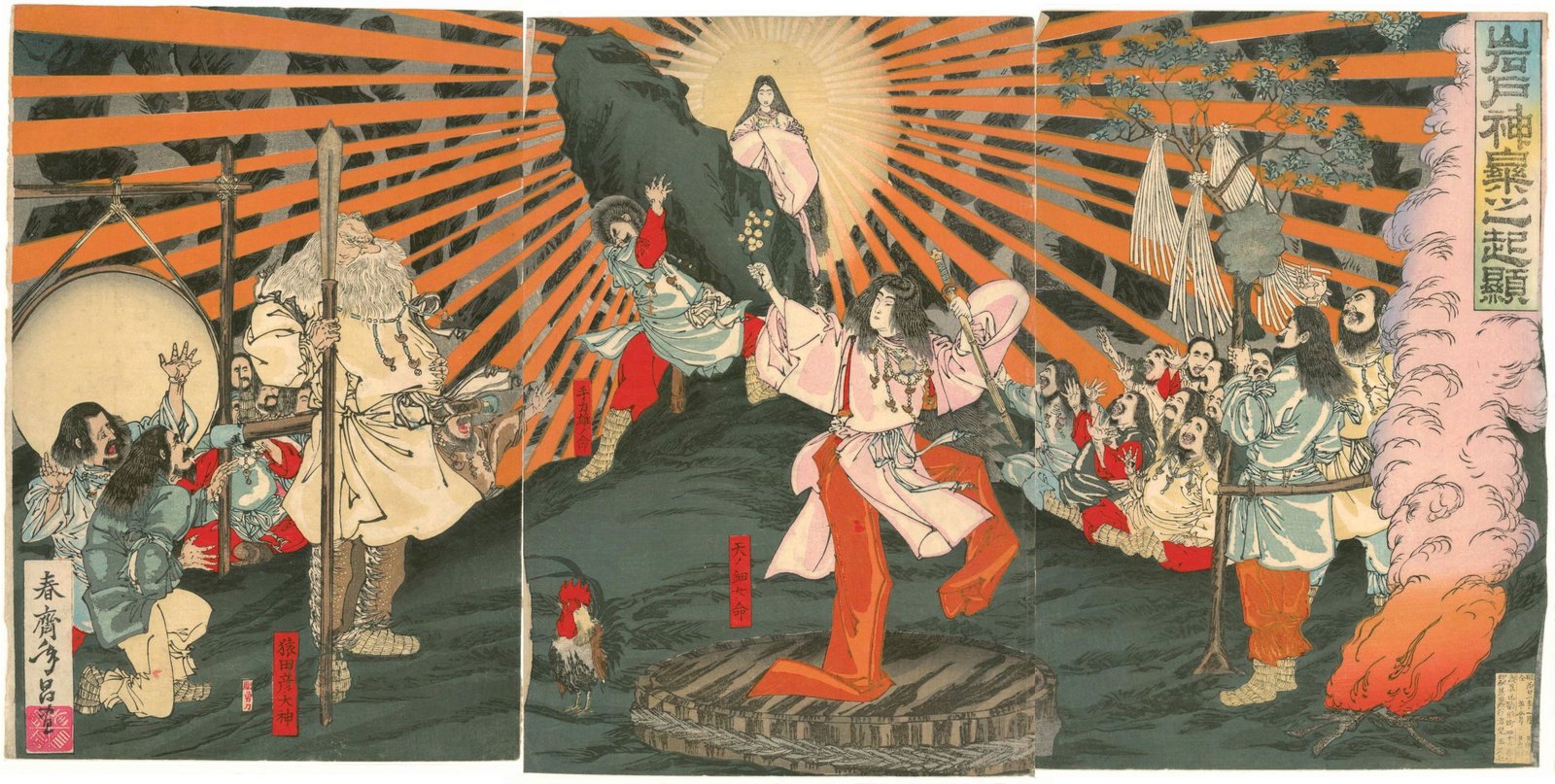
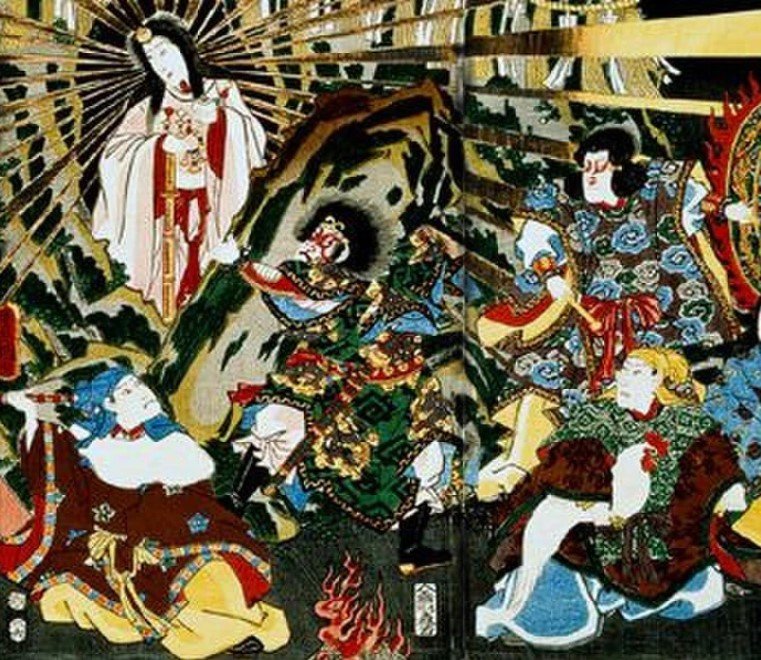
Getting her out took the whole assembly of gods and a fairly elaborate trick. On the advice of Omohi-Kane they set cocks outside the cave so their crowing would suggest that dawn had already come. They planted a large sakaki tree near the entrance and hung it with sparkling magatama jewels, fine white cloth and a mirror at its centre. Then the goddess Amenouzume danced so wildly outside the cave that the laughter of the other gods finally made Amaterasu curious enough to open the rock a crack, and while she stood distracted by her own reflection in the mirror, the strong god Ame-no-tajikara-wo hauled her out. Tuto-Tamu stretched a plaited straw rope behind her and told her flatly that she could hide no longer, and the world was bathed in sunlight again.
What the Cave Myth Symbolizes
The cave myth has no official meaning. No text in the tradition stops to explain what the cave stands for, so every reading of it is interpretation rather than doctrine. Four readings dominate:
- Seasonal renewal.
- An explanation of a solar eclipse.
- The winter solstice dressed as narrative, with the sun withdrawing to its weakest point and then being coaxed back.
- A social reading rather than an astronomical one: Susanoo breaks every rule of the celestial order, the order collapses into darkness, and it is restored only when the assembled gods perform the ritual correctly.
The social reading is the one that explains why the episode matters so much to Shinto practice. The objects used to lure her out, a mirror, jewels, white cloth on a sacred tree, a dance and a rope, are the same objects and gestures that shrine ritual still uses.
The Envoys Sent to Claim the Earth
Amaterasu needed three separate missions from heaven before the earth recognised her sovereignty, and the first two failed. She asked her son Ama-no-Oshiho-mimi to reign over the terrestrial kingdom and he refused: standing on Ama-no-hashidate, the bridge linking heaven to earth, he saw the disorder among the earthly deities and petulantly declined the job. Amaterasu consulted Taka-mi-Musubi, a council of all the gods was convened, and Ama-no-Hoki was sent down to assess the situation. Three years passed with no word from him.
A second council sends Ame-waka-hiko with a divine bow and arrows, and he proves no better. He is distracted into marrying Shita-teru-hime, daughter of the earthly ruler Oho-kuni-nushi, and forgets his mission entirely for eight years. When the gods finally send the pheasant Na-naki-me to find him, he reads the bird as a bad omen and shoots it on the spot. The arrow, being divine, passes through the pheasant and carries on up to heaven, landing at the feet of Taka-mi-Musubi, who throws it back down to earth, where it lands in the chest of Ame-waka-hiko and kills him.
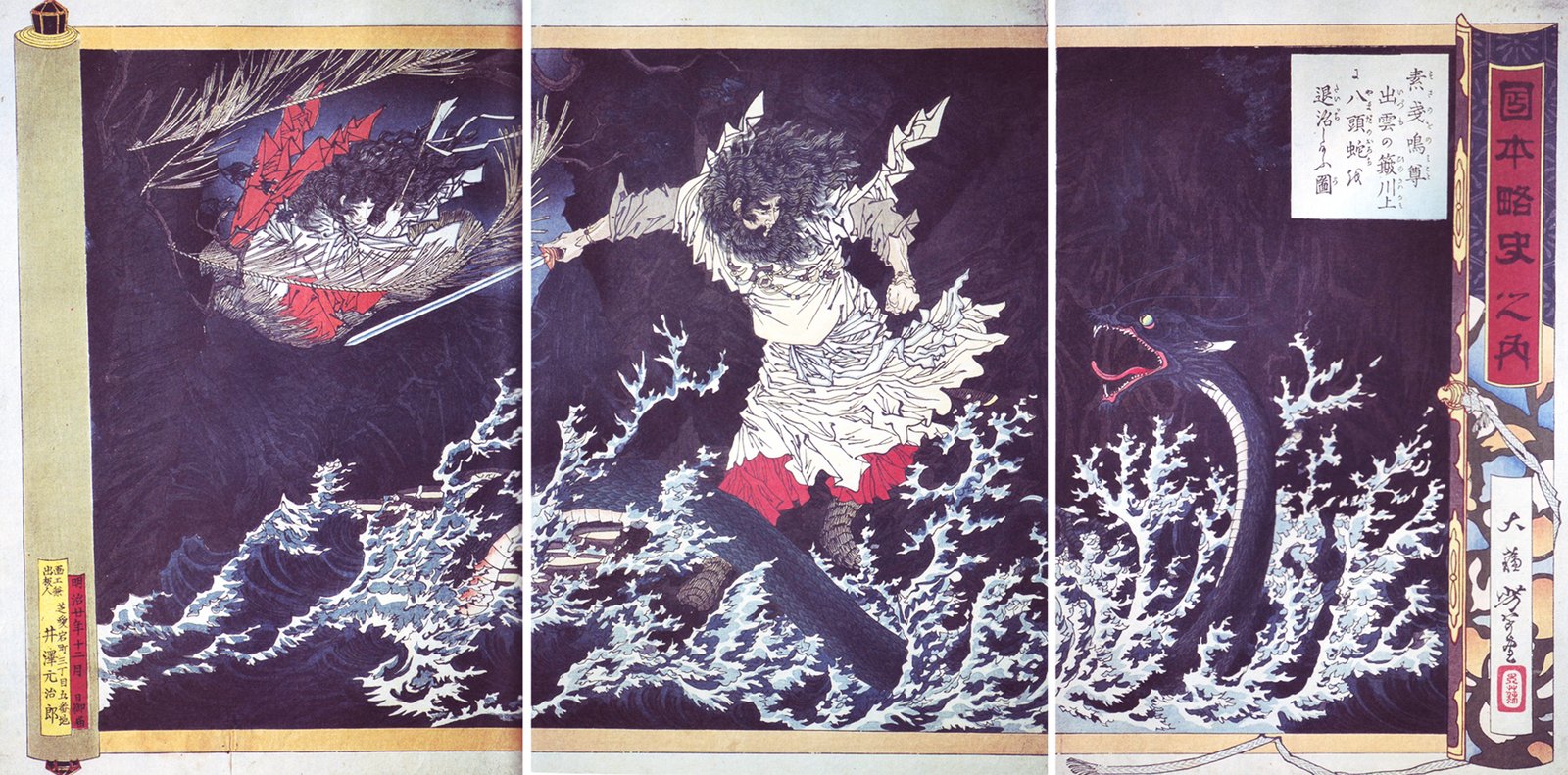
The third council finally sends gods equipped for the job: Take-mika-zuchi, the thunder god, and Futsu-nushi, the fire god, both armed with swords, to persuade Oho-kuni-nushi to recognise Amaterasu’s sovereignty over the earth as well as heaven. Oho-kuni-nushi consults his two sons, the elder Koto-shiro-nushi counselling peaceful concession and the younger Take-minakata advising resistance. Take-minakata fights Take-mika-zuchi, loses badly, and Oho-kuni-nushi hands over sovereignty and leaves to rule the underworld instead.
The Three Sacred Treasures and the Imperial Line
The three sacred treasures of Amaterasu are a mirror, a sword and a curved jewel, collectively sanshu no jingi, and they became the imperial regalia of the emperors of Japan. She handed them to her grandson Ninigi-no-Mikoto when she sent him down to govern the earth, after her son refused the job a second time and nominated Ninigi in his place.
| Treasure | What it is | Associated today with |
|---|---|---|
| Yata no Kagami | The mirror from the cave episode | Naiku, the Inner Shrine at Ise Jingu |
| Kusanagi no Tsurugi | The sword Susanoo took from a monster’s tail | Atsuta Jingu in Nagoya |
| Yasakani no Magatama | The curved jewel, or pearls, from the cave display | The imperial regalia in Tokyo |
The sword has the longest afterlife of the three. Atsuta Jingu, which was established to house it, describes Kusanagi as one of the three sacred treasures that symbolise the Imperial throne and dates its enshrinement there to roughly 1,900 years ago. The regalia mattered because of what they certified: the first Japanese emperor, Jimmu, who reigned from 660 to 585 BCE and founded the state in 660 BCE, was held to be a direct descendant of Amaterasu, and every emperor after him inherited that claim to divine ancestry and the absolute authority it justified.
Amaterasu and the Japanese Nobility
The Japanese noble houses traced their descent from Amaterasu through an exchange that happens before the cave episode. Amaterasu took Susanoo’s sword, broke it into three pieces, ate them and spat them out as three female deities. Susanoo took her necklace of 500 jewels, ate those, and spat out a mist from which five male deities formed. Those eight deities together were held to be the ancestors of the Japanese noble houses, which gave the aristocracy a genealogy running to the same source as the throne.
Ise Jingu, the Shrine Dedicated to Amaterasu
The main shrine dedicated to Amaterasu is Ise Jingu in Mie Prefecture, officially just Jingu, a complex of 125 individual shrines whose Inner Shrine, Naiku, is hers. Ise Jingu’s own account puts her enshrinement there at roughly 2,000 years ago, and explains that the Holy Mirror that stands for her sits inside the main sacred palace at the innermost courtyard, behind four rows of wooden fence, with public worship taking place at the third gate. The mirror was originally kept in the Imperial Palace and was moved to Ise during the reign of Emperor Sujin.
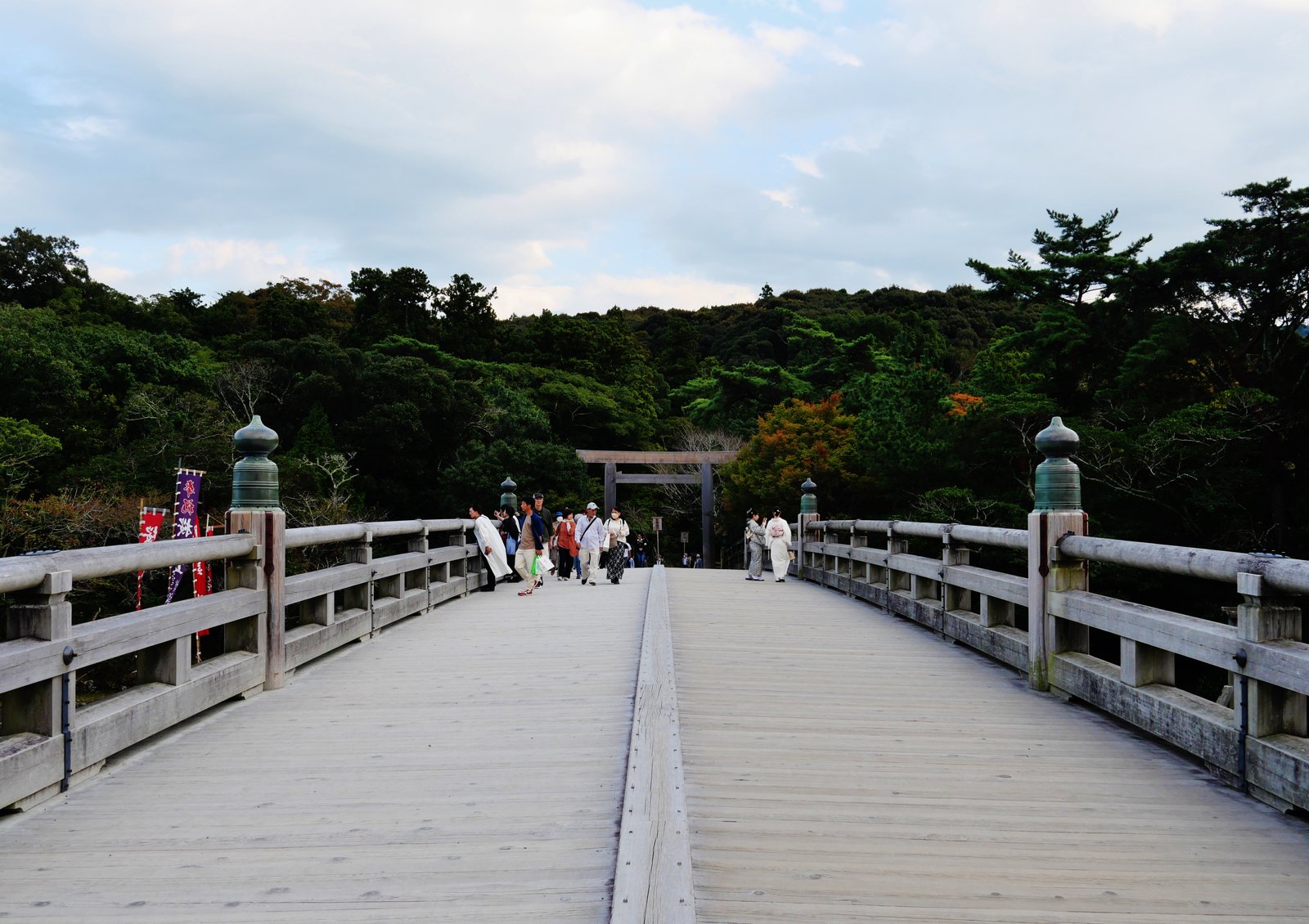
The buildings themselves are not meant to be permanent. Every twenty years the shrine is rebuilt on an adjacent site in the ritual called Shikinen Sengu, the bridge included, and the next cycle culminates in 2033. Two other places carry the cave myth on the ground: Amano Iwato Shrine in Takachiho, Miyazaki, which preserves the cave site, and Togakushi Shrine in Nagano, named for where the cave door is said to have landed.
Amaterasu, Inari and Kitsune: What the Link Actually Is
Amaterasu, Inari and foxes are three separate strands of Shinto, not a single chain of command, even though they turn up in the same conversations. Amaterasu belongs to the sun, the imperial tradition and the sacred mirror. Inari is a separate kami associated with rice and prosperity, and foxes are Inari’s messengers, not Amaterasu’s. The wider body of kitsune legend that grew up around those fox messengers is its own tradition again, and none of it reports to the sun goddess.
How Amaterasu Is Represented in Art
Amaterasu is identified in art by light itself rather than by an attribute she carries, usually as a burst of rays behind a robed figure at a cave mouth. Japanese art gives her a good-natured face, and often seats her back to back with her other brother, Tsukiyomi-no-Mikoto, the moon god. At Ise she is not depicted at all but represented by an object, the octagonal mirror called yata kayami.
Two birds belong to her. Cocks are associated with her because they herald the rising sun, and the raven yata garasu is treated as her messenger.
Her iconography therefore works differently from most of the pantheon. Where the wind god Fujin is recognisable by a specific attribute he carries, Amaterasu is recognisable by the light around her, which is why the same composition repeats across so many ukiyo-e triptychs.
Amaterasu in Modern Culture and Fashion
Amaterasu stays in circulation outside shrine ritual through two channels above all. The most widely seen modern version is the video game Okami, which casts her as its white wolf protagonist, and the cave scene remains one of the most reproduced subjects in Japanese woodblock printing, which is how most people meet her image before they meet her name.
That visual grammar is what makes her a natural motif on clothing. The sun disc, the radiating rays, the mirror and the rooster all read clearly at the scale of a print on a shirt, and the red and white of shrine ritual gives a palette that works without explanation. If you want a piece that carries this kind of ukiyo-e mythology rather than a generic graphic, Kamicrew’s ukiyo-e print shirts are built around exactly these old compositions.
FAQs
What does the name Amaterasu mean?
The name joins the characters for heaven and shining, so it is read as shining in heaven or the one who illuminates heaven. The fuller form, Amaterasu Omikami, adds an honorific meaning great august kami. Older texts also record her as Oho-hir-me-no-muchi and Amaterasu-oho-hiru-me.
Why did Amaterasu hide in the cave?
Her brother Susanoo wrecked her rice fields, defiled sacred spaces and finally threw a flayed horse into the hall where she was weaving. She withdrew into the heavenly rock cave and sealed it, and the world lost its light until the other gods tricked her into coming out.
Is Amaterasu related to the Japanese imperial family?
In the mythology, yes. She sent her grandson Ninigi-no-Mikoto to rule the earth with the three sacred treasures, and the first emperor, Jimmu, was held to be his direct descendant. Later emperors inherited that claim of divine ancestry, and Ise Jingu still describes Amaterasu as the ancestral kami of the Imperial family.
Where can you visit shrines connected to Amaterasu?
Naiku, the Inner Shrine at Ise Jingu in Mie Prefecture, is the main one. Amano Iwato Shrine in Takachiho, Miyazaki, preserves the cave site of the myth, Togakushi Shrine in Nagano is named for where the cave door landed, and Atsuta Jingu in Nagoya houses the Kusanagi sword.
Are Amaterasu and Susanoo enemies?
They are siblings who quarrel rather than sworn enemies. She exiles him from heaven after the weaving hall incident, but the sword he took from a monster’s tail becomes one of the three treasures she passes to her grandson, so the two of them stay tied together through the regalia.
Kamicrew Best Seller

Dont Touch Me Yokai Ukiyo-E Japanese T-Shirt
$25.49+
$29.99
(15% off)


Summer Vibes Salty Kawaii Japanese Hoodie
$44.99+
$49.99
(10% off)


Japanese Pin Horror 80s Retro Aesthetics T-Shirt
$25.49+
$29.99
(15% off)


El Gran Maja Japanese Kaiju T-Shirt
$25.49+
$29.99
(15% off)


Who Wants The Perfect Body Japan Capybara Kawaii Japanese Unisex Shirt
$25.49+
$29.99
(15% off)


Monster 8 Mask Vintage Animal Hoodie
$44.99+
$49.99
(10% off)


I Hate People Japanese Opossum Vintage Animal Hoodie
$44.99+
$49.99
(10% off)


I Got That Dog In Me Small Turtle Vintage Animal T-Shirt
$25.49+
$29.99
(15% off)

The Creation Of Cat Ukiyo-E Japanese T-Shirt
$25.49+
$29.99
(15% off)