
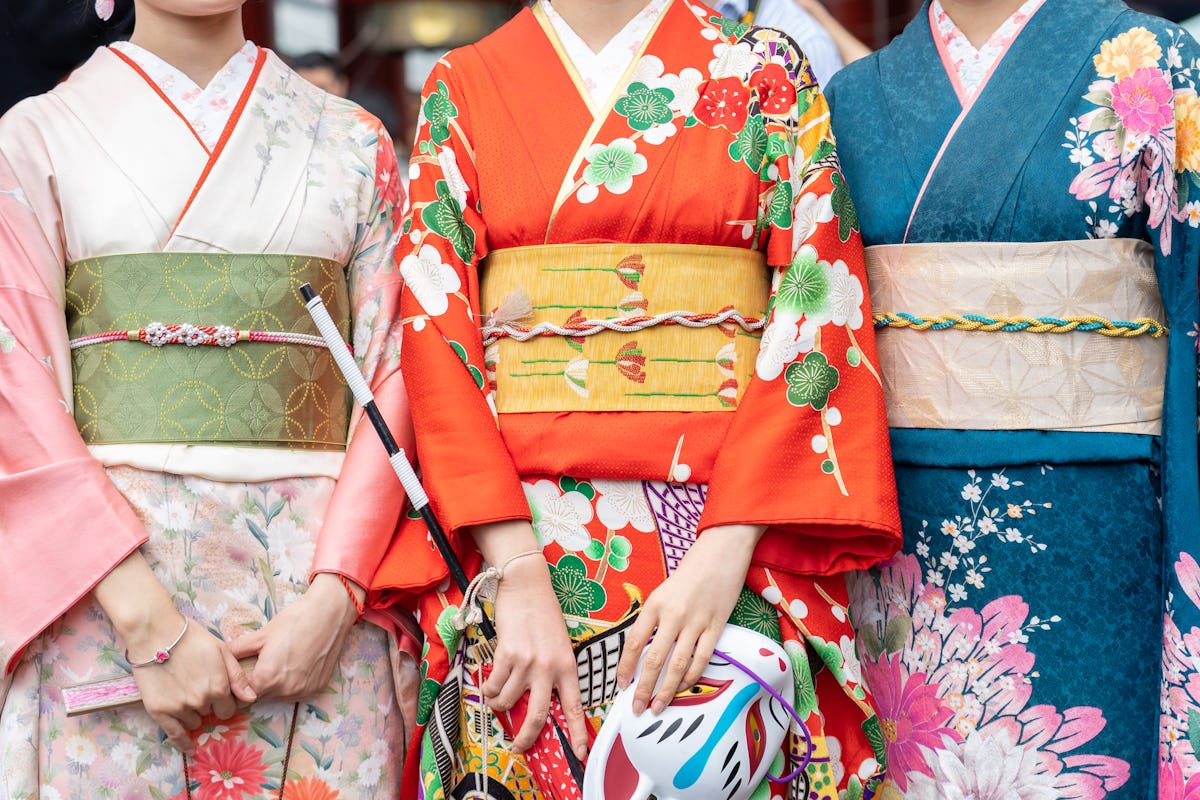
Wafuku (和服) is the umbrella term for traditional Japanese clothing. It covers the kimono and the summer yukata, the pleated hakama worn over them, the obi that holds everything closed, and the wooden geta and split toe tabi socks underneath. The word exists because it has an opposite: yofuku (洋服), Western clothing. Wafuku is cut in straight lines and tied onto the body, while yofuku is cut on curves and sewn to fit.
Before Japan reopened its ports in the 1860s nobody needed to draw that line, because there was only one way to dress. The position is now reversed: yofuku is what Japan wears daily, and wafuku appears on set occasions.
What wafuku means
The two characters split the same way yofuku does on the other side of the pairing: 和 (wa) for Japan sits opposite 洋 (yo) for the West, while 服 (fuku), clothing, stays fixed in both words. Shops and older speakers favour a third term for the same category, gofuku, a holdover from when the goods in question were sold as bolts of silk rather than finished garments.
Between them, wafuku and yofuku account for everything worn in Japan: traditional dress on one side, including the national dress, and on the other side everything not recognised as national dress or as the dress of another country.
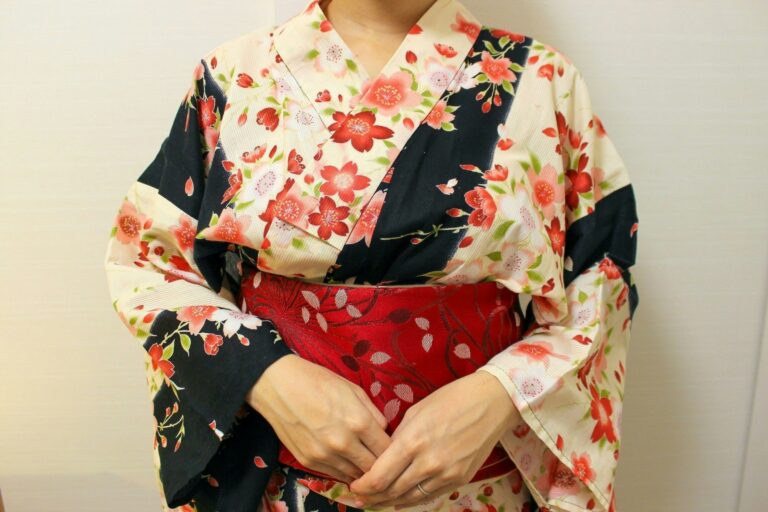
In loose usage wafuku is simply called kimono. That habit causes most of the confusion, because kimono is one member of the category rather than the category itself, and the word translates as nothing more specific than “thing to wear” or “thing worn on the shoulders”. Kimono also is not a single garment: the named types of kimono run from the most formal black crested robe down to a patterned everyday komon, and the differences sit in fabric, crest count, and where the pattern falls.
The category is broader than mainland tradition alone. The Ainu of Hokkaido have their own garment, the attus, and Ryukyuan dress, ryuso, is built from island fabrics including bingata stencil dyeing and airy bashofu woven from banana plant fibre, both documented by the Kyoto National Museum.
What separates wafuku from yofuku
Wafuku is cut in straight lines from flat panels and fitted to the wearer by wrapping the cloth and tying it. Yofuku is cut on curves and sewn to a body shape.
| Wafuku | Yofuku | |
|---|---|---|
| Cutting | Straight lines, flat panels | Curved cutting, shaped |
| Fit | Wrapped and tied on the wearer | Sized and sewn to fit |
| Fastening | Himo ties plus an obi | Buttons, zips, elastic |
| Pockets | None, items hang from the obi | Built into the garment |
| Wrap | Left over right, always | Not applicable |
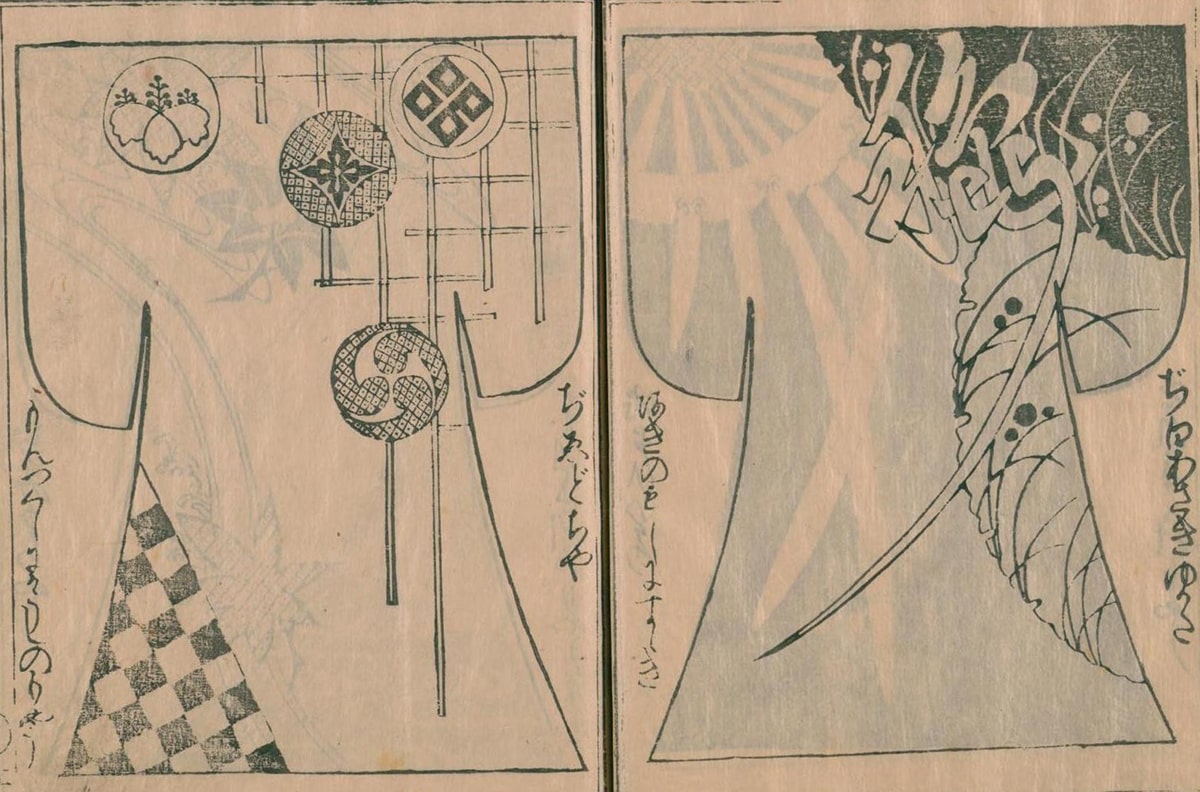
The difference is structural, not decorative. Western clothing is finished three dimensionally so that it sits close to the body. Wafuku is fixed onto the body instead, by wrapping the cloth and tying it with an obi. Nothing is shaped to a waist or a shoulder, which is why one garment can fit a range of very different bodies: the fitting happens when you put it on, not when it is sewn.
A kimono starts as a single bolt of fabric called a tanmono, cut to standard dimensions, and the whole bolt goes into one garment. The finished robe is four main strips, two covering the body and two forming the sleeves, plus narrow front panels and a collar, running roughly 39 to 43 inches long. Traditional construction is hand sewing, a technique called wasai, and even machine made kimono still need a good deal of it.
Fastening works differently too. There are no buttons, no zips, and no pockets anywhere, so flat ties called himo hold the layers and the obi goes on last. Modern obi are stiff enough that they no longer really hold the robe shut; the himo do that. Because there is nowhere to put anything, small containers hang from the obi on a cord instead. One rule has no exceptions: the left side wraps over the right, a convention fixed by the Yoro clothing code in 718 CE in imitation of Chinese practice, and reversed only when dressing the dead. For the lower body, pleated hakama trousers go over the kimono and raise the formality of the whole outfit.
How wafuku developed, from Yayoi to Meiji
Wafuku developed from unshaped Yayoi period garments tied at the waist and shoulders, through the small sleeved kosode of the Kofun and Heian periods, into the kimono silhouette that appeared once commoners began wearing the kosode on its own. The Edo period elaborated it. The Meiji era replaced it for daily wear.
| Period | Key garment | What changed |
|---|---|---|
| Yayoi | Kantoi, wrapped cloth | Unshaped cloth tied at the waist |
| Kofun | Early kosode | Tubular sleeves, right over left |
| Heian | Sokutai, junihitoe, kosode | Layered court robes, then kosode alone |
| Edo | Kosode, furisode | Wider obi, longer sleeves, new dyeing |
| Meiji | Yofuku uniforms | Western dress takes over daily wear |
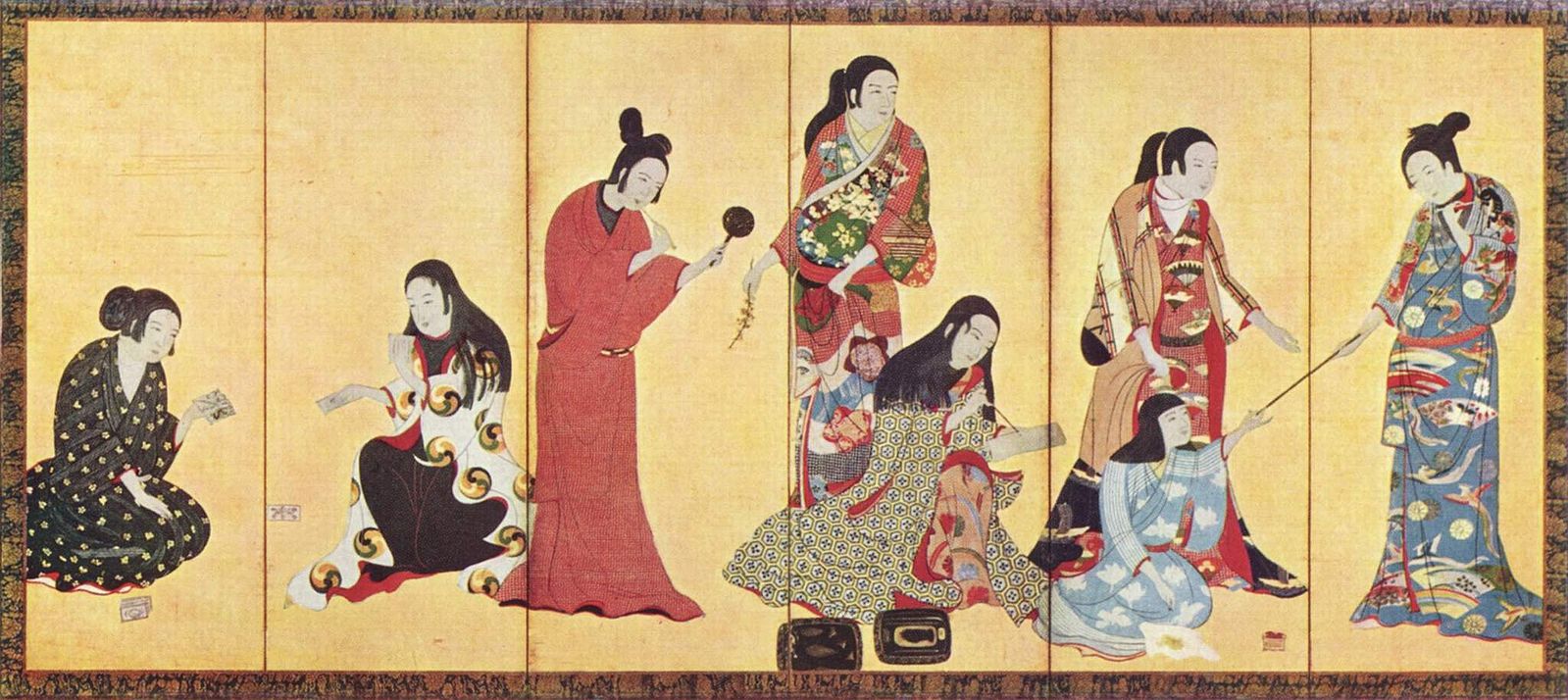
The earliest written description of clothing in Japan is not Japanese. The third century Chinese Wei Zhi, reporting on the Yayoi period, describes broad cloth made into unshaped garments tied about the waist and shoulders: men wrapped a single length of cloth around the body, women wore a kantoi, a garment pulled on over the head. Neither looks like wafuku yet. Sew sleeves onto a kantoi, move its opening to the front, and belt the torso, and you are most of the way there, which is thought to be roughly how wafuku came about.
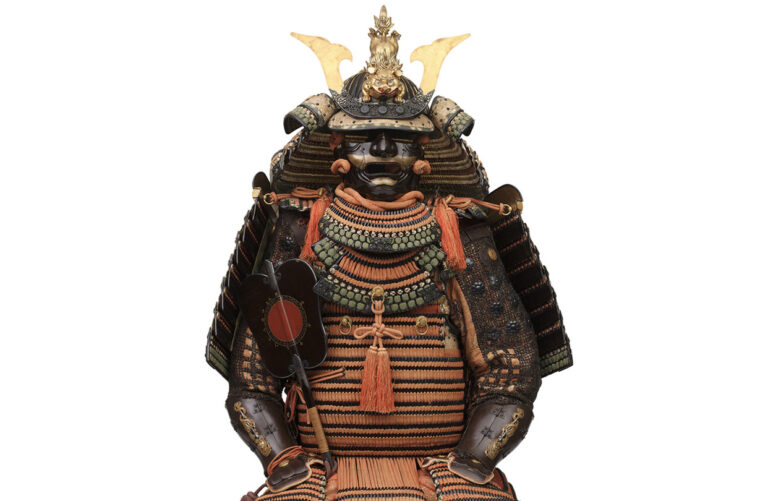
By the Kofun period the clay haniwa figures placed on burial mounds show garments resembling the kosode, the small sleeved robe that later became the base of the kimono. Sleeves and trousers were tubular, wrapped mo skirts were worn by both sexes and sometimes went over hakama, and at this stage the right side still wrapped over the left. Many of the figures wear armour, so they probably show riding or ceremonial dress rather than what anyone wore to work.
Heian Japan stopped sending envoys to the Tang court, imported goods dried up, and the vacuum produced kokufu culture, a self contained court style. Aristocrats who did not move much wore loose layered robes, hakama below and layer upon layer above, formalised as the sokutai for men and the junihitoe for women; the layered court wardrobe has been reconstructed in detail by the Costume Museum in Kyoto. Commoners meanwhile paired a kosode with hakama, and the yukatabira, a garment nobles put on for steam baths, is thought to be the ancestor of the yukata.
Late in the Heian period commoners began dropping the hakama and wearing the kosode alone in a flowing kinagashi style. That is the moment the kimono silhouette arrives. As the warrior class gained power its plainer taste carried weight, and kosode with hakama became formal dress rather than working dress. The Edo period then turned the kosode into a canvas: new weaving and dyeing methods, sleeves growing longer, the obi growing much wider, and the furisode emerging from that trend. Sumptuary laws banning purple, red, gold embroidery and intricate shibori for the lower classes pushed wealth into subtler display, the aesthetic called iki.
Then came Meiji. Policemen, railway workers and teachers were put into Western uniform, students followed, and wafuku fell out of daily use in favour of yofuku. Silk got cheaper at the same time, so the variety of wafuku actually widened even as fewer people wore it every day. The two words became a pair precisely because there were suddenly two wardrobes to choose between.
The main families of wafuku
Wafuku divides into three layers: garments wrapped around the body, among them the kimono, yukata, furisode, hakama and haori; footwear, including geta, zori and tabi; and accessories carried on the obi, from kanzashi hair ornaments to inro cases and folding fans.
Garments
- Kimono, the generic robe, always worn with an obi, with formality set by fabric, decoration and the number of family crests
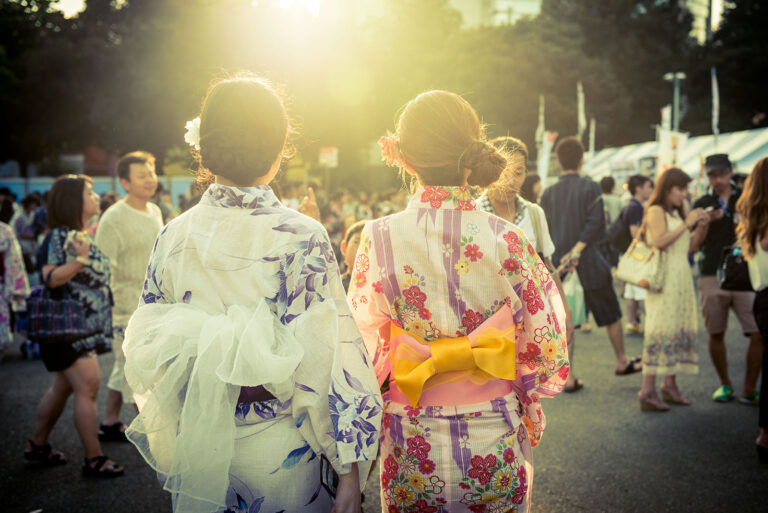
- Yukata, an unlined cotton or linen version worn by men and women at summer festivals and around hot springs
- Furisode, a formal kimono with sleeves that can pass a metre in length, worn by young unmarried women at coming of age ceremonies
- Tomesode and homongi, formal women’s kimono distinguished by how far the painted pattern climbs above the waist
- Hakama, long pleated trousers worn over the robe, once samurai and noble dress and now seen on martial artists, Shinto priests and graduating students
- Haori, a loose jacket, usually plain on the outside and originally menswear before women took it up
- Samue and jinbei, monks’ work clothes and summer loungewear respectively, both now sold as going out clothes
The two wardrobes part company at the level of naming: women’s traditional wear carries a long ladder of separately named formality grades, while men’s traditional wear varies mostly by fabric, crest count and whether hakama are worn at all.
Footwear
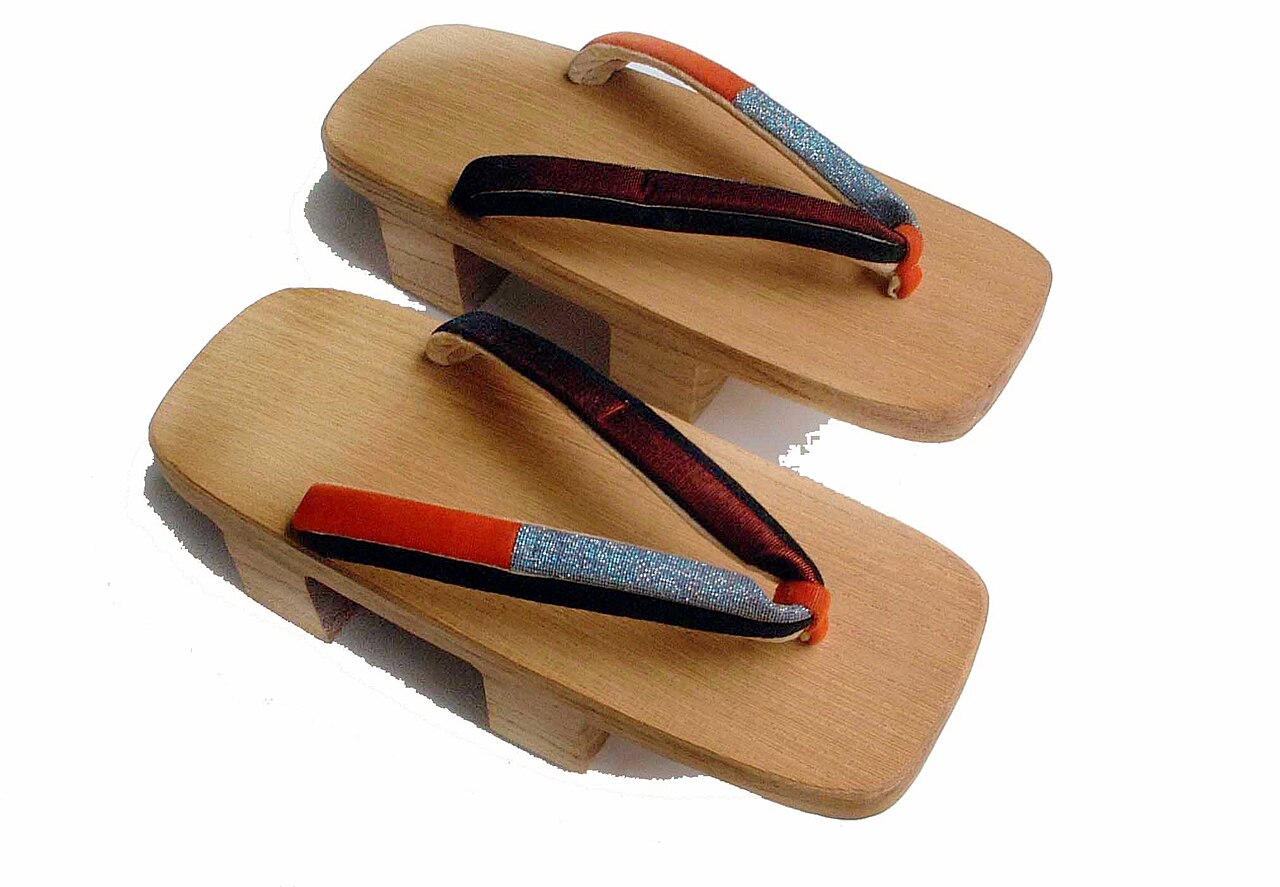
- Geta, wooden sandals, often raised on ha (teeth) that keep the feet clear of rain and snow
- Zori, flat soled sandals whose straps, called hanao, get embroidered and metallic on formal pairs
- Tabi, ankle socks with the big toe split off, closed with metal fasteners at the back
- Jika-tabi, rubber soled split toe shoes invented for workers in the early twentieth century
- Waraji, rice straw sandals laced at the ankle
- Okobo, tall platform sandals worn mainly by maiko, with strap colour signalling how experienced the wearer is
Accessories
- Obi, the sash, where the knot type and whether it sits front or back once read as a statement of social status
- Kanzashi, hair ornaments ranging from a plain pin to elaborate silk, metal or tortoiseshell pieces
- Sagemono, literally hanging things, the compartmented inro case, the drawstring kinchaku bag and the slim kiseru pipe, all suspended from the obi by a cord stopped with a carved netsuke
- Sensu and uchiwa, the folding and rigid fans, still standard for kabuki and noh performers
- Wagasa, a handmade umbrella of oiled washi paper stretched over 30 to 70 bamboo ribs
When wafuku is worn in Japan today
Wafuku is occasion dress in Japan today rather than daily wear. It appears at coming of age ceremonies, weddings, funerals, memorial services, graduations, the New Year period, and Shichi-go-san for children aged three, five and seven, and most often as a cotton yukata at summer festivals. Geisha, maiko and sumo wrestlers wear it as professional dress.
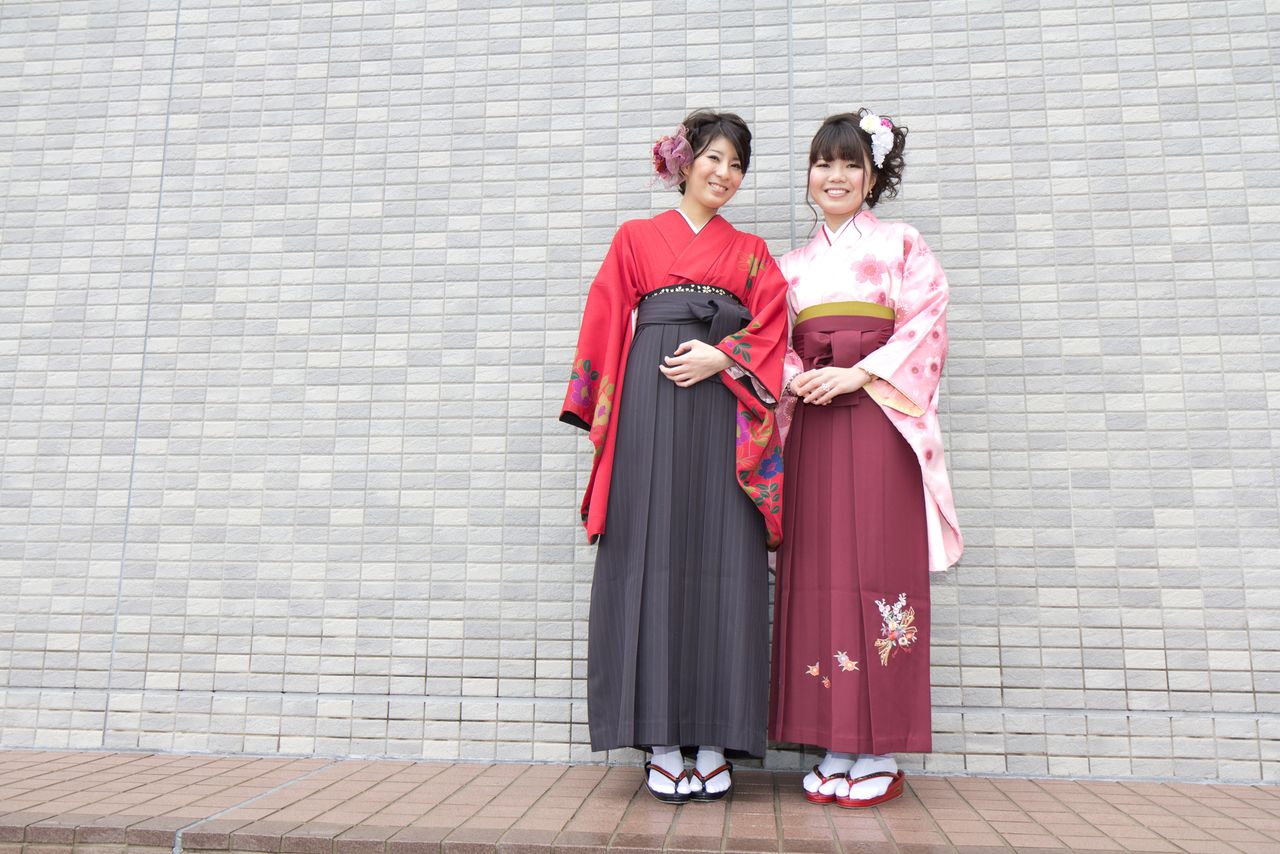
Many families still keep one formal kimono passed down for exactly these dates rather than buying new for each event, with rental shops filling the gap for everyone else and turning the tradition into part of the sightseeing experience, particularly in Kyoto.
The cotton yukata wins out over a lined kimono in summer heat mainly because it breathes and launders easily after a night of festival food and standing crowds, which is also why it is the one piece of wafuku most first time visitors try on themselves.
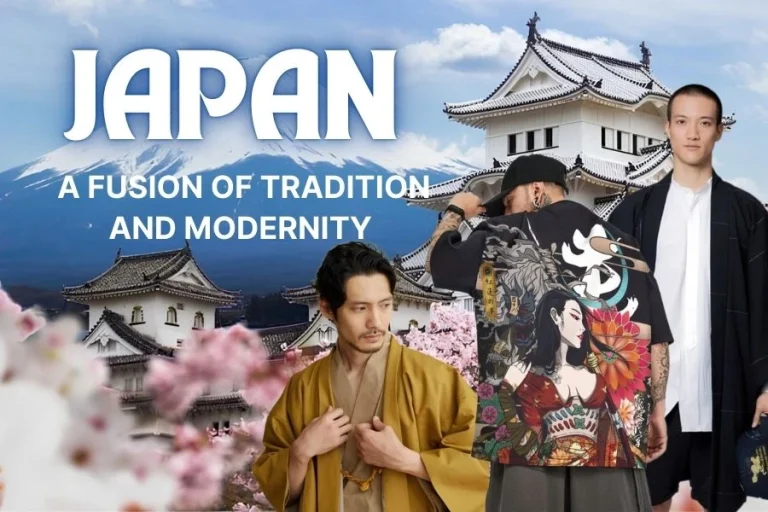
Traditional clothing in Japan has a reputation for being difficult and expensive, and the elaborate rules behind that reputation apply to formal dress only. Worn as everyday clothing there are no complicated rules at all, and Edo period townspeople were known for walking around in a deliberately relaxed, slightly undone version. Rental shops now stock lace kimono, and some makers cut wafuku from denim, so the category is loosening again rather than closing.
Kamicrew designs shirts, hoodies and kimono style jackets around the same visual language that ran across Edo period kosode. If a full traditional outfit is more than you want to commit to, carrying cranes, waves and ukiyo-e scenes on everyday clothes is a smaller way into the same tradition.
Kamicrew Best Seller

Dont Touch Me Yokai Ukiyo-E Japanese T-Shirt
$25.49+
$29.99
(15% off)


Summer Vibes Salty Kawaii Japanese Hoodie
$44.99+
$49.99
(10% off)


Japanese Pin Horror 80s Retro Aesthetics T-Shirt
$25.49+
$29.99
(15% off)


El Gran Maja Japanese Kaiju T-Shirt
$25.49+
$29.99
(15% off)


Who Wants The Perfect Body Japan Capybara Kawaii Japanese Unisex Shirt
$25.49+
$29.99
(15% off)


Monster 8 Mask Vintage Animal Hoodie
$44.99+
$49.99
(10% off)


I Hate People Japanese Opossum Vintage Animal Hoodie
$44.99+
$49.99
(10% off)


I Got That Dog In Me Small Turtle Vintage Animal T-Shirt
$25.49+
$29.99
(15% off)

The Creation Of Cat Ukiyo-E Japanese T-Shirt
$25.49+
$29.99
(15% off)