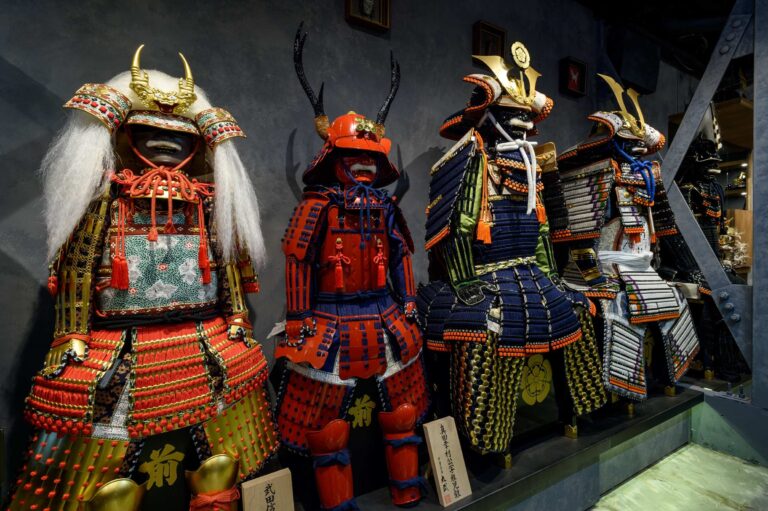

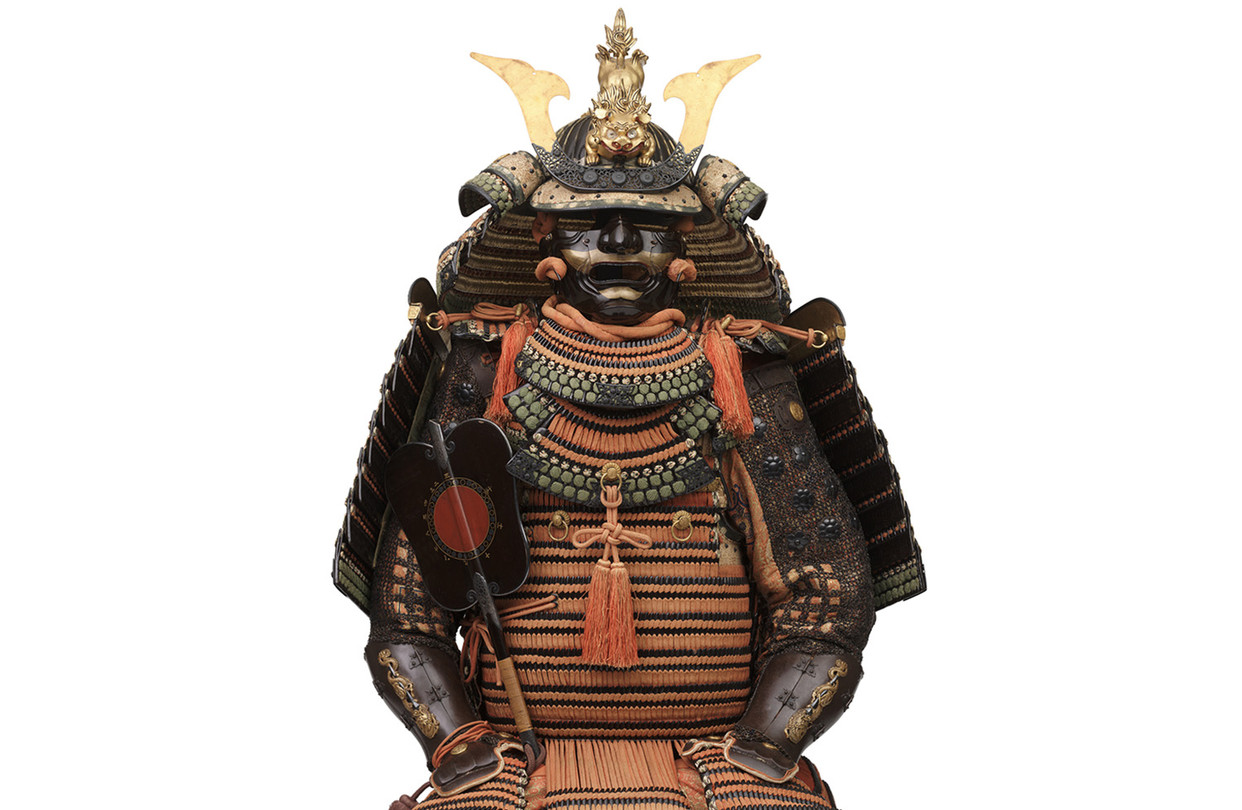
A suit of samurai armor is an assembly of separately made pieces, not a single garment, and nine of them carry the main coverage: the kabuto (helmet), mengu (face armor), dou (cuirass), kusazuri (plated skirt), sode (shoulder guards), kote (armored sleeves, ending in tekko hand plates), haidate (thigh guards), suneate (shin guards) and kogake (armored foot covers). The complete assembled set is called a gusoku. Everything beyond those nine is a filler plate, an under-layer, or a piece of identifying gear tied onto the same frame.
Most of these names describe a job rather than a shape, which is why the same part can look completely different across two suits. A dou from the Heian period and a dou made after firearms reached Japan are both cuirasses, and almost nothing else about them matches.
What a full suit of samurai armor is called
Individual styles of gusoku carry their own names: o-yoroi for the heavy armor worn on horseback, do-maru for the lighter suit worn on foot, and tosei-gusoku, literally modern armor, for the simplified style that appeared once matchlocks changed Japanese warfare.
Grouped by the area they cover, the parts fall into three bands: head and face, torso, and limbs. Museum catalogue entries describe a single suit in the same terms, listing the facemask, helmet, throat protector, hand and arm guards, leg guards and boots as separate features of one object.
| Part | What it is | What it protects |
|---|---|---|
| Kabuto | Helmet | Skull and crown |
| Mengu | Face armor | Face, jaw and throat |
| Dou | Cuirass | Chest and torso |
| Kusazuri | Plated skirt | Hips, groin and upper leg |
| Sode | Shoulder guards | Shoulders and upper arms |
| Kote | Armored sleeves | Arms and forearms |
| Haidate | Thigh guards | Thighs |
| Suneate | Shin guards | Shins and calves |
| Kogake | Armored tabi | Tops of the feet |
Kabuto: the helmet and its fittings
The kabuto is the samurai helmet, a bowl of iron or leather plates riveted together, ranging from three plates on plain examples to well over a hundred on the most elaborate. Hanging from its bottom edge is the shikoro, the flared neck guard that takes a cut aimed at the nape.
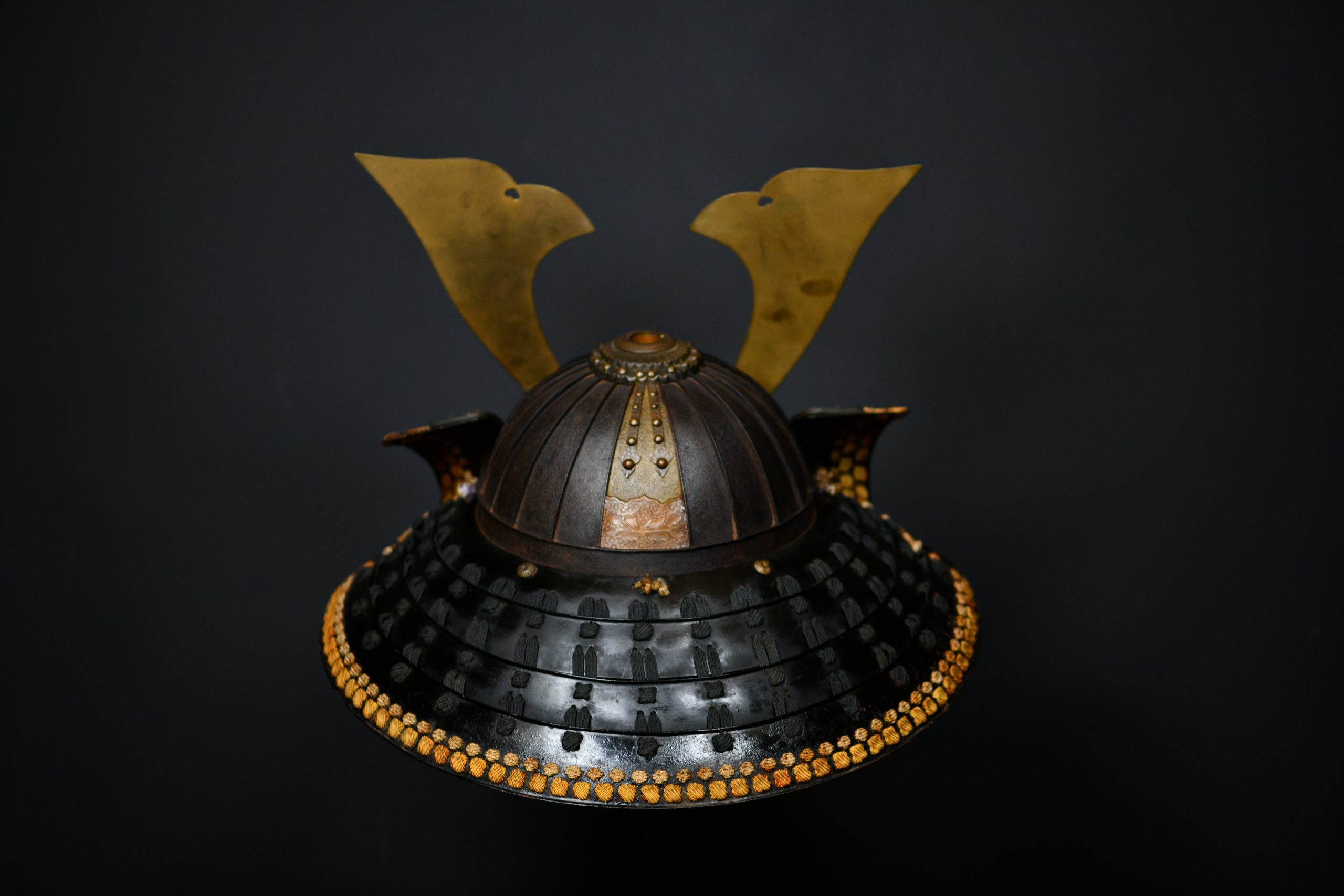
A nineteenth-century construction diagram of samurai armor names the smaller helmet fittings individually, and those names are the ones collectors and museums use on their labels:
- Mabisashi, the forehead plate riveted across the front of the bowl, acting as a brow visor.
- Fukikaeshi, the lames at the sides of the shikoro turned back into wing-like flanges beside the temples.
- Maedate, the front crest, mounted at the centre of the brow. A sun disk is one recorded example.
- Wakidate, the side crests rising from the temples. Water buffalo horns appear in the same diagram.
- Kasa-jirushi, a small identification badge worn on the back of the helmet.
The helmet carried meaning beyond protection. A Japanese proverb, katte kabuto no o o shimeyo, translates as tighten the string of the kabuto after winning the war, a warning against dropping your guard once a fight is over.
Mengu: face armor and throat guards
Mengu is the collective term for lacquered metal or leather facial armor in a suit of samurai armor. It shields the face and jaw, anchors a top-heavy kabuto to the head through metal posts, and carries its own throat defence in the yodare-kake hanging from the lower edge of the mask.
The mask was not only defensive. Because the kabuto could be tied and secured to it, the helmet and the face armor worked as one unit rather than two accessories. Typical designs leaned into intimidation, with moustaches, sharp teeth and demonic eyes worked into the face.
The yodare-kake itself is made from several rows of iron or leather plates, or from kusari (chain armor) sewn to a cloth backing. Separate throat and neck pieces existed too, including the nodowa and the guruwa. For lighter or improvised protection there were hachi-gane, also called hitai-ate, portable forehead plates worn without a full helmet.
Dou: the cuirass at the core of the suit
The dou is the cuirass, the main body of samurai armor, made from iron and leather plates of various sizes and fitted over the chest. Every other part attaches to it or hangs from it. Cuirasses are classified by how many sections they divide into, so a five-piece and a two-piece cuirass are different constructions of the same part.
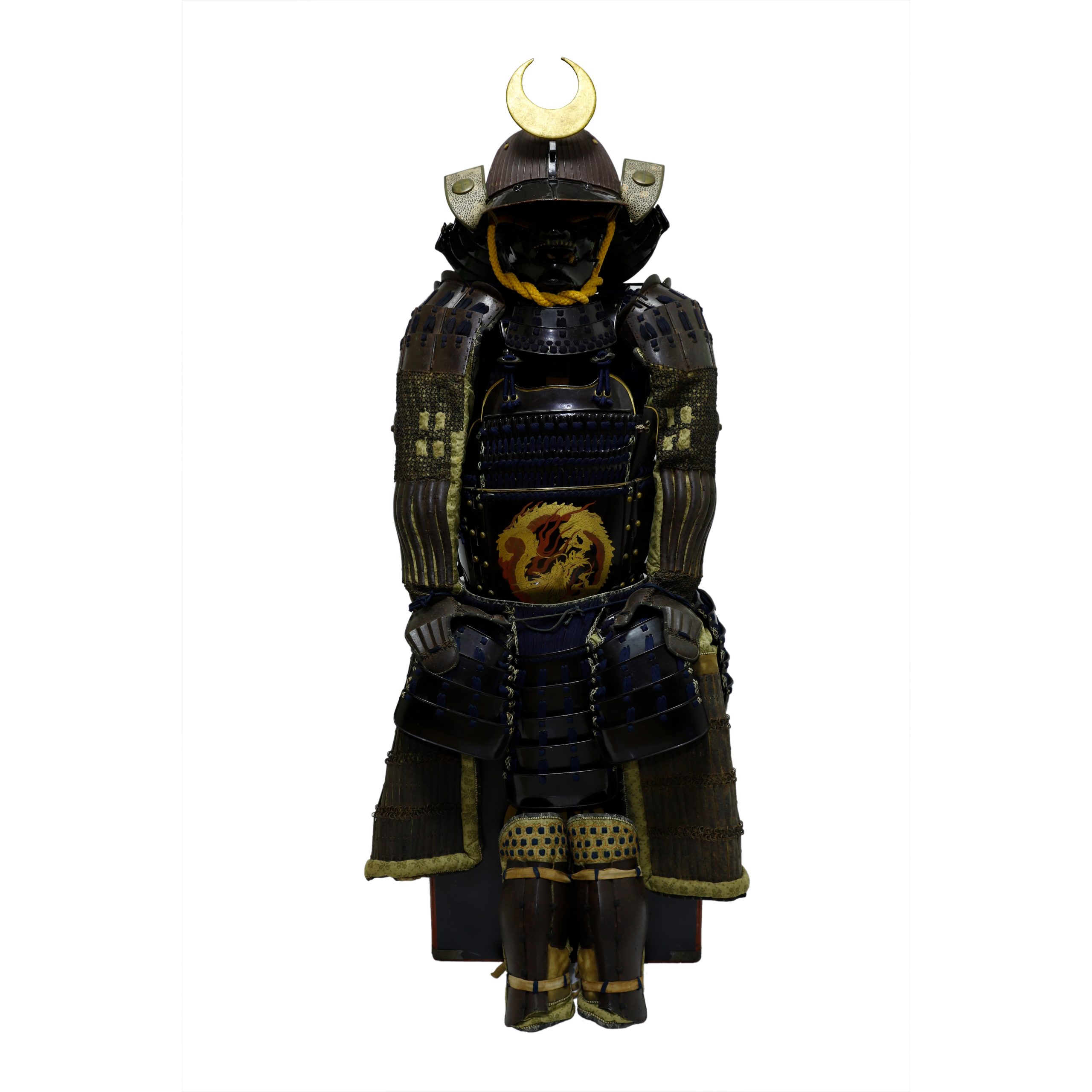
Leather straps called nerigawa held the structure together, and lacquer was applied over the surface to weatherproof it against a climate that would otherwise destroy iron and silk. Once armorers moved to large single plates the dou stopped flexing, and suits were given hinges so the wearer could open and close the armor to get into it. The most extreme version was the nanban do gusoku, where front and back were each a single iron plate with a raised centre and a V-shaped bottom, copied from Portuguese plate armor. How a suit was laced and finished also signalled who was wearing it, and the relationship between samurai rank and armor lacing is a subject in its own right.
Kusazuri, haidate, suneate and kogake: hips to feet
Below the cuirass, samurai armor works down the leg in four stages: kusazuri, then haidate, then suneate, then kogake, with the tateage plate sitting at the knee between thigh and shin. What separates them is how each one is built and fastened.
- Kusazuri is built from iron or leather plates hung in rows from the front and the back of the dou.
- Tateage is the Japanese name for what European armor calls a poleyn.
- Haidate is cloth first: small iron or leather plates are usually joined to each other by kusari, then sewn down to the fabric, and the finished guard ties around the waist.
- Suneate uses iron splints connected by kusari and sewn to a cloth backing that ties around the calf.
- Kogake follows the Japanese split-toe cut, and was worn with cotton linen waraji-gake-tabi socks laced into the sandals for comfort.
Sode, kote and tekko: shoulders, sleeves and hands
Sode are the large rectangular shoulder guards of iron or leather plates attached to the upper part of the dou, and on the heaviest suits they are big enough to work as a mobile shield for the arm that draws a bow. Kote are the armored sleeves below them, closed off at the wrist end by the tekko.
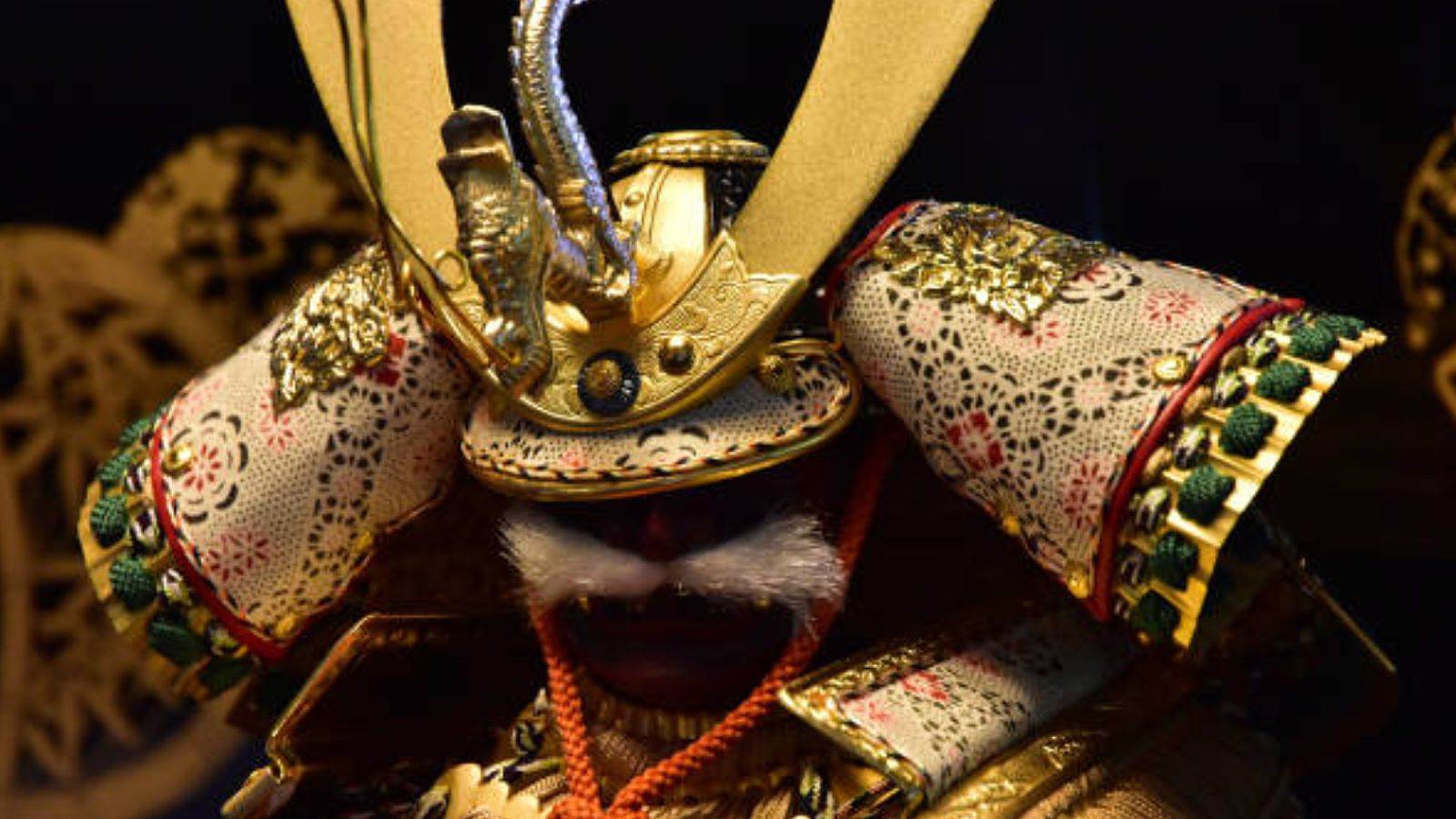
The kote are shaped like long gloves that reach up to the shoulder, made from cloth faced with iron plates of various sizes and joined by kusari, often with silk brocade and inner quilting. A shorter variant, han kote, covers only the forearms. A small shoulder badge, the sode-jirushi, could be worn alongside the sode for identification.
Under-armor and gap-filling pieces of a gusoku
A suit of gusoku also includes secondary pieces that rarely appear in a simple parts diagram, because they sit under or between the main armor. Padded collars, armpit guards, armored vests and cloth garments faced with chain or small plates all belong to this group, and several exist to make the weight of the dou bearable rather than to add coverage.
- Tate-eri, a small padded piece like a pillow with a standing armored collar, worn on the shoulder so the weight of the dou does not sit directly on the body. The collar was lined with kikko armor to guard the neck.
- Manju no wa, shoulder pads, collar and armpit guards combined into one garment that covers the upper chest, faced with kusari, karuta plates or kikko. Worn, it looks like a small tight-fitting vest with wings that pass under the armpits from the back.
- Manchira, a larger armored vest covering the chest and sometimes the neck and armpit. Some versions were worn over the dou rather than under it.
- Wakibiki, a rectangle of armored cloth, or a single piece of iron or hardened leather, hung from the shoulder by cords to cover the exposed armpit.
- Yoroi zukin, cloth hoods with armor sewn to them, along with yoroi katabira jackets and yoroi hakama trousers built the same way. The armor could be exposed or hidden between layers of cloth.
- Kusari gusoku, full suits of Japanese chain mail, used where flexibility mattered more than plate coverage.
Foot soldiers were equipped differently. Ashigaru retainers were issued the jingasa, a war hat resembling a civilian conical hat, made from metal or leather instead of a full kabuto.
How samurai armor changed over time
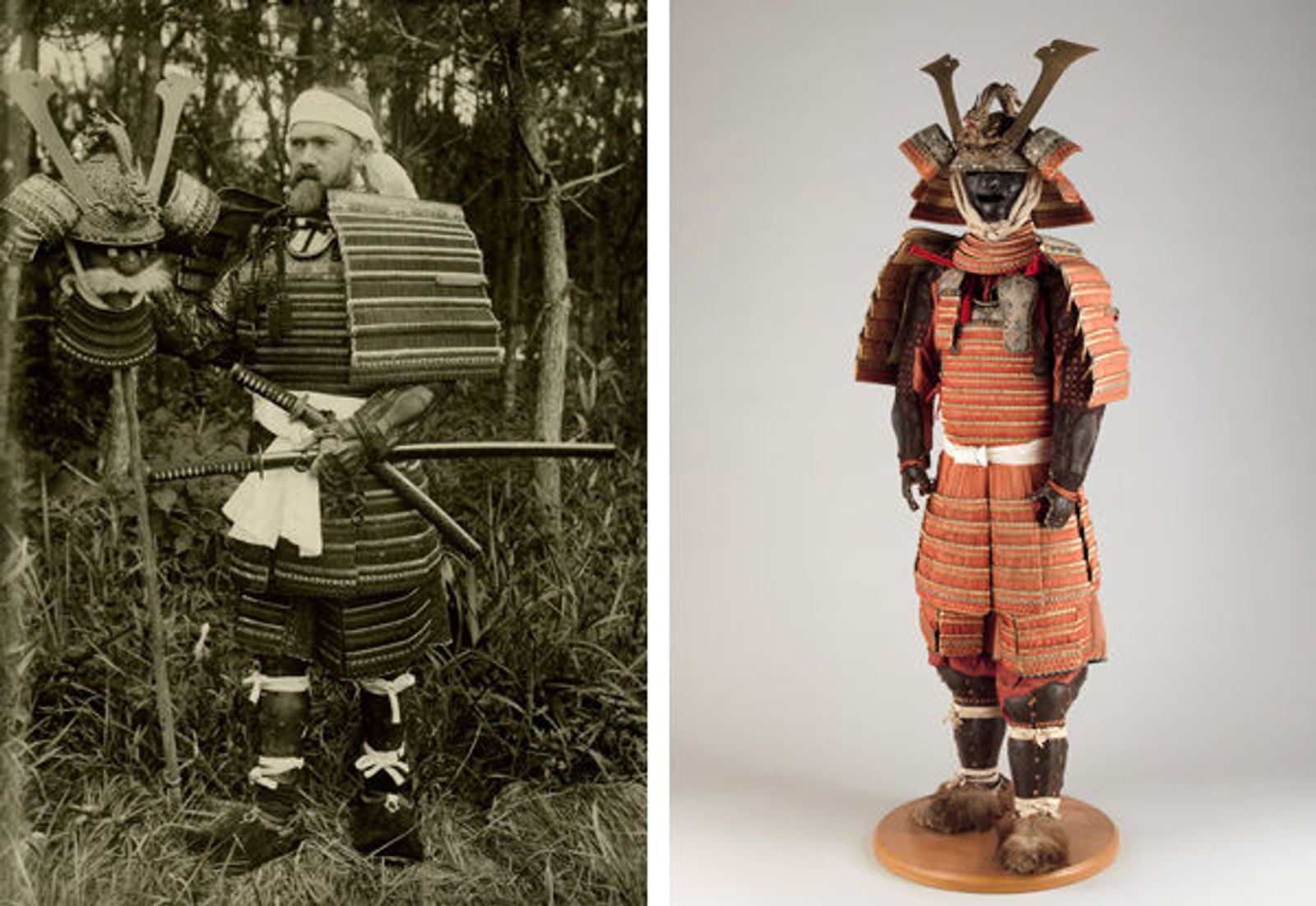
Japanese body armor predates the samurai class by centuries, with cuirasses and helmets being made as early as the fourth century. From there the story runs in three moves: a heavy laced suit for mounted archers in the Heian period, lighter builds for men who fought on foot from the Kamakura period onward, and a stripped-down suit made to survive a bullet after matchlock firearms reached Japan in 1543.
| Period | Armor types | What changed |
|---|---|---|
| From the fourth century, before the samurai | Tanko, keiko | Iron plates connected by leather thongs; keiko added upper torso protection for cavalry |
| Heian, 794 to 1185 | O-yoroi, do-maru | The cuirass settled into the form known as the dou |
| Kamakura | Hara-ate, haramaki | Minimal armor covering only the front of the torso and the sides of the abdomen, then extended around the back |
| Nanboku-cho | Haramaki with added parts | Demand for light, cheap armor rose as ashigaru and conscripted farmers fought on foot; kabuto, face armor and kote were added on top |
| Muromachi | Sugake odoshi lacing, iyozane scales | Lacing and scale overlap reduced to speed up production |
| From 1543 | Tosei-gusoku, nanban do gusoku, tameshi gusoku | Armor lightened, simplified and bullet-tested after matchlocks arrived through the Nanban trade |
| Edo to 1877 | Gusoku as formal dress | Armor worn mainly as a marker of status; last recorded use in the Satsuma Rebellion |
Muromachi armorers simplified production. Dense kebiki odoshi lacing, which covered the entire surface of the scales with cord, was joined by sugake odoshi, where only two cords connect the scales. Scale overlap was reduced in the same spirit, with the new iyozane overlapping a quarter of each scale where traditional honkozane overlapped half.
Firearms forced the last big change. Matchlocks were mass-produced in Japan within a few years of arriving, so armor had to be lighter, faster to make and better at stopping a bullet. Tosei-gusoku was developed from the do-maru design, plate-style nanban do gusoku imitated European armor, and bullet-tested suits called tameshi gusoku let samurai keep wearing armor at all. Tokugawa Ieyasu handed the first nanban set to Sakakibara Yasumasa just before the Battle of Sekigahara in 1600, and the final recorded use of samurai armor came in 1877. Conservators at the Asian Art Museum note that the mix of steel, leather and wood in a single suit is exactly what makes surviving armor so difficult to stabilise and conserve.
Clothing and gear worn with samurai armor
Samurai armor was never worn against bare skin. Under the plates came a shitagi shirt, a fundoshi loincloth, hakama trousers, tabi socks and footwear, with kyahan gaiters under the suneate and yugake gloves under the kote. Over the armor went the uwa-obi sash, plus banners, cloaks and crests that identified the wearer.
Hakama could be full length or cut short as kobakama, and footwear ran from woven waraji sandals to leather kutsu riding boots and kegutsu shoes trimmed with bear fur. The everyday versions of several of these pieces are still part of what samurai wore out of armor, and the same pleated hakama trousers survive today in formal and martial-arts dress.
The uwa-obi carried the katana, wakizashi and tanto, and a sleeveless jinbaori jacket sometimes went over the whole assembly. The rest of what a samurai wore on the battlefield existed to be seen rather than to stop a blade:
- Sashimono, a small banner fixed to the back of the dou by dedicated fittings, so the wearer could be identified as friend or foe in a melee.
- Horo, a cloak reserved for high-ranking samurai that also gave some protection from arrows.
- Agemaki, a decorative tassel worn on the back of some dou and kabuto, doubling as an attachment point.
- Jirushi, small identification flags and badges worn on the helmet or the shoulder.
- Datemono, the crests mounted at various points on the kabuto.
Samurai armor parts in Japanese fashion today
The parts of samurai armor outlived the fighting. Japanese households display miniature suits of armor and kabuto every Children’s Day on the fifth of May, Oyamazumi Shrine holds roughly forty percent of the armor Japan has designated as National Treasures and Important Cultural Properties, and menpo and kabuto silhouettes recur in contemporary graphic clothing.
The Children’s Day display is an adaptation of the older Imperial Court ritual of tango no sekku, where real armor, helmets and tachi swords were put out instead. Surviving suits are otherwise concentrated in shrines and museums. Auction demand is documented as well: one Kii Tokugawa family gusoku sold for just over $600,000 in 2009, recorded as the highest price Christie’s had taken for Japanese armor.
Each piece also has a distinct silhouette, which is what makes the parts list useful to designers rather than only to collectors. The flared shikoro, the layered kusazuri, the horned maedate and the grimacing menpo all read instantly at graphic scale, which is why menpo shapes keep resurfacing alongside traditional Japanese masks in streetwear prints. Kamicrew, a Japanese-fashion streetwear label, puts those motifs on its samurai shirt collection for anyone who would rather wear the language than study it.
FAQs
What are the parts of samurai armor?
Nine pieces cover the body: kabuto for the head, mengu for the face and throat, dou for the chest, kusazuri for the hips and upper legs, sode for the shoulders, kote for the arms and ending in tekko hand plates, haidate for the thighs, suneate for the shins, and kogake for the feet. Smaller filler plates and under-layers sit between them.
What is a full suit of samurai armor called?
A complete suit is a gusoku. Within that term, o-yoroi names the heavy armor of mounted archers, do-maru the lighter suit worn on foot, and tosei-gusoku, meaning modern armor, the simplified type built after firearms reached Japan.
What was samurai armor made of?
Armor was assembled from small iron scales called kozane, or from larger plates called ita-mono, riveted and laced together with cords of leather and braided silk known as odoshi, then usually mounted on a cloth or leather backing and lacquered. Chain armor, kusari, filled the flexible joints.
Why did a single suit of armor take so long to make?
The lacing was the bottleneck. Noble families used silk cords woven in family-specific patterns and colours, many of them made from well over a hundred strands of silk, and producing enough cord for one suit could take months of steady work. An o-yoroi finished to a high standard might need up to 300 metres of kumihimo braid.
What is the neck guard on a samurai helmet called?
The shikoro, a flared guard of several layers of curved iron or leather strips suspended from the bottom edge of the kabuto. Its outer side lames, turned back beside the temples, are the fukikaeshi. A separate throat guard, the yodare-kake, hangs from the face armor rather than the helmet.
Kamicrew Best Seller

Dont Touch Me Yokai Ukiyo-E Japanese T-Shirt
$25.49+
$29.99
(15% off)


Summer Vibes Salty Kawaii Japanese Hoodie
$44.99+
$49.99
(10% off)


Japanese Pin Horror 80s Retro Aesthetics T-Shirt
$25.49+
$29.99
(15% off)


El Gran Maja Japanese Kaiju T-Shirt
$25.49+
$29.99
(15% off)


Who Wants The Perfect Body Japan Capybara Kawaii Japanese Unisex Shirt
$25.49+
$29.99
(15% off)


Monster 8 Mask Vintage Animal Hoodie
$44.99+
$49.99
(10% off)


I Hate People Japanese Opossum Vintage Animal Hoodie
$44.99+
$49.99
(10% off)


I Got That Dog In Me Small Turtle Vintage Animal T-Shirt
$25.49+
$29.99
(15% off)

The Creation Of Cat Ukiyo-E Japanese T-Shirt
$25.49+
$29.99
(15% off)