

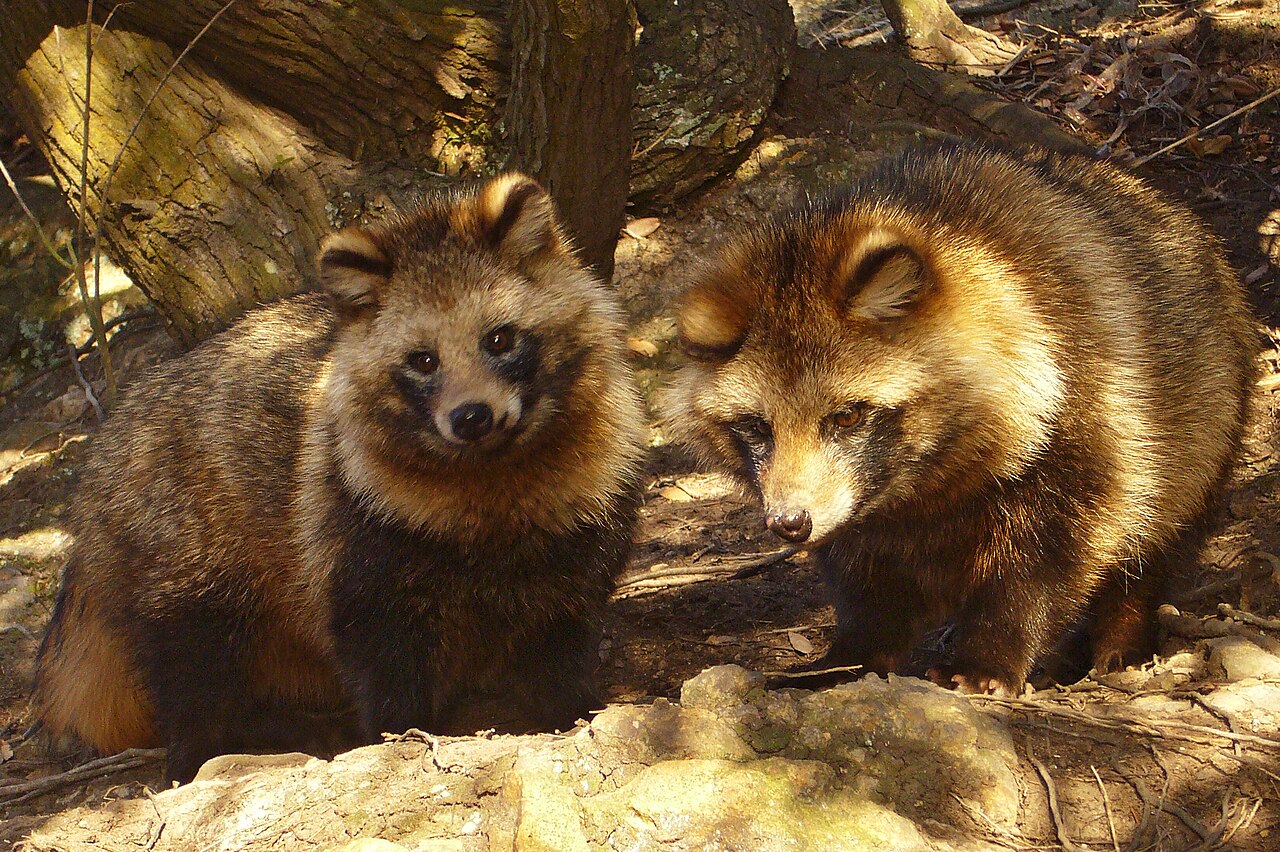
A tanuki is the Japanese raccoon dog, a real wild canid native to Japan, and at the same time the bake-danuki, the shapeshifting yokai that folklore built on top of that animal. The animal is a stocky nocturnal omnivore that raids gardens at night and retreats to a burrow through the coldest months. The folklore version turns itself into monks, teapots and roadside statues, drums on its own belly, and plays tricks on anyone walking home after dark.
Both meanings sit behind the same word, which is why a Japanese reader can see a tanuki in a nature documentary and a tanuki grinning outside a noodle shop and feel no contradiction.
What Is a Tanuki?
The tanuki is a canid, a member of the dog family, and not a raccoon or a badger despite the resemblance. English translations often turn it into “raccoon” because of the dark mask across its face, and the confusion is old. The Chinese character 狸 originally described medium sized cat-like mammals in China. When it reached Japan there was no exact local match for it, so scholars stretched it across tanuki, feral cats, wild boars, badgers, weasels and flying squirrels, which is how the tanuki ended up sharing names and stories with the mujina, the badger-like creature it is still occasionally confused with.
The folklore side has its own name. A tanuki with magical ability is a bake-danuki, literally a supernatural tanuki, and it belongs to the same broad family of spirits and strange beings as the fox spirit and the vengeful ghost. The tanuki is one of the clearest illustrations of what yokai symbolize, a creature people genuinely met in the woods and then explained through story.
The Real Animal Behind the Legend
The animal behind the folklore is the Japanese raccoon dog, a barkless, dark-masked canid endemic to Japan. It is nocturnal and crepuscular, unusually omnivorous for a canid, climbs trees for nuts and fruit, keeps to its burrow from about November until April, and lives seven or eight years in the wild. Taxonomists still disagree over whether it is a full species or a subspecies of the mainland raccoon dog.
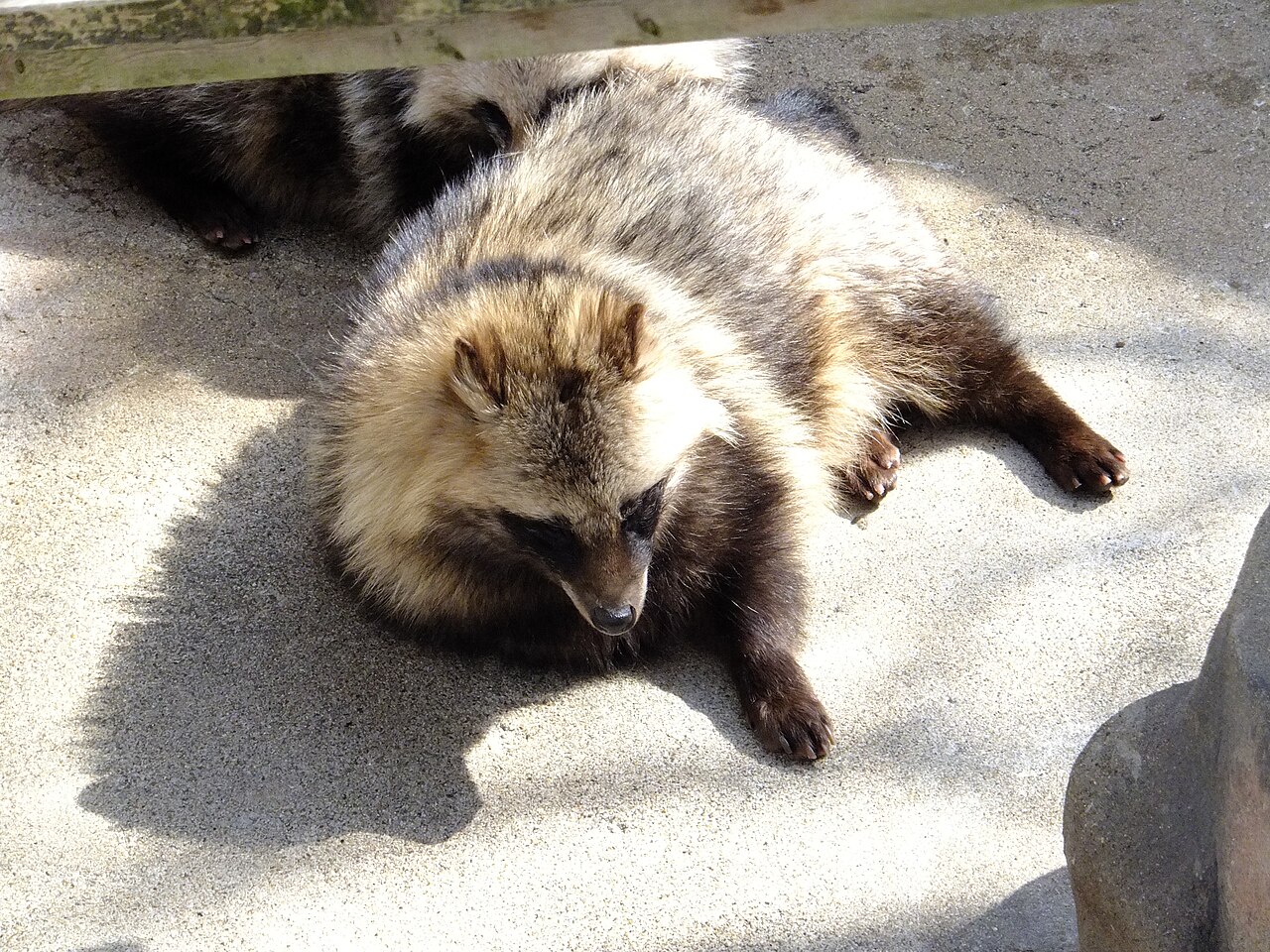
The American Society of Mammalogists treats the Japanese animal as its own species, Nyctereutes viverrinus, while the IUCN canid specialists and Mammal Species of the World keep it as a subspecies of the mainland raccoon dog, Nyctereutes procyonoides viverrinus. Genetic work supports the split, showing the Japanese population differs from continental raccoon dogs more than those continental populations differ from each other, with the divergence estimated at roughly 0.59 to 0.67 million years ago. Compared with mainland raccoon dogs it has a smaller stomach and shorter fur with less insulating value, and it is endemic to Japan.
In the field it reads as a stout-bodied, short-legged animal with a distinctive facial mask, more un-doglike than any other Japanese canid. It is barkless and reputedly silent. It is also far more omnivorous than most of its relatives, eating small prey such as amphibians, reptiles and birds alongside considerable plant material, gorging on nuts, fruits and berries in season, and it will climb trees with its curved claws to reach them. Coastal animals work the tideline for whatever has washed up. Pairs are nocturnal and crepuscular, favour heavily wooded ground, and do well on the fringes of human habitation where forest and farmland meet.
Autumn is for putting on weight. From about November until April tanuki retreat to their burrows, though they are not true hibernators and will come out during warm spells. Breeding runs from February to April, gestation lasts about nine weeks, and litters are typically four to six pups. A wild tanuki lives seven or eight years, while captive animals have reached thirteen. Where densities are high on Honshu the population pays for it, with sarcoptic mange stripping the fur off affected animals and ticks carrying Lyme disease. Plenty of tanuki now live inside Japanese cities, stealing cat food and working through household rubbish, which has quietly kept the animal familiar rather than mysterious.
How the Tanuki Became a Yokai
The tanuki was already a shapeshifter in the earliest Japanese written record, the Nihon Shoki of 720, and its reputation softened over the following thousand years. The idea reached Japan from China between the fourth and seventh centuries as something malevolent that took human shape to haunt people. Across the Edo period, between 1603 and 1868, the image shifted toward the harmless and comic, and finally toward prosperity.
The Nihon Shoki, completed in 720 during the Nara period, notes under the reign of Empress Suiko that “in two months of spring, there are tanuki in the country of Mutsu, they turn into humans and sing songs”. Shapeshifting was attached to the animal from the first time anyone bothered to write it down. Later collections kept the thread going, including the thirteenth century Uji Shui Monogatari, and by the Edo period the tanuki was a stock character rather than a rumour.
Ancient belief had already treated tanuki as gods with power over the natural world, and after Buddhism spread they were recast as divine messengers and guardians, which left the animal with an unusually forgiving character sheet.
The fox makes the contrast clear. The kitsune serves Inari, the deity of rice and prosperity, and is portrayed as sharp, dangerous and capable of real harm. The tanuki is the fox’s clumsier cousin: just as magical, considerably funnier, and rarely malicious. A Japanese proverb sets the balance out plainly, that the fox has seven disguises and the tanuki has eight.
| Tanuki | Kitsune | |
|---|---|---|
| Temperament in folklore | Comic, clumsy, rarely malicious | Sharp, dangerous, capable of real harm |
| Divine role | Nature god, later Buddhist messenger and guardian | Servant of Inari, deity of rice and prosperity |
| Disguises in the proverb | Eight | Seven |
What Powers Does a Bake-danuki Have?
A bake-danuki has three signature abilities in folklore: transformation into people and objects, belly drumming known as tanuki-bayashi, and the stretching of its oversized kinbukuro or golden bags. Some accounts add illusions, possession, and the power to swell into a giant. Its weakness is concentration, because a distracted tanuki lets its tail slip back into view.
Shapeshifting and illusion
The bake-danuki’s core skill is transformation, and it is generous with it. Human form is the favourite, often a monk or a traveller, and a tanuki in human shape can live undetected among people for a long stretch. It does not stop at bodies: stones, trees, statues and ordinary household items are all fair game, which makes it a very different proposition from the object spirits that come to life from the object’s own side. Some accounts give it illusions, possession, or the ability to swell into a giant and frighten travellers off a mountain road. The weak point is concentration. A distracted tanuki lets its tail slip back into view, and the disguise is finished.
The belly drum
Tanuki drum on their own stomachs, a habit named tanuki-bayashi, and the sound folklore gives it is a rolling “pom poko”. The classic prank is drumming in the dark to lure travellers and monks off their path, or simply to unnerve whoever is within earshot. The same round belly became a symbol of bold decision making in later depictions, so the joke and the virtue share a body part.
The golden bags
The tanuki’s most conspicuous feature in art is its enormously oversized scrotum, the kinbukuro or golden bags. Folklore has it stretching to the size of eight tatami mats, and Kuniyoshi’s woodblock series of 1842 shows tanuki using theirs as fishing nets, boats, umbrellas and blankets, with other tales adding drums, fans and weapons. The likely origin is a craft pun rather than an anatomical claim: goldsmiths wrapped gold in tanuki hide before hammering it into leaf, so a small nugget could be stretched into a huge sheet, and kinbukuro means both a money bag and the animal’s anatomy. That is why the trait reads as luck with money rather than crudeness.
The Tales That Made the Tanuki Famous
Two folk tales carry most of the tanuki’s reputation, and they pull in opposite directions. Bunbuku Chagama, the magic tea kettle, is the grateful comic tanuki that repays a rescuer. Kachi-Kachi Yama is the murderous one, in which a rabbit avenges a farmer’s wife. Three regional tanuki, Danzaburou-danuki, Shibaemon-tanuki and Yashima no Hage-tanuki, carry legends of their own.
Bunbuku Chagama emerged in the seventeenth century. In one telling a woodsman rescues a tanuki that repays him by turning into a chagama, a metal tea ceremony kettle, which he sells on to a priest. Another version has the priest Shukaku’s kettle turn out to be the tanuki all along. Either way the animal hates being used as cookware, and once it is set over the fire its limbs pop back out and it bolts. The ending is oddly commercial: the tanuki agrees to perform, dancing as a kettle on a tightrope, and earns its rescuer a living as a travelling entertainer. The kettle from the story is kept at Morin-ji, the Soto Zen temple in Tatebayashi that the tale is attached to.
Kachi-Kachi Yama is the other side of the animal. Here the tanuki robs a farmer’s field, is caught by the farmer’s wife, and then deceives and murders her. A rabbit takes up the revenge on the farmer’s behalf, sets light to the firewood strapped to the tanuki’s back while striking flint behind it, which is where the onomatopoeic “kachi-kachi” of the title comes from, and finishes the job with a boat race. The rabbit’s boat floats. The tanuki’s boat, made of mud, sinks in the middle of the lake.
Regional tanuki have their own legends. Three are famous enough to be named individually: Danzaburou-danuki of Sado Island in Niigata, Shibaemon-tanuki of Awaji Island in Hyogo, and Yashima no Hage-tanuki of Kagawa. Temples still mark the connection, with tanuki dedications at Yashima-ji in Takamatsu and Chingodo in Asakusa.
Tanuki Statues and the Eight Lucky Signs
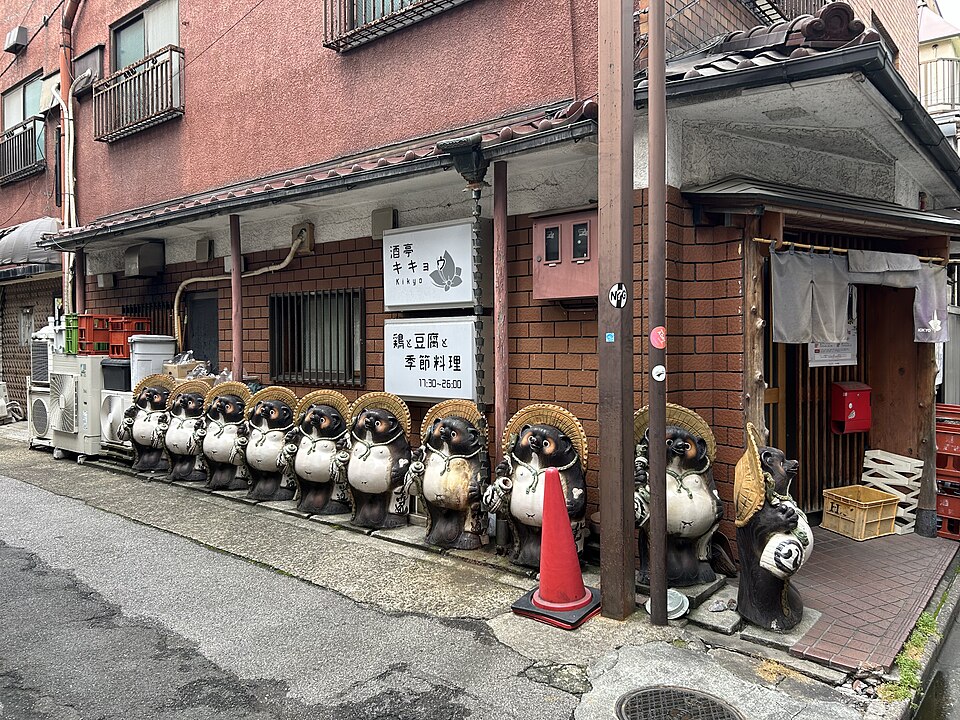
The grinning ceramic tanuki outside Japanese restaurants and bars is a modern object with a short, traceable history. Most are produced in the ceramic workshops of Shigaraki in Shiga prefecture, and the figure as it is recognised today traces to the potter Tetsuzo Fujiwara, who moved to Shiga in 1936. In 1952 a Buddhist monk fixed the design’s meaning by assigning eight auspicious attributes, which is why every Shigaraki tanuki carries the same kit. The Taisho era had already settled the look, with the big scrotum, the straw hat, the sake bottle, the account book and the drum-ready belly.
| Feature | What it stands for |
|---|---|
| Straw hat | Protection against trouble |
| Large eyes | Perceiving the situation and making good decisions |
| Smiling face | Friendliness toward customers |
| Sake bottle | Virtue and judging character |
| Promissory note or ledger | Trust and keeping accounts |
| Big belly | Calm, bold decisiveness |
| Golden bags | Luck with money |
| Large tail | Steadiness and finishing what was started |
Read together, the eight signs are a small business owner’s wish list, which explains the placement. A tanuki at the door of a bar or a noodle shop is asking for customers, good judgement and a full till.
The Tanuki in Art, Anime, and Games
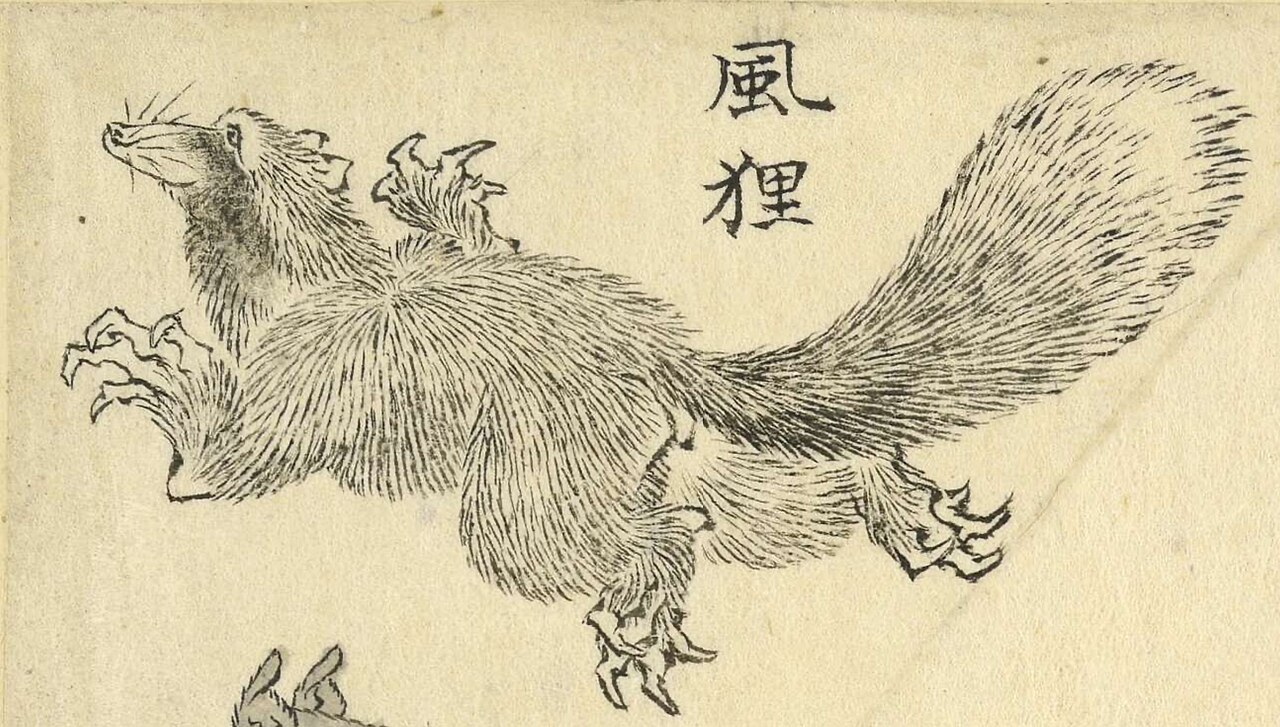
The tanuki has an unbroken visual record from Edo woodblock prints to modern games. Kuniyoshi devoted an 1842 series to its transformations, Hokusai sketched it among his studies of strange animals, and Kawanabe Kyosai painted one looking at its own reflection. Its best known modern appearances are Studio Ghibli’s Pom Poko (1994), Mario’s Tanooki suit in Super Mario Bros 3 (1988), and Tom Nook in Animal Crossing.
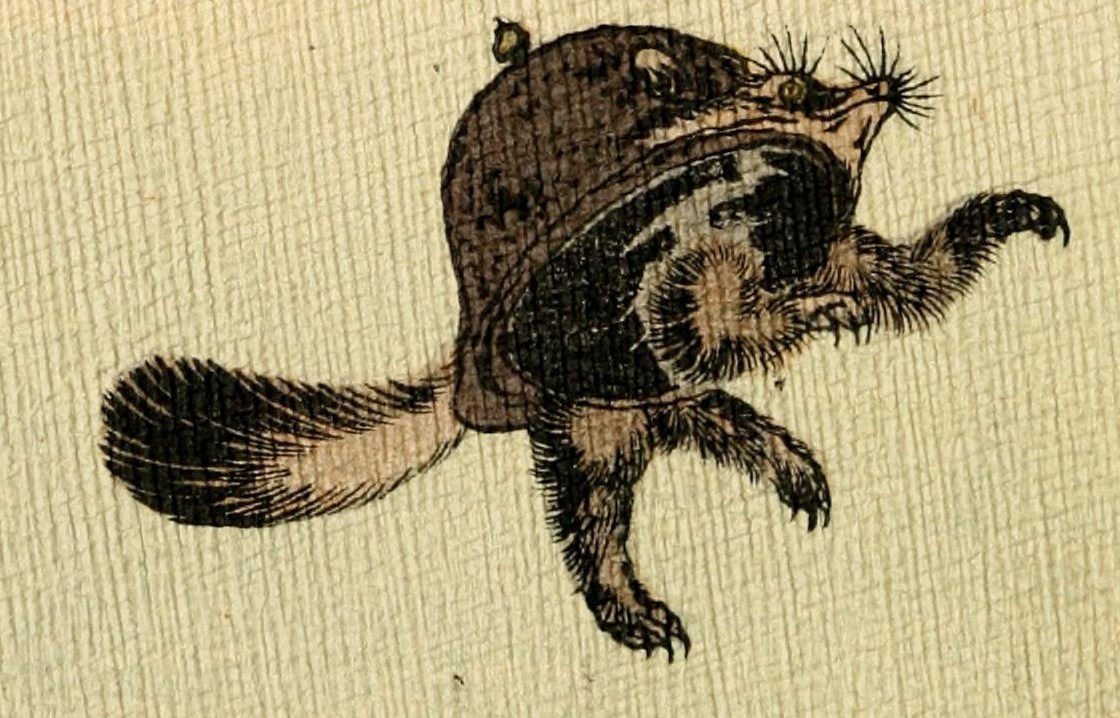
Painters and print makers took the tanuki seriously as a subject. Kuniyoshi built a whole 1842 series around its transformations, Hokusai sketched it among his studies of strange animals, and Kawanabe Kyosai painted a tanuki looking at its own reflection in water, now in the collection of the Metropolitan Museum of Art. Woodblock prints are where most people still first meet the creature’s older, wilder face, closer to the mask traditions in Japanese folklore than to the ceramic figure outside a bar.
Modern media kept it in circulation. Studio Ghibli’s Pom Poko, directed by Isao Takahata in 1994, is built on tanuki resisting a construction project that is eating their habitat, and the belly drumming of the title is the animal’s own folklore. Nintendo gave Mario the Tanooki suit in Super Mario Bros 3 in 1988, which is how a generation outside Japan learned the word. Animal Crossing hands the player’s finances to Tom Nook, a tanuki with a strong interest in debt. The Japanese release of Zootopia swapped in a tanuki newscaster, InuYasha has Hachiemon, Laughing Under the Clouds has Gerokichi, and GitLab picked a tanuki for its logo in 2015. Even the food carries the name, with tanuki soba named for the golden scraps of tempura batter scattered on top.
FAQs
Is a tanuki a raccoon or a dog?
A dog, biologically speaking. The tanuki is a canid, closely related to foxes and wolves rather than to the North American raccoon, which belongs to a different family entirely. The dark facial mask across its eyes is what drives the mistranslation into English.
What is a bake-danuki?
A bake-danuki is the supernatural version of the animal, a tanuki with magical powers, and it is the form that appears in Japanese folklore. The word combines bake, meaning to change or transform, with danuki. Regional names such as mujina and mami often overlap with it.
Are tanuki real animals or just legend?
Both. The Japanese raccoon dog is a living wild canid found throughout Japan, including inside major cities, and the bake-danuki yokai grew out of encounters with it. The folklore never replaced the animal.
Why do tanuki statues have exaggerated anatomy?
Because it stands for money rather than sex. Goldsmiths once wrapped gold in tanuki hide to hammer it into thin leaf, stretching a small amount a very long way, and kinbukuro carries both meanings of money bag and anatomy. On a Shigaraki statue it is the sign for financial luck.
What does the tanuki’s belly drumming mean?
Tanuki-bayashi, the belly drumming, is the animal’s signature prank in folklore, a “pom poko” beat used to confuse travellers walking in the dark. In the symbolism of Shigaraki statues the same belly stands for calm and bold decision making.
If the tanuki’s mix of mischief and good fortune is your kind of folklore, Kamicrew’s yokai shirts put the same creatures on something you can actually wear.
Kamicrew Best Seller

Dont Touch Me Yokai Ukiyo-E Japanese T-Shirt
$25.49+
$29.99
(15% off)


Summer Vibes Salty Kawaii Japanese Hoodie
$44.99+
$49.99
(10% off)


Japanese Pin Horror 80s Retro Aesthetics T-Shirt
$25.49+
$29.99
(15% off)


El Gran Maja Japanese Kaiju T-Shirt
$25.49+
$29.99
(15% off)


Who Wants The Perfect Body Japan Capybara Kawaii Japanese Unisex Shirt
$25.49+
$29.99
(15% off)


Monster 8 Mask Vintage Animal Hoodie
$44.99+
$49.99
(10% off)


I Hate People Japanese Opossum Vintage Animal Hoodie
$44.99+
$49.99
(10% off)


I Got That Dog In Me Small Turtle Vintage Animal T-Shirt
$25.49+
$29.99
(15% off)

The Creation Of Cat Ukiyo-E Japanese T-Shirt
$25.49+
$29.99
(15% off)