

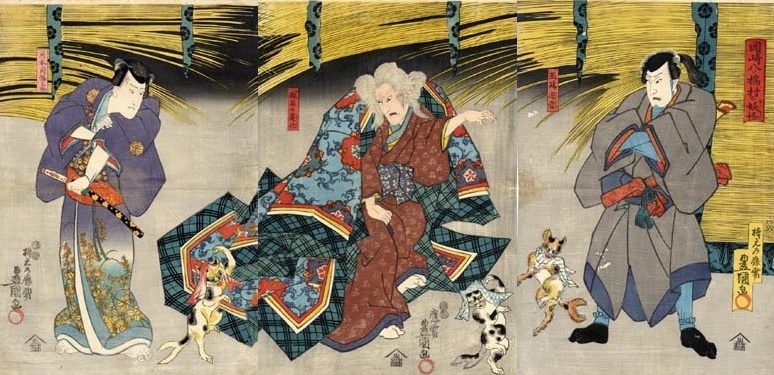
A nekomata (猫又) is a Japanese yokai cat whose single tail has split into two, and folklore gives it that tail one of two ways: by living to a great age as a house cat, or by being born a giant predator in the mountains. The name translates roughly as forked cat. Where the ordinary transformed cats of Japanese legend can be merely mischievous, nekomata are described as hostile to people. They walk upright, they speak human language, they throw fire, and they command the dead.
The creature also has a paper trail. The first known written appearance of the word nekomata sits in a courtier’s diary from 1233, and by the Edo period the nekomata had become a fixture of yokai catalogs, kabuki stages and woodblock prints.
What Does Nekomata Mean?
Nekomata means something close to forked cat. It joins neko, cat, to a mata element written variously 又, 股 and 胯, several of which carry a sense of forking or splitting at the hips. The word names one specific yokai, a cat whose tail has divided in two, and it is not interchangeable with the two broader labels for supernatural cats.
Three Japanese words get tangled together in cat folklore, and separating them fixes most of the confusion.
Bakeneko comes from bakeru, to change or transform, plus neko, cat. It is the broad label for a cat that shapeshifts. Kaibyo pairs kai, supernatural or strange, with byo, the Sino-Japanese reading of cat, and works as an umbrella term for any uncanny cat. Nekomata is the specific one, a two-tailed cat that has become a yokai and does strange things with the power that comes with it.
The writing has shifted over the centuries. Early texts use 猫また, and later forms include 猫又, 猫股 and 猫胯. Supernatural cats appear in Chinese sources as far back as the Sui dynasty under names such as 猫鬼, the cat demon.
Bakeneko vs Nekomata: What Actually Separates Them
Every nekomata is a kind of bakeneko, but not every bakeneko becomes a nekomata. Bakeneko is the broad label for any shapeshifting cat, folklore usually ties it to a cat that died badly or was wronged, and it keeps a single tail. Nekomata is the narrower term: two tails, a transformation earned by age and size, and a temperament the sources describe as uniformly malicious toward humans.
| Trait | Bakeneko | Nekomata |
|---|---|---|
| Tails | One | Two, the original tail split down the center |
| Scope of the term | Any shapeshifting cat | One specific two-tailed yokai |
| How it transforms | Died badly or was wronged | Lived long, grew large, grew a long tail |
| Temperament | Playful, spiteful or simply odd | Malicious toward humans across the board |
The second tail is not grown so much as made, since the existing tail splits down the center into two identical tails at the moment of transformation. Anyone weighing bakeneko vs nekomata for a story or a design is really choosing between a trickster and a predator.
Two Kinds of Nekomata
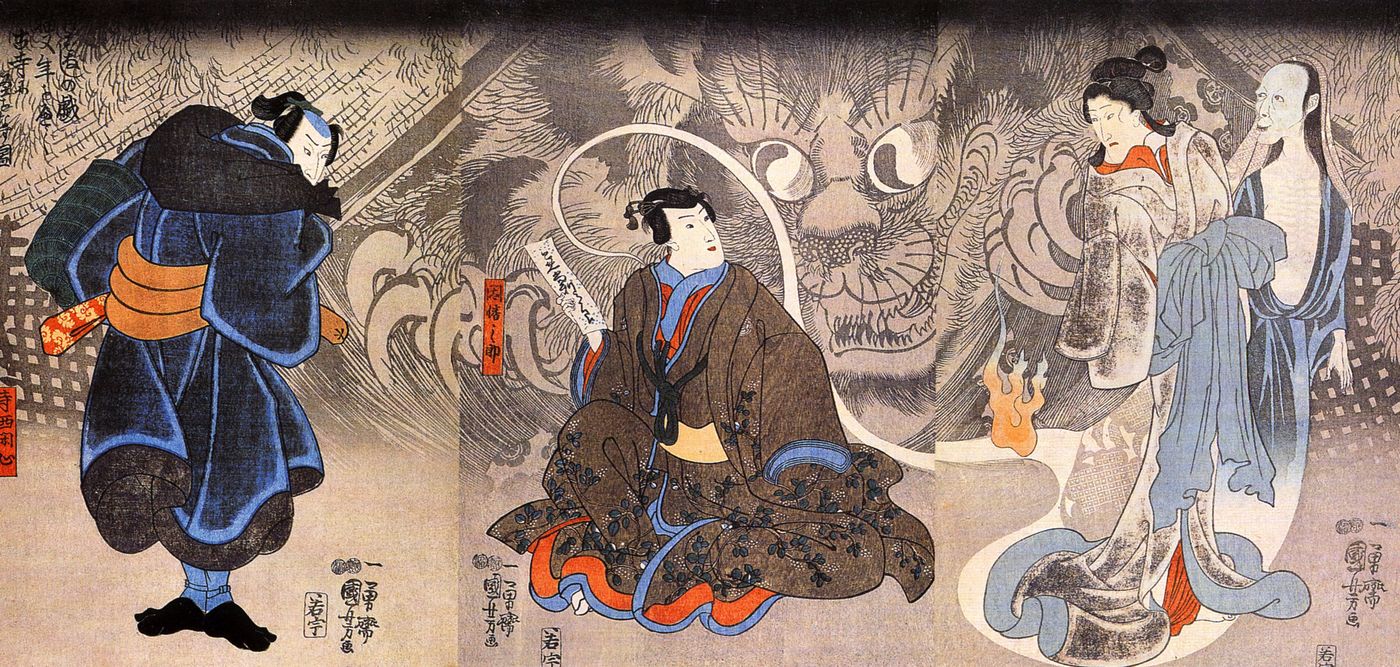
Nekomata folklore keeps two separate populations that barely resemble each other. Mountain nekomata are wild beasts, a species of their own, living in deep forest and hunting animals as large as boar and bears. Domestic nekomata start as ordinary house cats and cross over by reaching old age. Both end up with two tails, and almost nothing else about them matches.
Mountain nekomata
Mountain nekomata are wild beasts rather than reformed pets, living in deep mountains and forests as their own species. Descriptions grow with the retelling, from an animal as large as a wild boar to something the size of a leopard or a lion, with one account putting a specimen at roughly 2.8 meters. They hunt what large predators hunt: boar, dogs, bears and people. Mount Nekomata in old Etchu Province, now Toyama Prefecture, still carries the name.

Domestic cat nekomata
Domestic nekomata start on someone’s floor. A house cat that reaches old age is said to cross over, and the threshold most often quoted in the folklore falls somewhere between seven and twenty years. That range says a lot about the period it comes from, when a cat surviving two decades was rare enough to look like a sign of something. By the Edo period the belief had hardened into household caution, and keeping a cat too long was treated as a genuine risk.
The First Written Nekomata, in 1233
The earliest known written record of a nekomata is dated 1233 and sits in the Meigetsuki, the diary the poet and courtier Fujiwara no Teika kept for 56 years. In that entry Teika notes a creature in the Nara area with the eyes of a cat and the body of a dog that had killed seven or eight people. The word he used for it was nekomata.
| Source | Date | What it records |
|---|---|---|
| Meigetsuki, Fujiwara no Teika | 1233 | Cat-eyed beast near Nara, seven or eight dead |
| Tsurezuregusa, Yoshida Kenko | 1331 | Touches on the creature |
| Tonoigusa | 1660 | Edo collection carrying nekomata tales |
| Roo Chabanashi | 1742 | Edo collection carrying nekomata tales |
The mid-Edo scholar Arai Hakuseki set out the underlying rule plainly, that old cats become nekomata.
What Does a Nekomata Look Like?
A nekomata looks like an ordinary cat most of the time, and the two tails are the tell that gives it away. The domestic kind can pass as a normal animal, which is exactly what makes the stories work. Once it drops the disguise it stands on its hind legs and speaks in human language. Mountain specimens are the ones drawn at monstrous scale, closer to a big cat than a house cat, with a body many meters long.
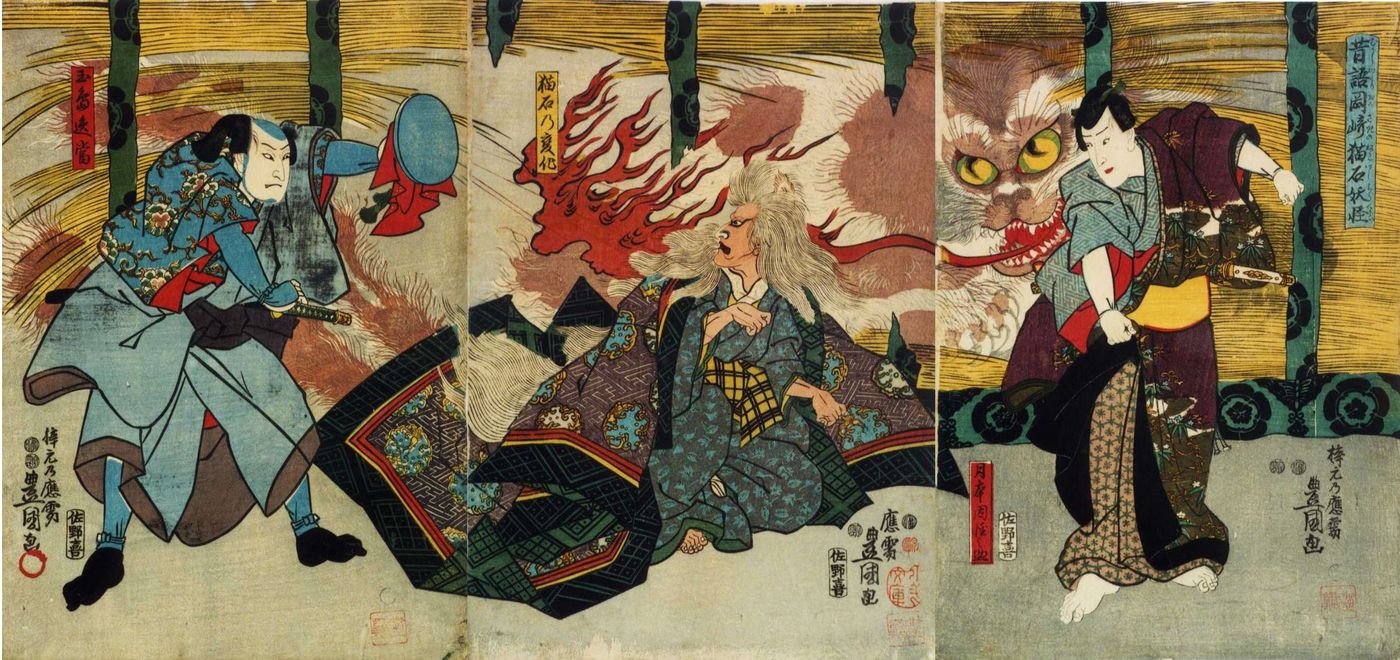
Print artists tended to solve that problem of scale by drawing the beast twice in one image, a normal cat in the room and an enormous shadow cat filling the wall behind it.
What Do Nekomata Do?
Nekomata are credited with powers unusually aggressive for a domestic animal turned spirit. They summon fireballs and are blamed for destructive blazes, they animate and revive corpses, they blackmail or enslave the people around them, they take human shape for trickery, and they talk and dance upright. The folklore places them nearer to necromancers than to household spirits.
- Fire, since they summon fireballs and are blamed for blazes that cause widespread destruction and deaths, with some accounts having them start fires with their tails.
- Control of the dead, because nekomata are said to manipulate corpses, animating or reviving bodies, which puts them nearer to necromancers than to household spirits.
- Coercion, where a nekomata uses what it knows and what it can do to blackmail or enslave people, and may curse or kill a former owner.
- Impersonation, taking human shape for trickery rather than for disguise alone.
- Talking and dancing, with a 1683 account of a temple cat overheard chatting with the neighborhood cats, and other tales describing cats dancing upright with a tenugui cloth tied on the head, sometimes at the pillow of a sleeping person.
The dancing has a plain explanation running under it. Meat was scarce, so cats were rarely fed any, and they went instead for the fish oil burning in andon paper lamps. A cat reaching up into a lamp, lit from below with its shadow thrown huge and flickering across the wall, is very close to the image the stories describe.
Nekomata Disease
Folklore also records nekomata byo, a nekomata sickness, described as dreadful and possibly the same thing as rabies. It is a reminder that some of these accounts are recording something real and misunderstood rather than inventing it from nothing.
Nekomata in Edo Art and After
The nekomata reached its widest audience through Edo-period visual culture. Sawaki Suushi included it in the Hyakkai Zukan in 1737, and Toriyama Sekien put it in Gazu Hyakki Yagyo in 1776, which is where a great deal of later yokai imagery ultimately comes from. Kabuki took up the ghost cat plots, and nineteenth-century print artists gave the theater versions their looming, wall-sized cats.
Painted yokai scrolls such as the Bakemono no e scroll of around 1700, digitized by the Harold B. Lee Library, show how fixed the visual vocabulary had become by then.
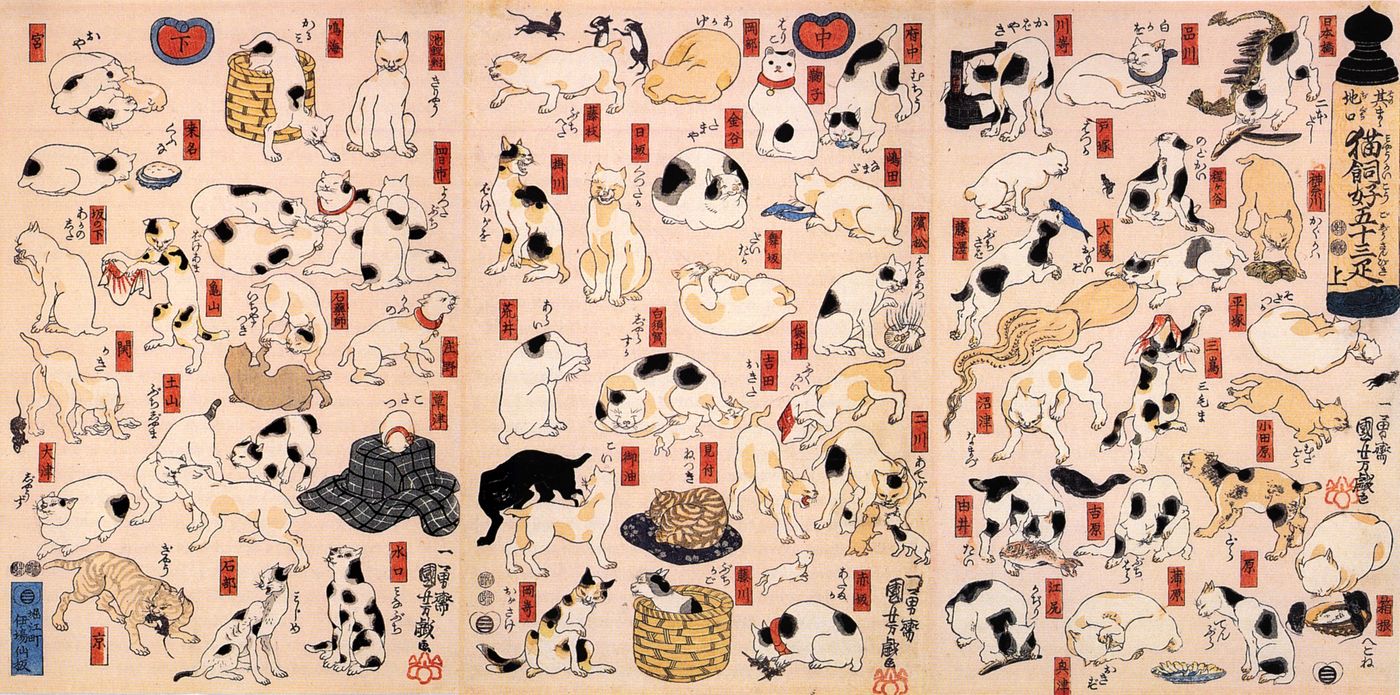
Modern anime, games and manga inherited all of it, which is why two-tailed cat designs turn up so consistently in Japanese pop culture. The nekomata sits in the same category of animal shapeshifter as the kitsune, the fox spirit that also gains tails as it ages, and the tanuki, Japan’s shapeshifting raccoon dog. The idea that age alone can turn an ordinary thing into a spirit runs further through the folklore still, and it is the same logic behind tsukumogami, the object spirits that wake after a century of use.
Is Your Cat a Nekomata?
Edo-period households watched for a specific set of signs, and only one of them was conclusive: a tail that has split in two. The rest are circumstantial, a tail that lengthens and moves like a snake, skin that glows when the fur is stroked backwards, a taste for lamp oil, an attraction to corpses and strong smells, and fires starting nearby.
- Stroke it backwards against the grain of the fur, and skin that glows counts as a sign.
- It drinks the oil out of lamps.
- The tail lengthens and starts moving like a snake.
- It is drawn to corpses and to strong smells, which the folklore reads as sinister and a hungry carnivore reads as food.
- Fires start around it, in the hearth or apparently on their own.
- The tail has split in two, which settles the question.
Wearing the Nekomata
As a motif the nekomata gives a designer more to work with than a cute cat does. The two tails read instantly, the classic print silhouette of a giant cat behind a small one carries the whole story in a single shape, and the palette of Edo woodblock work translates cleanly onto dark fabric. If a two-tailed cat with real folklore behind it is the kind of thing you want on a tee or a hoodie, Kamicrew’s yokai shirts are where to look.
FAQs
How many tails does a nekomata have?
Two. The single tail splits down the middle into two identical tails when the cat transforms, so a two-tailed cat in Japanese folklore is a nekomata by definition.
What is the difference between a bakeneko and a nekomata?
Bakeneko is the broad term for any shapeshifting cat in Japanese folklore, and it keeps one tail. A nekomata is the narrower case: two tails, a transformation earned by great age and size rather than by a bad death, and a temperament described as malicious toward humans. Every nekomata is a bakeneko, but not every bakeneko becomes a nekomata.
Is a nekomata good or evil?
Hostile. The folklore treats nekomata as malicious toward humans across the board, which sets them apart from bakeneko, whose behavior ranges from mischief to outright revenge.
How long does a cat have to live to become a nekomata?
Long enough to count as old, with the sources usually placing the threshold between seven and twenty years, and Edo-period households treating a very long-lived cat as a reason for caution.
Do nekomata appear in modern Japanese pop culture?
Constantly. The two-tailed cat design passed from Edo yokai catalogs and kabuki ghost cat plays into anime, manga and games, which is where most people meet the creature first.
Kamicrew Best Seller

Dont Touch Me Yokai Ukiyo-E Japanese T-Shirt
$25.49+
$29.99
(15% off)


Summer Vibes Salty Kawaii Japanese Hoodie
$44.99+
$49.99
(10% off)


Japanese Pin Horror 80s Retro Aesthetics T-Shirt
$25.49+
$29.99
(15% off)


El Gran Maja Japanese Kaiju T-Shirt
$25.49+
$29.99
(15% off)


Who Wants The Perfect Body Japan Capybara Kawaii Japanese Unisex Shirt
$25.49+
$29.99
(15% off)


Monster 8 Mask Vintage Animal Hoodie
$44.99+
$49.99
(10% off)


I Hate People Japanese Opossum Vintage Animal Hoodie
$44.99+
$49.99
(10% off)


I Got That Dog In Me Small Turtle Vintage Animal T-Shirt
$25.49+
$29.99
(15% off)

The Creation Of Cat Ukiyo-E Japanese T-Shirt
$25.49+
$29.99
(15% off)