
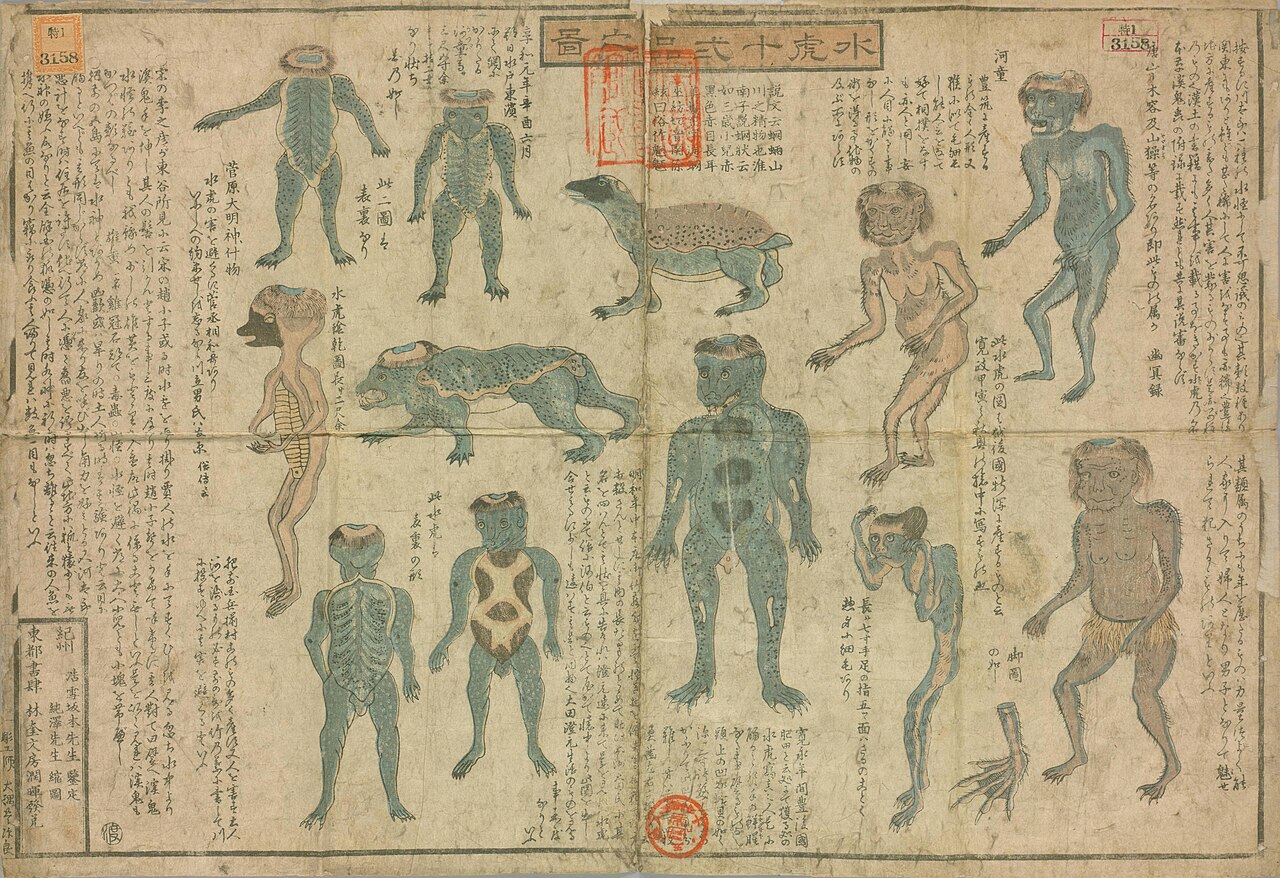
A kappa is a river dwelling yokai of Japanese folklore, shaped like a child sized reptilian humanoid with a turtle beak, a shell on its back, webbed hands and a dish of water set into the top of its skull. The name is written 河童 and reads as “river child”, with kawataro and kawako as the common alternates. Folklore casts the creature two ways at once. It drowned livestock and pulled the shirikodama out of swimmers, and it also taught villagers bone setting, kept every promise it made, and accepted cucumbers at the water’s edge as a minor water god. The dish is the whole creature in miniature, because a kappa whose dish runs dry cannot move and may die.
| Kappa at a glance | Detail |
|---|---|
| Japanese name | 河童, read as “river child” |
| Common alternate names | kawataro, kawako |
| Type | Water yokai, also revered in Shinto as a water god |
| Habitat | Rivers, lakes, ponds, waterways, cisterns and wells, across the whole of Japan |
| Defining feature | The sara, a water filled dish on the crown of the skull |
| Diet | Omnivore, with cucumbers and human entrails as the two stated preferences |
| Weakness | Spilling the water from the dish, which leaves the kappa unable to move |
What Is a Kappa?
A kappa is a child sized water yokai recorded across the whole of Japan rather than in one province, living in rivers, lakes, ponds, waterways, cisterns and wells. It is an omnivore with two stated preferences, cucumbers and human entrails, which is a fair summary of how ambivalent its reputation is. Young kappa live in family groups while adults are solitary, and both are physically stronger than a grown man.
What separates the kappa from most of Japanese folklore‘s water spirits is intelligence. Kappa are among the few yokai said to learn human languages, they hold detailed medical knowledge, and they enjoy martial arts and games. Their character is described as proud and stubborn but fiercely honorable, and the honor is not decorative. A kappa never breaks a promise, which is the hinge on which almost every kappa story turns, and it is also the reason a creature this dangerous could be bargained with at all. That mix of menace and obligation is close to the center of what yokai symbolize in general.
What the Kappa Looks Like
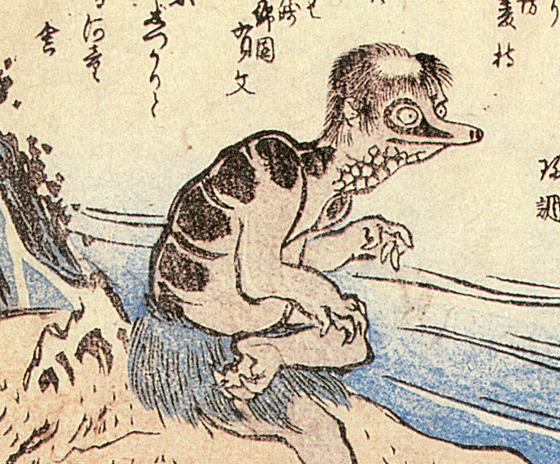
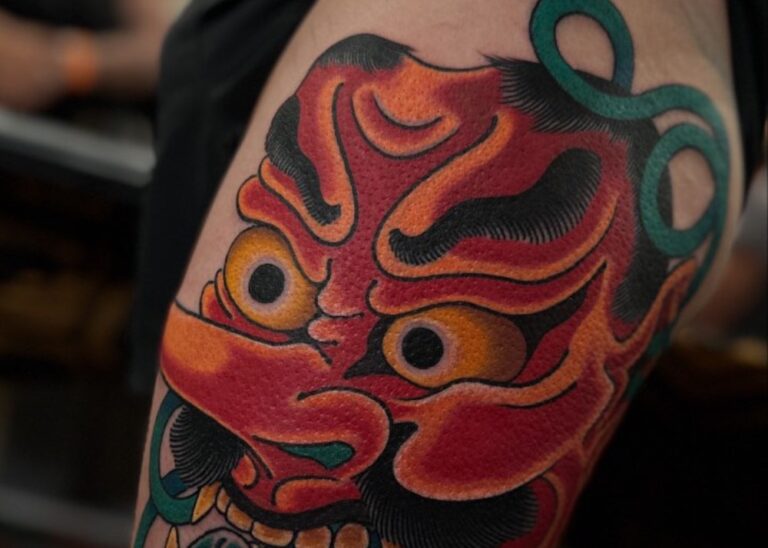
A kappa looks like a scaly child sized humanoid with a turtle beak, a shell on its back, webbed thumbless hands and feet, removable waterproof skin, and a water filled dish on the crown of its skull. The scales are not always green. Descriptions run from a deep earthy green through bright reds to blue.
| Body part | What the folklore describes |
|---|---|
| Crown of the skull | The sara, a dish shaped depression that must stay filled with water at all times |
| Face | Ends in a turtle beak |
| Back | Carries a shell |
| Hands and feet | Webbed and thumbless |
| Skin | Scaly, removable and waterproof, coloured deep green, red or blue |
| Arms | Connected to each other inside the shell, so one lengthens as the other contracts |
| Anatomical oddity | Credited with three anuses |
The sliding arm is old rather than invented for effect, and the early 1700s encyclopedia Wakan sansai zue records the arm passing straight through from one side to the other as though it were elastic. The dish matters most of all: should the water spill and the dish dry out, the kappa cannot move, and it may not survive. Regional colour varies on top of all this. In the tales collected around Tono in northern Japan, published by the folklorist Yanagita Kunio in 1910 as Tono Monogatari, the local kappa carry the same shell, webbed feet and water filled crown as elsewhere but are red rather than green.
Where the Kappa Came From
No single animal explains the kappa. The standard candidates are monkeys, turtles, and the now extinct Japanese river otter, a nocturnal animal roughly two feet long that would read in poor light as something small, humanoid and wrong. A 2012 Japanese television programme argued instead for the giant salamander, on the strength of its aggressive feeding.
The oldest sources support the mammal reading rather than the reptile one, since early kappa were conceptualised as monkey like or otter like animals, not shelled amphibians. The name was never settled either. Before Edo standardised the creature, each region had its own word for it.
| Region | Local name |
|---|---|
| Kamigata (Kyoto and Osaka) | kawataro, gataro |
| Tohoku | medochi |
| Hokuriku | mizushi |
| Chugoku and Shikoku | enko |
| Kyushu | hyosube |
The written record reaches back further than the modern picture suggests. The fifteenth century Kagakushu carries the creature, and a Japanese to Portuguese dictionary compiled by Jesuit missionaries in Nagasaki in 1603 lists it as well, which means foreign visitors were writing the kappa down more than four centuries ago.
Why the Kappa Was Feared
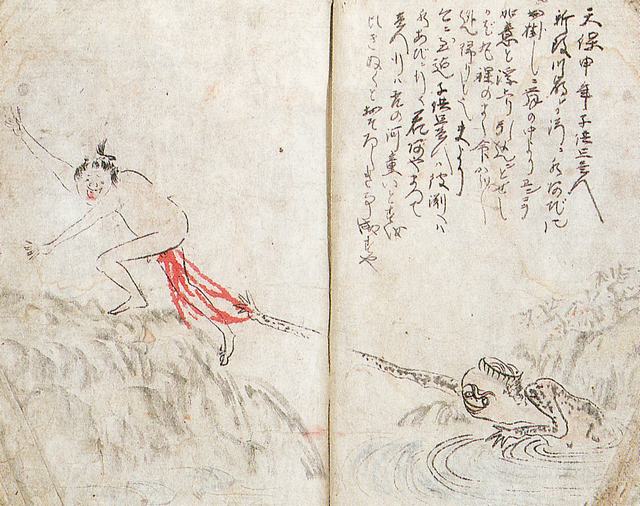
The original kappa was a predator, and the sources are blunt about it. It dragged people, cattle and horses into the water and ate their internal organs, attacked livestock with no apparent motive, committed sexual violence, caused illness and madness, and devoured people alive. Its specific prize was the shirikodama, a mythical ball of flesh described as sitting just inside the anus, taken by insertion or by suction.
Whatever the shirikodama was supposed to be, its function in the story is obvious enough, since a drowned body pulled from a river gave a village a creature to blame. Read alongside the umibouzu that capsized boats out at sea, the kappa is the freshwater half of the same idea, a supernatural explanation stationed exactly where people actually drowned.
Most of that violence has been quietly edited out of the modern creature, and two explanations are offered for the edit. One is that modern audiences will not accept graphic cruelty in a children’s character. The other, argued from the scholarship on male male sexuality in Japanese discourse, is that the kappa’s metaphorical associations became stigmatised as Japan modernised along Western lines in the late nineteenth and twentieth centuries.
How to Escape or Defeat a Kappa
Bow to it. A kappa is compelled to return a bow, so a person who bows deeply enough forces the kappa to bow back, the water tips out of the dish on its head, and the creature is left unable to move. The trick works because the kappa will not break the rule even to save itself. Kappa bested this way have been made to swear loyalty and friendship to their victor for the rest of their lives.
The folklore also records a set of things kappa will not tolerate:
- Gourds, sesame and ginger, all reported as foods kappa dislike
- Iron, which they avoid
- Flatulence, since a kappa cannot stand the gas of other creatures
Cucumbers sit awkwardly in this list, because beliefs about eating them before swimming contradict each other from region to region. In some places a cucumber marks you as a friend, in others it marks you as prey.
From Monkey to Turtle: How the Kappa’s Image Changed
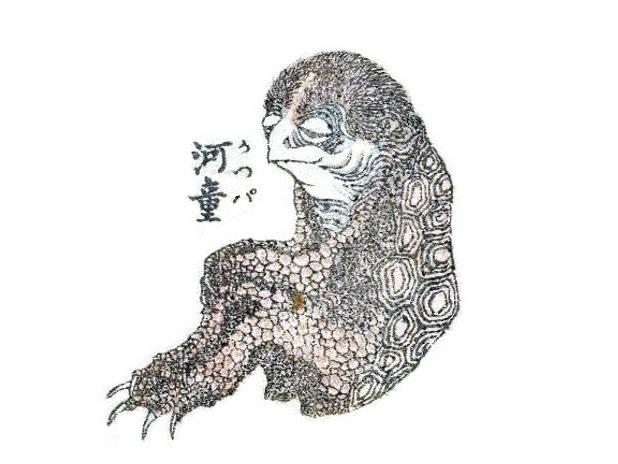
The green turtle kappa everyone recognises is a comparatively recent invention. Early illustrations show a hairy, monkey like animal, and the 1715 encyclopedia Wakan sansai zue pictures that version. Katsushika Hokusai and his contemporaries then rebuilt it, drawing kappa with pointed beaks, shells and bodies modelled on various kinds of turtle, and colouring them green, possibly borrowing from frogs.
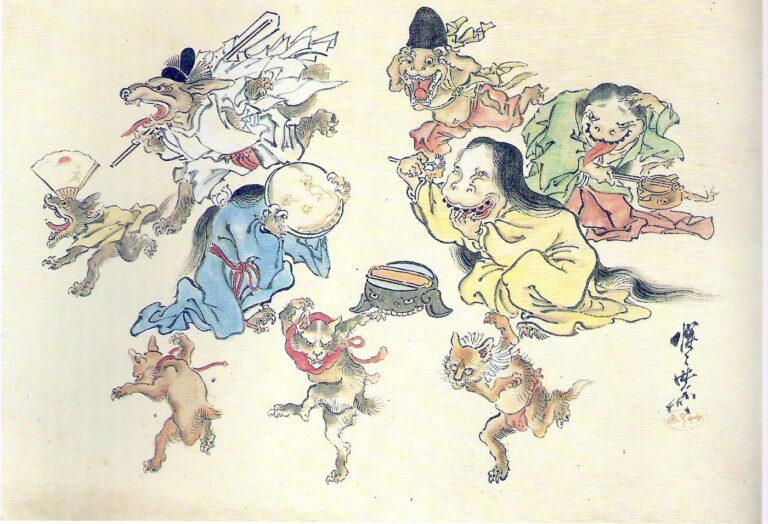
The result was effectively a new tradition rather than a refinement of the old one, and it is the one that stuck. Toriyama Sekien, whose Gazu hyakki yagyo appeared in 1776 as the first of four illustrated yokai books, gave later ukiyo-e artists a working catalogue of these creatures, and Utagawa Toyokuni and Kawanabe Kyosai worked the same territory.
Why Edo’s version won has nothing to do with folklore and everything to do with printing. Woodblock publishing concentrated in Edo through the nineteenth century, so the capital’s kappa travelled on paper while the medochi and the hyosube stayed local. The pattern matches what happened to language, where the Tokyo dialect became standard Japanese for the same structural reason.
How to Get Along With a Kappa
Leave cucumbers, and accept a wrestling match. Offerings of cucumber were left at riverbanks in exchange for the kappa’s help with irrigation and its goodwill toward children, and the cucumber roll sold today as kappamaki takes its name from the creature. In return, legend credits kappa with teaching humans about medicine and bone setting. Sumo is the kappa’s game, and a challenge is a recognised way of dealing with one.
Two places in Tokyo carry the bargain in their names. Sogenji temple in Asakusa, known locally as Kappa-dera, keeps a mummified kappa hand, and the neighbourhood credits kappa with building flood control works there. The nearby Kappabashi bridge is tied to a raincoat merchant said to have employed kappa labour on the job. Neither story asks to be believed literally, but both show a creature treated as a difficult neighbour rather than a monster to be driven out.
The Kappa as a Water God
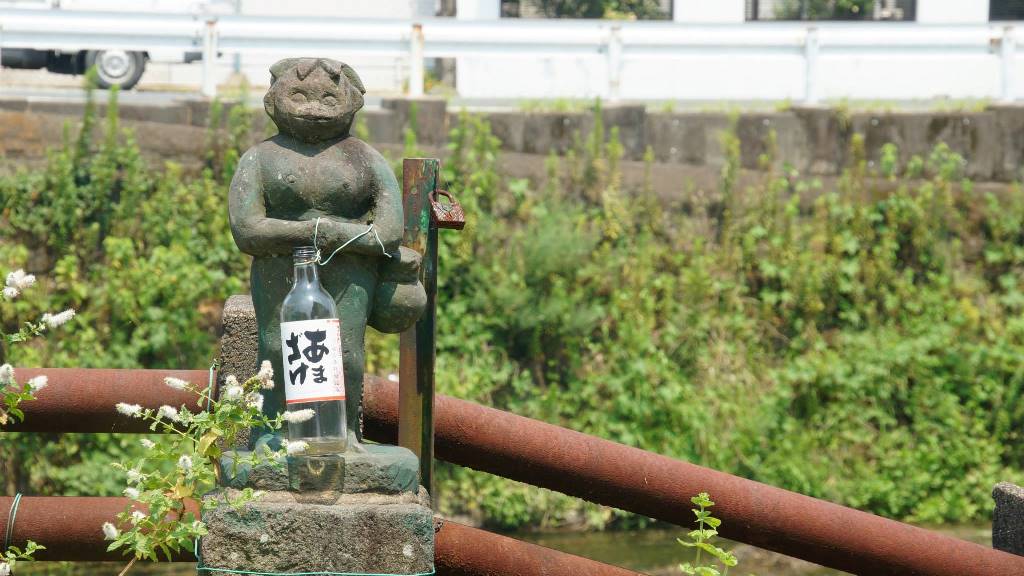
In Shinto the kappa is revered as a kind of water god, and the shrine stories explain that promotion through a bargain. A kappa is caught, it promises to stop drowning the villagers, and it is then venerated as a water kami. Kahaku Shrine in Nankoku, Kochi Prefecture, holds an annual kappa festival built on exactly that plot.
The promise is what makes the arrangement stable, because a kappa that keeps its word is more reliable than a river that does not. It is a strange promotion for something that ate people, and it only works because honor is the one trait the folklore never lets the creature drop.
From Terror to Mascot: The Modern Kappa
The kappa turned cute in print in the 1950s, starting with Shimizu Kon’s manga Kappa kawataro and Kappa tengoku. Both were substantial hits, and Shimizu’s version went on to serve as a mascot for Tokyo Citizen’s Day on October 1 and to appear in commercials for snacks and sake, with Kojima Ko producing kappa designs for the Kizakura sake brewery. Mizuki Shigeru’s Sanpei the Kappa in the 1960s pushed the same transformation further.
The senjafuda record tracks the shift neatly, since kappa are noticeably scarce in the early twentieth century slips held in the University of Oregon’s Starr Collection but turn up far more often in postwar material, including a six slip set from 1961 titled “Six Views of the Kappa at Rest”.
The warning function never fully disappeared. Kappa still illustrate no swimming signs beside rivers and ponds, doing in cartoon form what the old stories did in prose, and the creature has been drafted into anti littering and environmental campaigns. The folklorist Michael Dylan Foster has summed up the arc precisely, noting that a yokai that used to represent the violence and unpredictability of the natural world, and especially water, has now literally become a poster child for the effort to stop the sacrifice of nature.
The Kappa in Modern Design and Fashion
The kappa translates to a graphic more cleanly than most yokai because three details read at any size, the beak, the shell and the dish on the crown. The dish does the work of a logo, since it is the one element nothing else in the yokai catalogue has, and the green palette the ukiyo-e artists invented is already a complete colour scheme. A tengu needs its nose and its robes to be legible, while a kappa needs only the shape of its head.
The creature’s postwar softening also matters for anything wearable. Decades of manga, mascots and sake labels have made the kappa readable as mischief rather than horror, which is why it sits comfortably on a print in a way that a flayed shirikodama story never would. Worn today it reads as a nod to the trickster half of the folklore, with the older and grimmer version left as context for anyone who looks it up.
Kamicrew designs apparel around Japanese mythology, so if the kappa is the yokai you would rather wear than meet at a riverbank, the yokai shirt collection is the place to start.
FAQs
What is a kappa yokai?
A kappa is a river dwelling yokai of Japanese folklore, shaped like a child sized reptilian humanoid with a turtle beak, a shell on its back, webbed hands and a water filled dish set into the crown of its skull. The name is written 河童 and reads as “river child”. Folklore treats it as both a drowner of swimmers and a minor water god.
What is a kappa’s weakness?
The dish of water on top of its head. A kappa must keep that depression filled at all times, and if the water spills the creature cannot move and may die. Because kappa are compelled to return a bow, bowing to one makes it bow back and empty the dish itself.
Why do kappa like cucumbers?
Cucumbers were the standard offering left at riverbanks to buy a kappa’s goodwill, traded for help with irrigation and for leaving children alone. The vegetable is attached to the creature firmly enough that the cucumber sushi roll is called kappamaki. Beliefs about eating cucumber before swimming vary by region and contradict each other.
Are kappa good or evil?
Both, and the sources do not resolve it. Early folklore has kappa drowning people and livestock and devouring their organs, while the same tradition has them teaching medicine and bone setting, keeping every promise, and receiving worship as water kami. The modern mascot version keeps only the friendly half.
What is the shirikodama?
The shirikodama is a mythical ball of flesh said to sit just inside the human anus, and it is what a kappa was believed to be after when it pulled swimmers under. Accounts describe the kappa extracting it by insertion or by suction. It is the single most explicit piece of the old lore and the first thing dropped from modern retellings.
What is a kappa called in different parts of Japan?
Before Edo standardised the creature, each region used its own name. Kappa was kawataro or gataro in Kamigata, medochi in Tohoku, mizushi in Hokuriku, enko in Chugoku and Shikoku, and hyosube in Kyushu. Kawataro and kawako remain the common alternates to kappa today.
Are kappa still worshipped in Japan?
Yes, in specific places. Kahaku Shrine in Nankoku, Kochi Prefecture, holds an annual kappa festival based on a local tale of a captured kappa that promised to stop drowning villagers and was then venerated as a water kami. Sogenji temple in Asakusa, known as Kappa-dera, keeps a mummified kappa hand and credits kappa with local flood control works.
Kamicrew Best Seller

Dont Touch Me Yokai Ukiyo-E Japanese T-Shirt
$25.49+
$29.99
(15% off)


Summer Vibes Salty Kawaii Japanese Hoodie
$44.99+
$49.99
(10% off)


Japanese Pin Horror 80s Retro Aesthetics T-Shirt
$25.49+
$29.99
(15% off)


El Gran Maja Japanese Kaiju T-Shirt
$25.49+
$29.99
(15% off)


Who Wants The Perfect Body Japan Capybara Kawaii Japanese Unisex Shirt
$25.49+
$29.99
(15% off)


Monster 8 Mask Vintage Animal Hoodie
$44.99+
$49.99
(10% off)


I Hate People Japanese Opossum Vintage Animal Hoodie
$44.99+
$49.99
(10% off)


I Got That Dog In Me Small Turtle Vintage Animal T-Shirt
$25.49+
$29.99
(15% off)

The Creation Of Cat Ukiyo-E Japanese T-Shirt
$25.49+
$29.99
(15% off)