

A tsukumogami (付喪神) is an object that has acquired a soul, treated in Japanese folklore as a specialized branch of yokai covering possessed household things rather than creatures or ghosts. In the medieval texts that define the idea, a container, tool, or instrument that survives a service life of nearly one hundred years receives a spirit of its own, grows limbs and a face, and starts acting on its own intentions. The concept did not begin as a horror story. It began as Buddhist instruction in the Muromachi period Tsukumogami ki, and only later hardened into a category of monster.
What Tsukumogami Are in Japanese Folklore
The Tsukumogami ki, a Muromachi period otogizoshi, states that after a service life of nearly one hundred years, utsuwamono or kibutsu, meaning containers, tools, and instruments, receive souls. That medieval definition is narrower than the popular one, and the objects it names are ordinary household goods: sandals, umbrellas, lanterns, bedding, kettles, mirrors, musical instruments, rolls of cloth.
What separates a tsukumogami from the rest of Japanese folklore is that it was never alive. An onryo was a person before it was a spirit, and its grievance is personal. A tsukumogami’s grievance is occupational instead. It is angry about how it was used and how it was thrown away.
Susuharai: The Year-End Sweep That Emptied a House
The custom that generated the tsukumogami stories was susuharai (煤払い), literally sweeping soot, the annual cleaning that prepared a Japanese household for the New Year. Old possessions went out with the dust. Part of the point, according to the tradition, was preventive: people threw objects away before they reached a hundred years so that they could not transform into yokai in the first place.
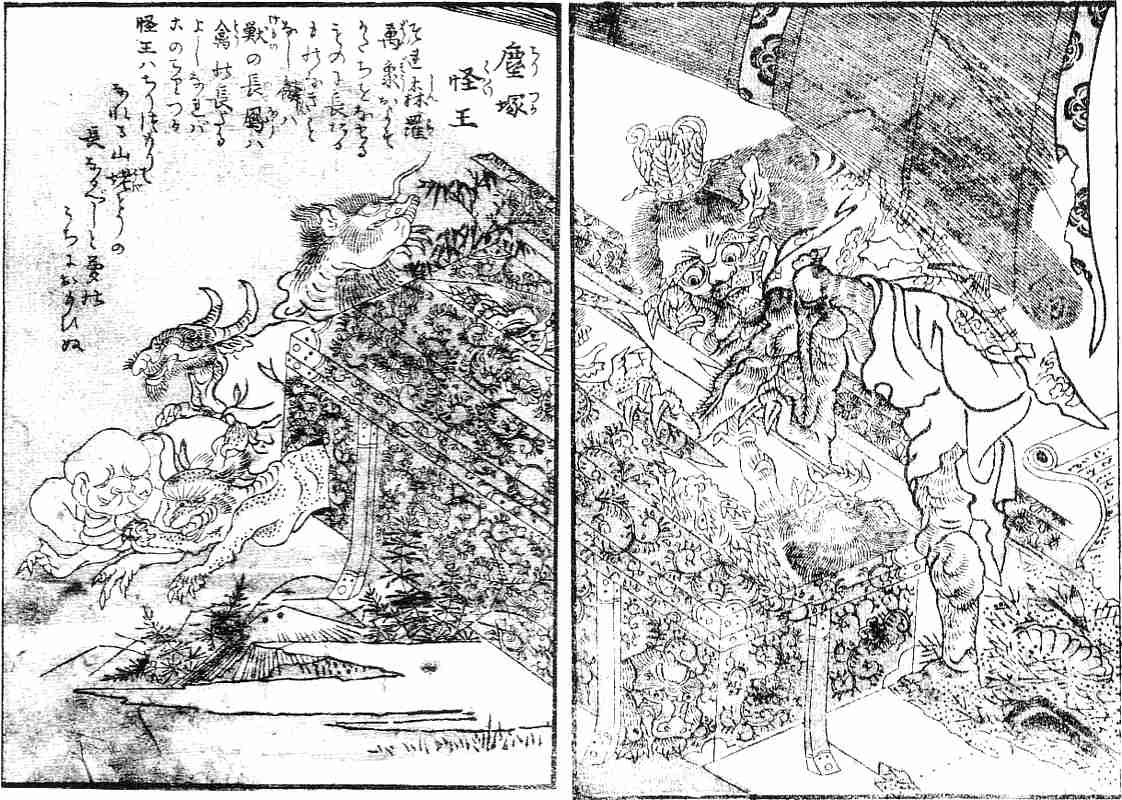
The Tsukumogami ki takes that housekeeping habit and reads it from the tools’ side. Objects discarded at ninety-nine years have been put out precisely on the eve of the spiritual empowerment they were owed, and they know it. Disposal is not tidying in this telling. It is betrayal after a lifetime of service, and the tools respond accordingly.
Ninety-Nine Years and the Pun Behind the Name
The word tsukumogami predates the monster. It appears in a ninth century waka poem in The Tales of Ise, where it described an old woman’s white hair, joining tsukumo with 髪 kami, meaning hair. The first element is of uncertain meaning and has long been read as simply old, expressed metaphorically as ninety-nine years.
The transformation happened through a homophone. 髪 kami, hair, sounds identical to 神 kami, the word for spirit and for the deities of Shinto worship, from Amaterasu downward. Ninety-nine-year hair became ninety-nine-year spirit, and the kanji 付喪神 that now carries the term was fixed in the Tsukumogami Emaki rather than in the original poem.
Named Tsukumogami and the Objects Behind Them
The named tsukumogami read as an inventory of a household rather than a bestiary of wild beasts. The recurring types are possessed straw sandals, paper umbrellas, paper lanterns, futons, tea kettles, sake jars, mirrors, musical instruments, and lengths of cloth, each carrying its own name in the tradition.
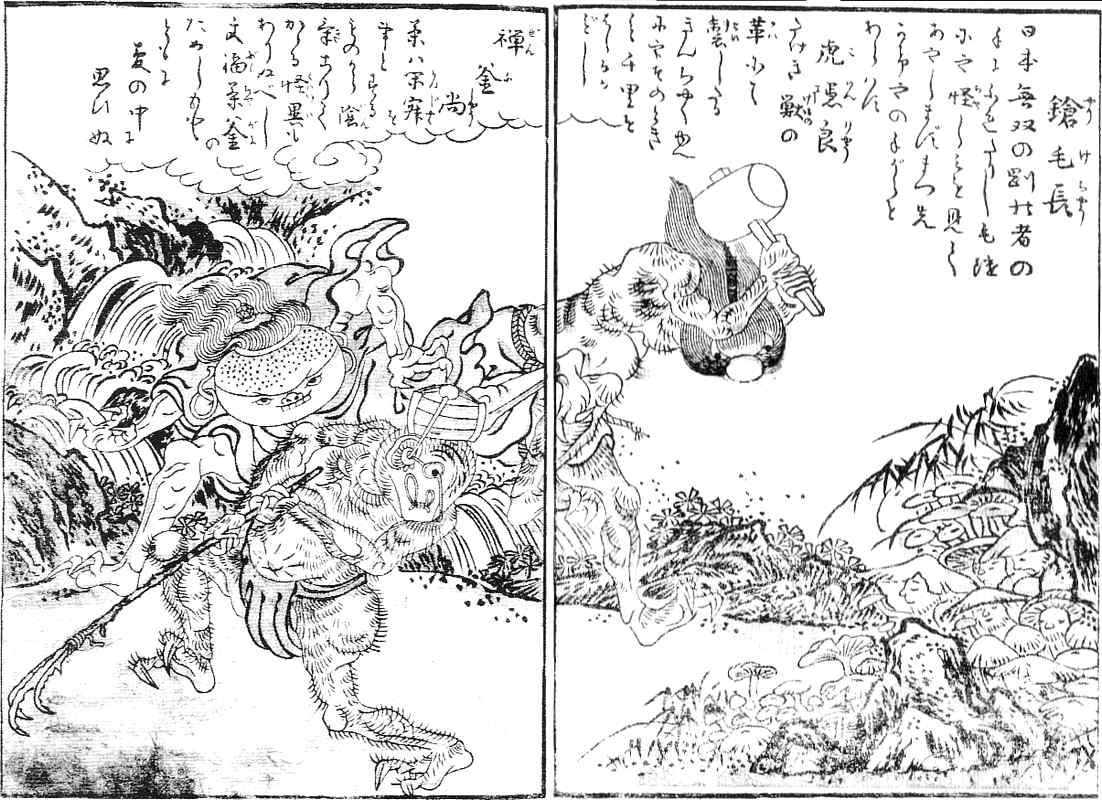
Among the ones the tradition records:
- Bakezori, a possessed pair of straw sandals.
- Kasa-obake, an animated paper umbrella, also given as karakasa-obake, although its origin as a distinct yokai is unknown and it is not attested in the classical sources, so its place in the tsukumogami canon looks like a later attribution.
- Chochin-obake, an animated paper lantern.
- Boroboroton, a possessed futon.
- Biwa-bokuboku and koto-furunushi, an animated lute and a thirteen-string zither.
- Kameosa, a possessed sake jar, and ungaikyo, a possessed mirror.
- Morinji-no-kama, a possessed tea kettle, also recorded as zenfusho.
- Jatai, cloth taken from a folding screen, and kyorinrin, possessed scrolls and papers.
- Ittan-momen, a roll of cotton, and shirouneri, a possessed mosquito netting or dust cloth.
Others in the same lists include abumi-guchi, byobunozoki, furu-utsubo, ichiren-bozu, kosode-no-te, kurayaro, kutsutsura, menreiki, minowaraji, shamichoro, shogoro, yamaoroshi, and zorigami, the possessed clock.
A Revenge Plot With a Doctrinal Payoff
The Tsukumogami ki is a revenge narrative with a doctrinal ending. The discarded tools transform, gain limbs and independent agency, organize themselves collectively, and plot attacks on the people who dumped them. Then the story turns: the objects undergo Buddhist salvation rather than being destroyed.
That ending is the reason the text exists. Objects grasping at a hundred years of service illustrate attachment and delusion, their rage is spiritual confusion rather than malice, and their conversion demonstrates that even a resentful sake jar can be brought to enlightenment. Noriko T. Reider, whose study and translation remain the standard English treatment, argues that by the tenth century these myths were being used to help spread the doctrines of Shingon Esoteric Buddhism to a variety of audiences.
Painted Processions: Where the Familiar Imagery Comes From
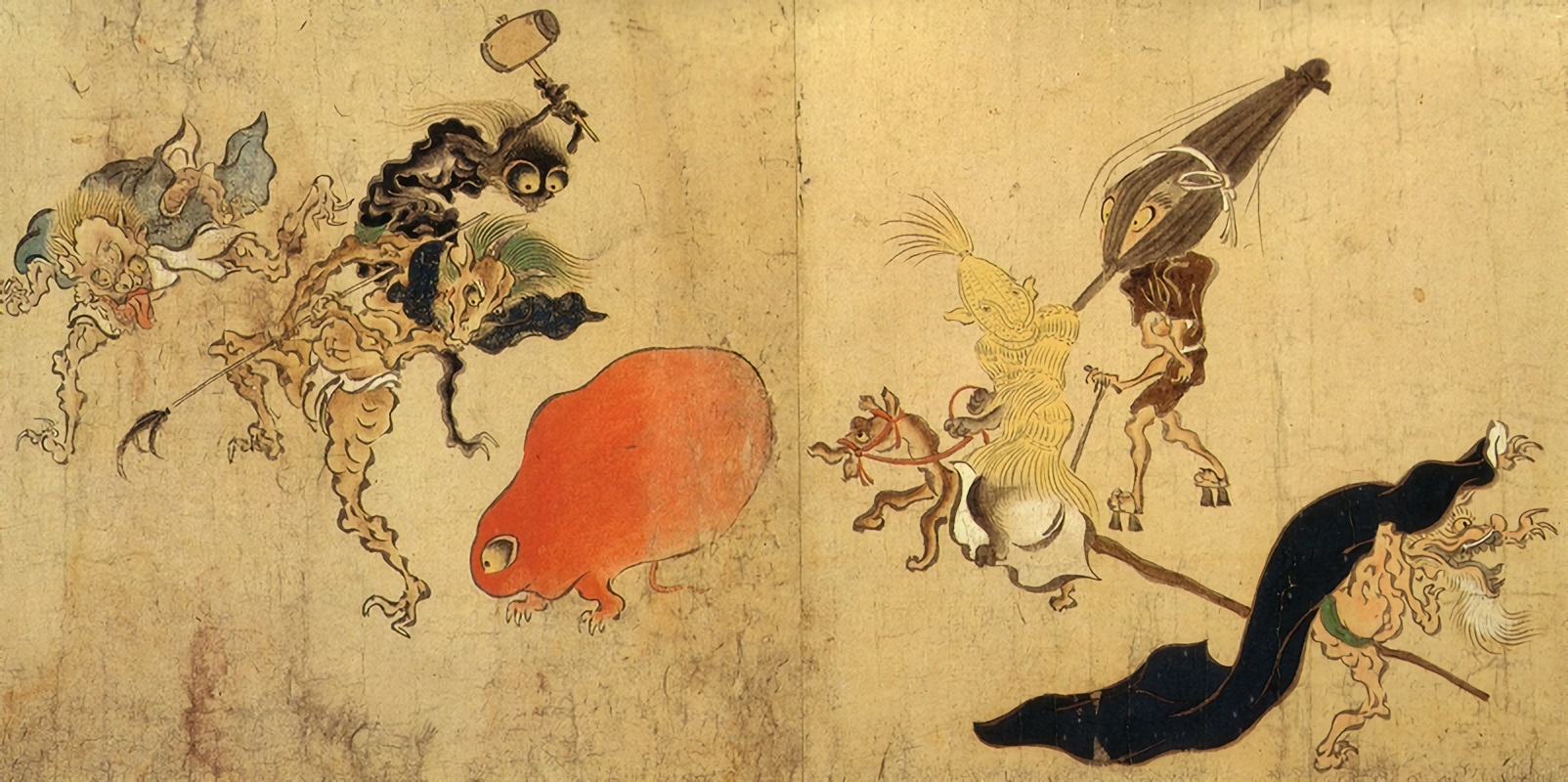
The images most people picture come from the Hyakki Yagyo Emaki, the night parade of one hundred demons, painted in the Muromachi period, 1336 to 1573. Instruments, umbrellas, and cooking utensils walk on their own arms and legs in a procession. Scholars have inferred that the parade shown in these scrolls is the youbutsu, the aged objects, of the Tsukumogami Emaki turned into a festival march.
There is no single authoritative original. Multiple sixteenth century versions survive, along with later copies such as the British Museum scroll of around 1800, and the Kyoto University Rare Materials Digital Archive holds some of the material these comparisons rest on. The visual tradition of mono-no-ke, strange things, was already developing from the Kamakura period onward.
From Buddhist Parable to Edo Print Catalog
During the Edo period, 1603 to 1867, object spirits stopped being religious instruction and became entertainment. The eighteenth century artist Toriyama Sekien treated them as material for illustrated catalogues, drawing entries such as suzuri-no-tamashii, the inkstone spirit, which appears in his Konjaku Hyakki Shui, published circa 1781. Sekien’s figures are witty and self-consciously invented, and they circulated as prints rather than as doctrine.
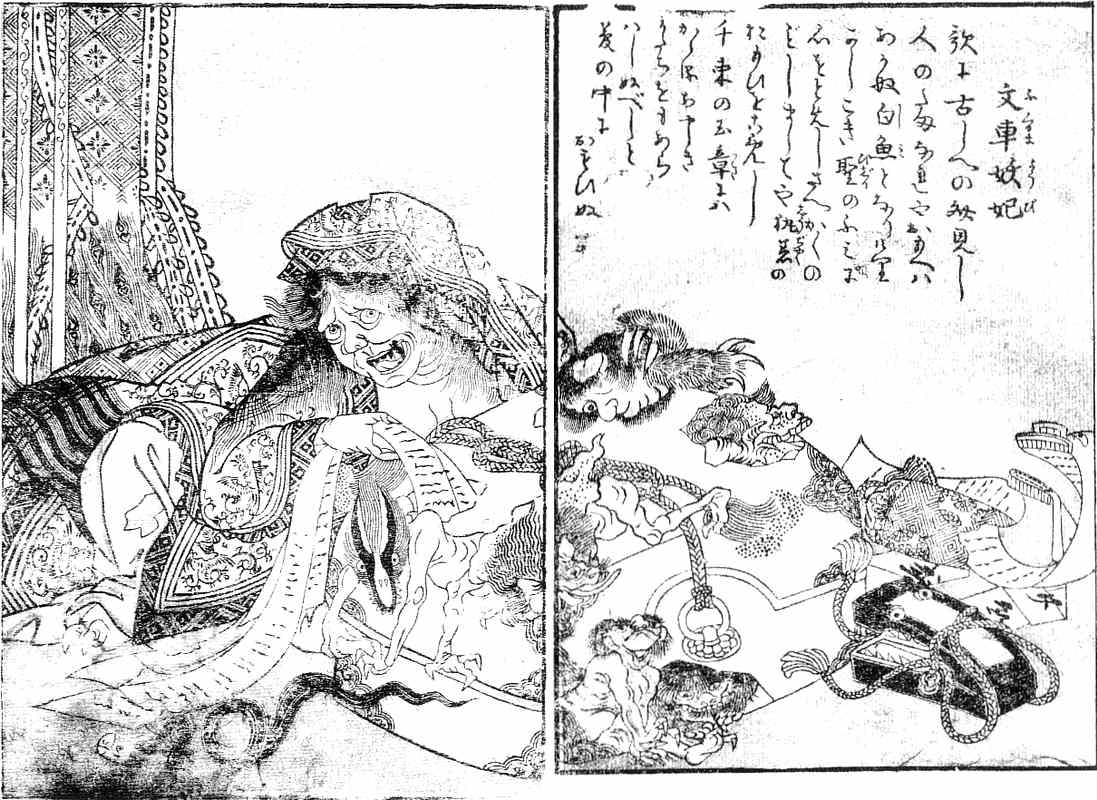
Komatsu Kazuhiko records that belief in tsukumogami declined across more recent generations, and that the Bakumatsu period ukiyo-e which revived the imagery were made in an era already cut off from any actual belief in the idea. By the twentieth century the Buddhist content had become effectively invisible to outsiders, leaving popular folklore where doctrine used to be.
How Much of This Is Documented, and How Much Is Guesswork
The visual record of tsukumogami is stronger than the doctrinal one. Scrolls, prints, and copies survive in quantity and can be compared directly, through collections such as the University of Chicago’s East Asian Scroll Paintings project. Reider’s translation, Michael Dylan Foster’s Pandemonium and Parade, and Meiji period work by Inoue Enryo supply the interpretive frame around them.
What the sources do not deliver is a single fixed definition. The term has been attached to several different concepts over time, and confusion about what it actually means is documented rather than resolved. The popular version, an object that wakes up on its hundredth birthday, is a simplification of a narrower medieval claim about tools that have served nearly that long.
Wearing the Tsukumogami Idea
Object spirits work as design material because the concept is already graphic. A kettle with legs, an umbrella with one eye, a roll of cloth with a face: the joke and the menace are in the silhouette, which is exactly what a print needs. That same instinct for turning an ordinary thing into a character explains a great deal about what yokai symbolize across the wider tradition.
FAQs
What does the word tsukumogami mean?
It began as a poetic term for old white hair, joining tsukumo, long read as simply old and expressed metaphorically as ninety-nine years, with 髪 kami, hair. Because 髪 kami is a homophone of 神 kami, spirit, ninety-nine-year hair became ninety-nine-year spirit, and the kanji now used, 付喪神, was fixed later in the Tsukumogami Emaki.
How long does an object take to become a tsukumogami?
The Tsukumogami ki sets the threshold at a service life of nearly one hundred years, after which containers, tools, and instruments receive souls. The associated number is ninety-nine, which comes from the old reading of tsukumo as ninety-nine years, and objects discarded at that point are the ones the stories treat as dangerous.
Are tsukumogami evil?
Not in the source text. Their anger is presented as spiritual confusion born of attachment rather than malice, and the Tsukumogami ki ends with the objects undergoing Buddhist salvation instead of being destroyed. The malevolent version, in which discarded tools simply attack, is what remained after the doctrinal framing faded.
Is a tsukumogami a yokai?
It is usually treated as a specialized branch of the yokai family, covering possessed objects specifically rather than creatures or ghosts. The boundaries are genuinely unsettled, because the term has been applied to several different concepts in Japanese folklore over time.
What is the most famous tsukumogami story?
The Tsukumogami ki itself, in which household tools thrown out during the New Year cleaning transform, band together, plot revenge on their former owners, and are then brought to Buddhist salvation. Its imagery survives most visibly in the Hyakki Yagyo Emaki scrolls of animated objects parading through the night.
If old tools with minds of their own belong on a shirt as much as in a scroll, Kamicrew’s yokai collection is where these legends turn into wearable graphics.
Kamicrew Best Seller

Dont Touch Me Yokai Ukiyo-E Japanese T-Shirt
$25.49+
$29.99
(15% off)


Summer Vibes Salty Kawaii Japanese Hoodie
$44.99+
$49.99
(10% off)


Japanese Pin Horror 80s Retro Aesthetics T-Shirt
$25.49+
$29.99
(15% off)


El Gran Maja Japanese Kaiju T-Shirt
$25.49+
$29.99
(15% off)


Who Wants The Perfect Body Japan Capybara Kawaii Japanese Unisex Shirt
$25.49+
$29.99
(15% off)


Monster 8 Mask Vintage Animal Hoodie
$44.99+
$49.99
(10% off)


I Hate People Japanese Opossum Vintage Animal Hoodie
$44.99+
$49.99
(10% off)


I Got That Dog In Me Small Turtle Vintage Animal T-Shirt
$25.49+
$29.99
(15% off)

The Creation Of Cat Ukiyo-E Japanese T-Shirt
$25.49+
$29.99
(15% off)