

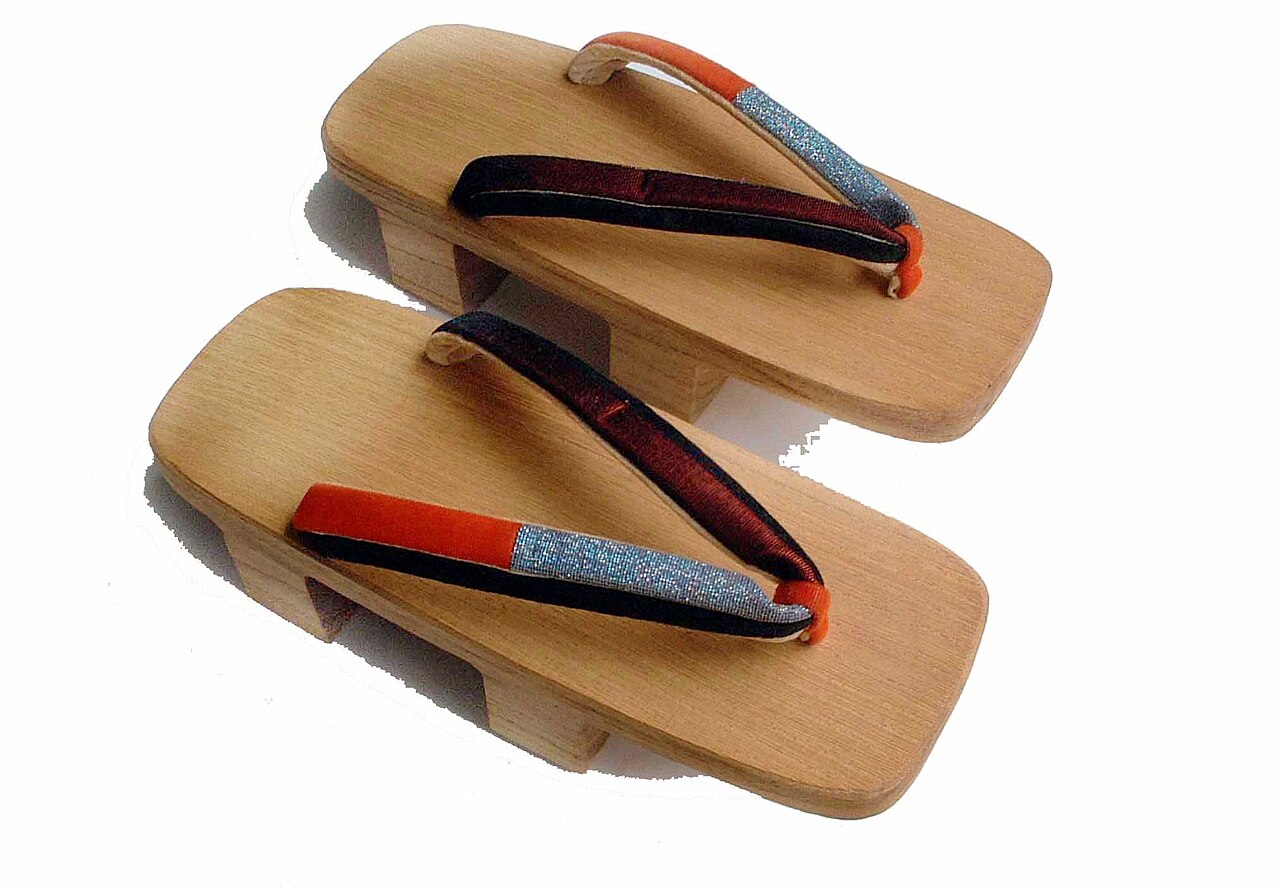
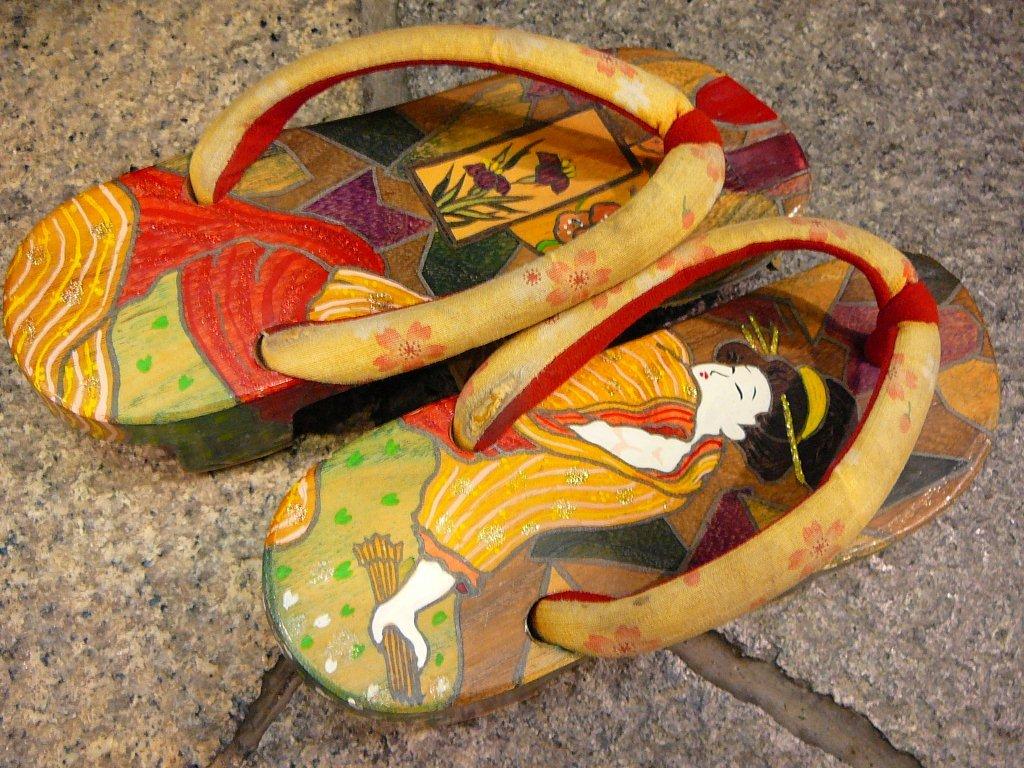
Geta (下駄) are traditional Japanese sandals: a flat wooden base held on the foot by a fabric thong and lifted off the ground by one to three wooden teeth, most often two. The height is the whole point. It kept a wearer’s feet, and the hem of the clothes above them, clear of dirt, water and snow. A pair has three named parts: the dai (base), the ha (teeth) and the hanao (thong).
The word covers a wide family of shoes rather than one design. Plain pairs for summer sit at one end, and at the other are the training pairs balanced on a single tooth. In between sit rain geta, the three toothed platforms worn by high ranking courtesans, and the solid lacquered blocks that apprentice geisha still wear in Kyoto. Most of what is left of that range now shows up in festival crowds and kimono districts rather than on a daily commute. This guide covers what a pair is made of, where geta came from, what each named type is called, and how to walk in them.
What Geta Sandals Are Made Of
Almost every pair of geta, from cheap festival wear to a lacquered antique, is built from three parts. The board the foot rests on is the dai (台), literally “stand”. The blocks beneath it are the ha (歯), meaning “teeth”. Running between the big toe and the second toe is the hanao (鼻緒), a V shaped cloth thong.
The “teeth” name is taken from what a pair looks like in profile. The wood matters more than it looks. Paulownia, known in Japanese as kiri, is prized because it is very light, and a pair cut from it costs accordingly; cedar is the other common choice. The teeth are usually not glued on but carved from the same block as the base, with harder wood drilled into the bottom so they do not split, and some pairs get a metal plate or a glued rubber sole on the contact surface to stretch their life. When there are two teeth, the front one sits under the ball of the foot and the geta pivots on it as you walk, while the rear one sits under your standing centre of gravity.
That pivot is what produces the sound. Japanese calls it karankoron (カランコロン), the wooden clack that follows a wearer down a street. Solid wood has its costs too: geta are heavy to lift and hard underfoot compared with anything cushioned, and there is no left and right shoe, much like a Western wooden clog.
The dai shape carries a quiet gender code. Oval bases read as feminine and squarer, more rectangular ones as masculine, with finishes ranging from bare wood to lacquer and wood stain. Straps vary just as much: wide and padded or narrow and hard, in printed cotton with traditional motifs, or in vinyl and leather. Inside the hanao runs a cord, hemp traditionally and synthetic now, knotted in a particular way through the three holes in the dai. The thong sits in the middle rather than off to one side because on a rectangular base any other position would make the inner back corners collide as you walk. Straps are replaceable, but breaking one is considered very unlucky.
The History of Geta, From Rice Paddies to Edo Fashion
Geta descend from wooden clogs made in China, arriving in Japan as farm footwear long before they became fashion.
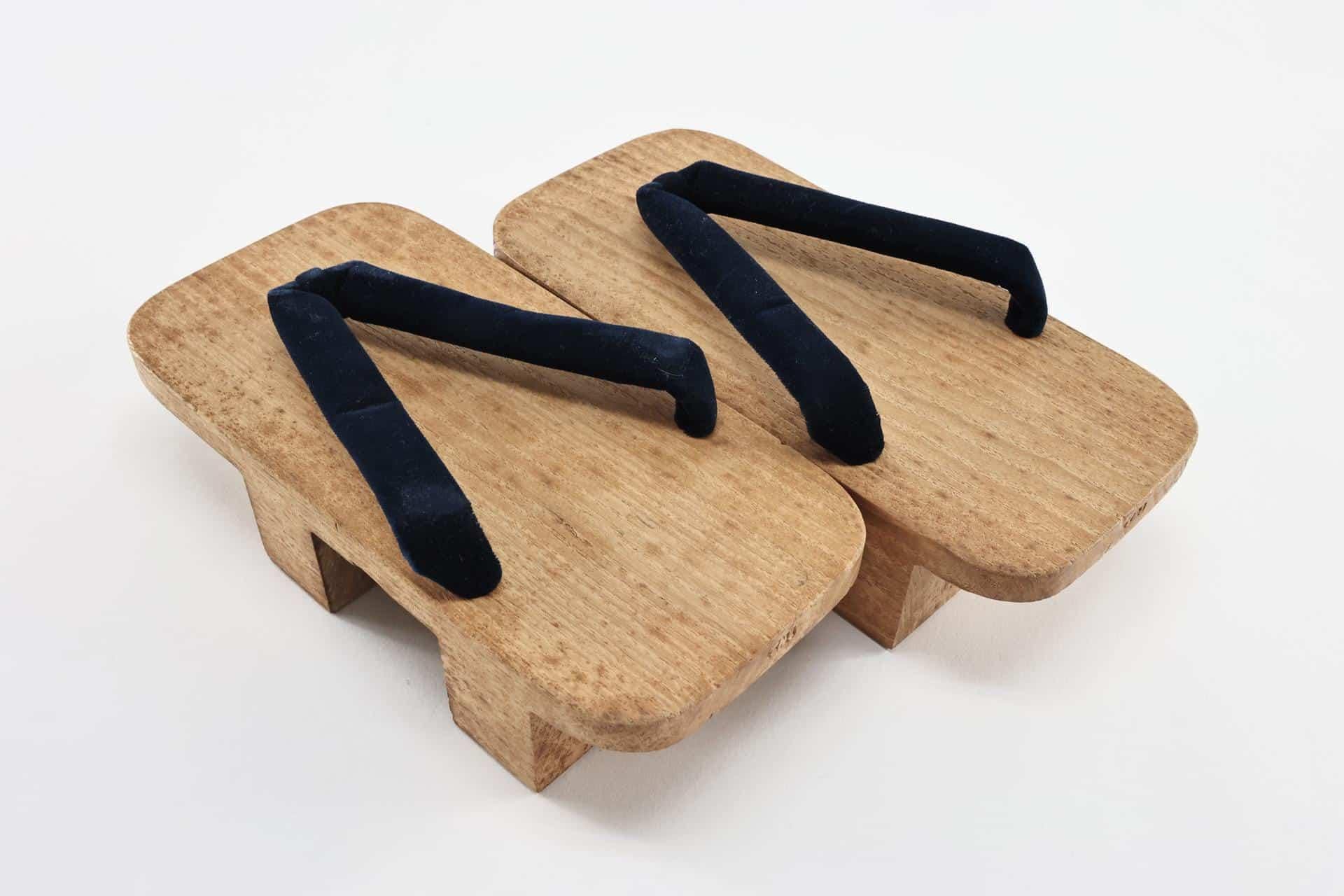
The oldest known pair comes from a Liangzhu culture site near Ningbo, in Zhejiang, roughly 3400 to 2250 BCE, and was built differently from a modern one, with five or six holes rather than three. Chinese records mention wooden clogs from the Spring and Autumn period (771 to 476 BCE) through the Qin (221 to 206 BCE) and Han (202 BCE to 220 CE) dynasties, and geta style shoes were still worn in southern China until sometime between the Ming and Qing dynasties. Wooden shoes of a similar kind from Korea’s Joseon dynasty, called namaksin, have also been dug up. The likeliest route is that geta came out of southern China and reached Japan later; Japanese examples from the latter part of the Heian period (794 to 1185) were found in Aomori in 2004 during an excavation on the right bank of the Shinjo river.
The farm version was called ta-geta, named for ta, the rice field, because ordinary footwear was useless in soft mud. Those had no teeth and straw thongs. A stranger cousin, nezura-geta, had needles fixed to the sole like spikes and was worn on beaches and in shallows for catching fish. By the Heian period the raised sole was doing its familiar job of holding a hem 4 to 5 cm above the mud and snow, which is also why sushi chefs favoured tall pairs: it kept their feet away from the scraps on the kitchen floor. Priests climbing mountains wore a one toothed type called takaba, a design suited to slick mountain paths.
What ordinary people switched to instead was plain straw zouri, which left geta a rare and expensive thing. In the Edo era (1603 to 1868), geta returned as fashion: they stopped being only wet weather footwear and started being worn on dry days too from the middle of the period, and workshops multiplied until more than 200 kinds were being made. Not much of that production was wasteful, either. The owner of Naito, one of the best known footwear makers, cut his geta from the leftovers of his own timber and textile businesses.
Japanese Sandal Names: Geta, Zori, Waraji, and Setta
Four names cover most traditional Japanese sandals, and outside Japan they get mixed up constantly because of a shared family resemblance: all four use a V shaped hanao thong, leave the toe open, and fit either foot. What actually separates them is sole material and the setting each is acceptable in, from a rice paddy to a tea ceremony. The table below lays out those differences at a glance; the sections after it cover why each shoe ended up where it did.
Waraji
Waraji are grass or straw sandals, woven by hand and tied to the foot with strings around the ankle. They were the footwear of commoners, from farmers to monks, and farmers wove them during the off season as a second income. Straw is breathable and suits a humid Japanese summer, which is why waraji also came to stand for humble, frugal living. Buddhist monks and yamabushi, the mountain worshippers, wore them on pilgrimages involving long walks over rough ground, and a few rural towns still weave them, mostly for visitors.
Zori
Zori translates roughly as grass or straw shoe. The sole is woven from jute or straw, and several woven layers are stacked so the finished sandal is a low platform with the heel slightly raised. Many are upholstered in leather or textile so the weave never shows. Rounded, elevated and neat, zori read as formal, and they are the sandal for the more dressed-up types of kimono at a tea ceremony, a wedding, an ikebana gathering or a shrine ritual. In modern usage zori has drifted towards meaning women’s sandals.
Setta
Setta (雪駄) are usually credited to the tea master Sen no Rikyu, who wanted footwear for snow and rain that would keep a guest’s feet dry and let them cross a garden without slipping or leaving marks in the snow. Monks and samurai adopted them for that mix of dignity and practicality before townspeople and artisans made them an everyday shoe. Metal heel pins called chara-gane gave setta their signature chara-chara sound, a deliberate piece of Edo period style. Setta have since become gendered as men’s sandals, though modern handmade pairs with cushioned footbeds and rubber soles are sold as unisex.
| Geta 下駄 | Zori | Waraji | Setta 雪駄 | |
|---|---|---|---|---|
| Sole | Wooden, raised on teeth | Woven straw or jute, layered | Hand woven straw or grass | Flat layered platform, leather |
| Height | About 5 cm to 20 cm | Low platform, slight heel | Flat | Flat and low |
| Held on by | Hanao thong, no left or right | Hanao thong | Thong plus ankle strings | Hanao thong, padded footbed |
| Sound | Loud wooden clack | Quiet | Quiet | Chara-chara from heel pins |
| Worn with | Yukata, festivals, summer | Kimono at formal occasions | Work, pilgrimage, farm dress | Formal or casual daily wear |
Types of Geta and Their Names
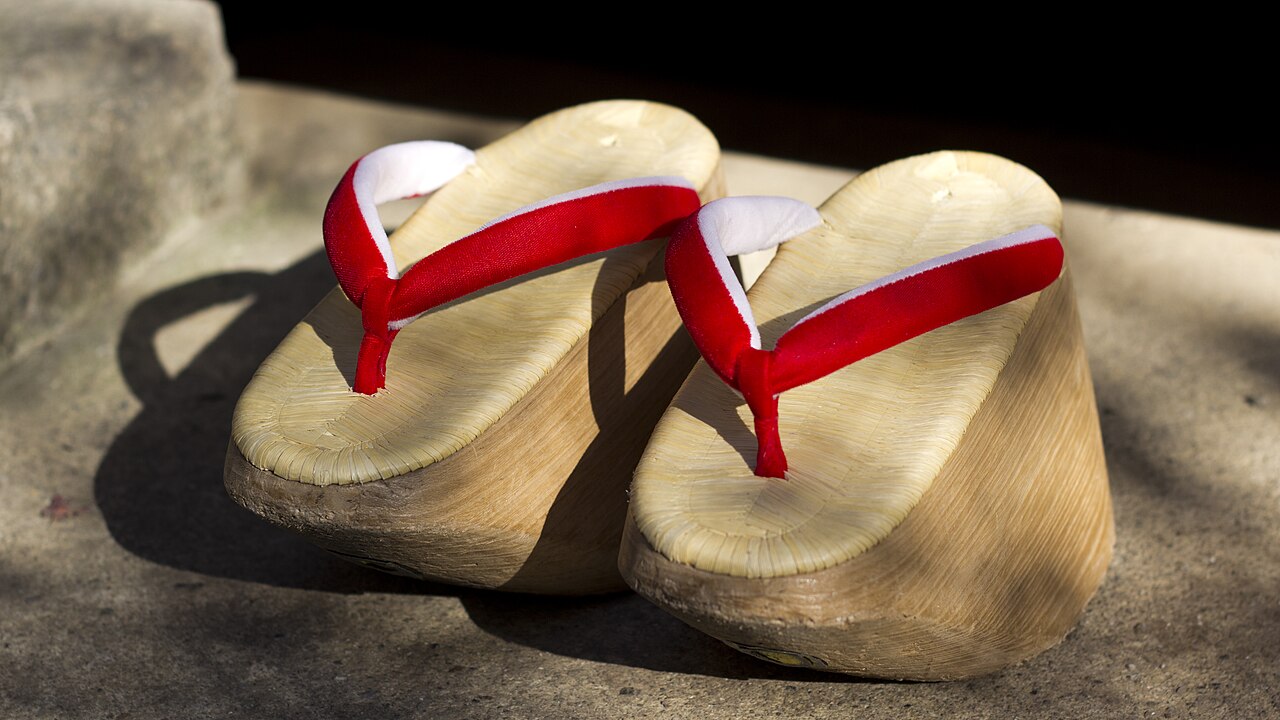
Geta types are named for their teeth: how many, how tall, and who wore them. Two toothed pairs run from about 5 cm to 18 cm. Single toothed tengu geta and ippon-geta stand 14 to 20 cm. Koma-geta carry three tall lacquered teeth. Okobo have no teeth at all and are cut from one solid block, 10 to 13 cm high.
| Name | Teeth | Height | Worn by |
|---|---|---|---|
| Plain low geta | Two | About 5 cm | Everyday and summer wear |
| Takai geta | Two | About 10 cm | Anyone wanting more height |
| Ashida | Two, tall | About 18 cm | Rain and mud |
| Ta-geta | None | Flat board | Yayoi period rice farmers |
| Nezura-geta | None, spiked sole | Flat board | Fishers in beaches and shallows |
| Takaba | One | Tall | Heian priests on mountain paths |
| Tengu geta, ippon-geta | One, centred | 14 to 20 cm | Ascetics, fish merchants, balance training |
| Koma-geta, mitsu-ashi | Three | Tall, lacquered | Oiran in procession |
| Okobo, pokkuri, koppori | None, solid block | 10 to 13 cm | Maiko and young girls |
The single toothed geta is the one people photograph. Monks and mountain ascetics were wearing 20 cm versions more than a thousand years ago on the theory that standing and hiking on one tooth builds posture, core strength and balance, which is close to walking on stilts, and small groups in Japan still train in them. The name tengu geta comes from the tengu, the long nosed, red faced creature of Japanese folklore said to have worn them. The same tall, long toothed design had a much less mystical use: seafood and fish merchants wore it to stay above the scraps on their shop floors.
Okobo go the other way. The middle of the block is hollowed out from below and the front is sloped so walking is possible, which makes them close relatives of the chopines worn in Renaissance Venice. Maiko, apprentice geisha, wear them high enough to keep an elaborate hem off the ground and to make the wearer’s status visible at a glance. Very young girls wear a version with a small bell set into a cavity in the sole, usually in red, and not with a yukata but with a bright formal kimono for Shichi-Go-San. Oiran, the high ranking courtesans of the feudal period, went taller still in lacquered koma-geta, and unlike geisha and maiko they refused tabi socks even in winter, because a bare foot against lacquer was read as erotic.
How to Wear Geta Without Wobbling
Geta are worn deliberately too small. The heel should overhang the back of the dai, with about a finger’s width between the strap and the webbing of the toes. The toes then pinch the thong to lift the front at each step. That position puts the teeth under the wearer’s centre of gravity, which is what stops the wobble.
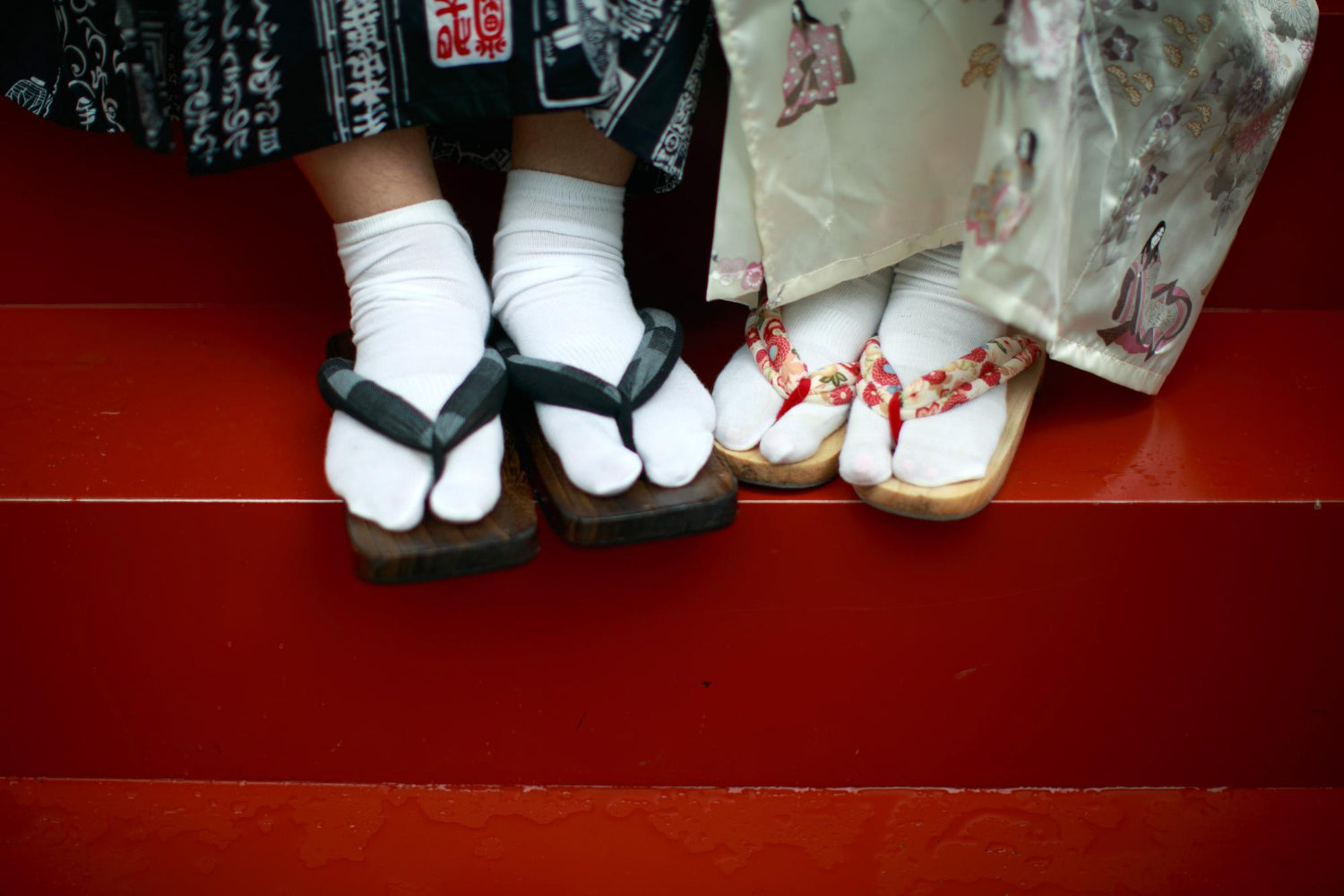
Feet hanging off the back of a pair look like a sizing mistake, and that is the usual assumption on first sight. It is not one.
Socks depend on what you have on. Geta belong with a yukata or other informal Japanese clothes, and sometimes with Western clothes in summer, and worn that way they need no socks at all; when tabi are involved, slightly more formal zori are the ordinary choice. White tabi with geta is still a common festival pairing, and okobo are normally worn with tabi.
Rain is fine, snow less so. The extra height and the impermeable wood keep feet dry, and because a geta sole does not flex it will not flick water and grit up the backs of your legs the way a soft sandal does. Snow is the problem: it packs into the teeth and makes walking awkward, so geta are not usually a snow shoe now, even though they were historically. Removable toe covers exist for cold and wet weather.
Where Geta Still Turn Up Today
Geta survive as occasion wear rather than daily footwear. Sumo requires them of new recruits. Summer festivals and Kyoto’s kimono rental shops keep them in circulation, the raised sole resurfaced in the atsuzoku platform shoes of the late 1990s, and museums now collect antique pairs as objects in their own right.
Footwear marks rank in the sumo stable, and as The Japan Times has explained, new recruits wear geta, wrestlers who have proved themselves move up to setta, and only the highest ranked get tabi.
Kyoto’s kimono rental shops have multiplied along with foreign visitors, and a session with a kimono, geta and often a traditional hairstyle runs 3,000 to 6,000 yen. Walking in them is awkward for the first ten minutes and then it is not.
The height also had a second life in fashion. By the late 1990s designers were competing over how tall a sole they could get away with, and the result was a hit with young women in a way that ran straight back to geta; the trend is one of the more recognisable threads in Japanese fashion of the 1990s. Noritaka Tatehana’s heel-less shoes, the ones that reached a global audience through Lady Gaga, are also credited to geta as a starting point. Manufacturers have met Western feet halfway too, with rounder shapes, ergonomically cut dai, a thick clog style heel instead of separate teeth, and the thong moved to the side like a flip-flop.
The Metropolitan Museum of Art holds a pair of women’s geta dated to the late 19th or early 20th century, built from wood, raffia and natural fibres. And one habit tied to geta outlasted the shoe: Japan still takes footwear off at the door, a practice that started to protect tatami flooring and stayed because a sandal you can step out of makes it effortless.
FAQs
What are geta sandals?
Geta are Japanese wooden sandals. A flat board called the dai carries the foot, one to three wooden teeth raise it off the ground, and a V shaped cloth thong called the hanao holds it on. There is no left or right shoe in a pair. Geta are worn with yukata and other traditional Japanese dress.
Are geta hard to walk in?
Geta are awkward at first rather than genuinely difficult. Solid wood is heavy and unforgiving underfoot, there is no cushioning, and the raised teeth demand that the wearer keep their weight over them, so the first walk in a new pair feels unsteady. Setting the heel over the back edge of the base and pinching the thong with the toes fixes most of the wobble.
Do people in Japan still wear geta?
Rarely as an everyday shoe, but yes for specific occasions. Someone who owns a pair might wear it a handful of times a year rather than for a daily commute, which is why the shoe reads as festive rather than practical to most people under 60. Modern versions with clog style heels and side mounted thongs are also sold for use with Western clothes, but the switch to sneakers and formal leather shoes decades ago ended geta as routine footwear for most of the population.
What is the difference between geta and zori?
The sole. Geta stand on wooden teeth, while a zori sole is woven and sits flat to the ground. That difference sets the register of each: zori are what people wear with kimono at formal occasions, and geta are the festive, summer end of the wardrobe.
Do you wear socks with geta?
Not necessarily. Bare feet are the default, because geta go with informal dress. Once tabi are on, zori are the more usual sandal, with festival outfits and okobo the two standing exceptions.
If the ukiyo-e prints that recorded all of this footwear are more your thing than the sandals themselves, Kamicrew’s ukiyo-e print shirts put the same woodblock imagery on something easier to walk in.
Kamicrew Best Seller

Dont Touch Me Yokai Ukiyo-E Japanese T-Shirt
$25.49+
$29.99
(15% off)


Summer Vibes Salty Kawaii Japanese Hoodie
$44.99+
$49.99
(10% off)


Japanese Pin Horror 80s Retro Aesthetics T-Shirt
$25.49+
$29.99
(15% off)


El Gran Maja Japanese Kaiju T-Shirt
$25.49+
$29.99
(15% off)


Who Wants The Perfect Body Japan Capybara Kawaii Japanese Unisex Shirt
$25.49+
$29.99
(15% off)


Monster 8 Mask Vintage Animal Hoodie
$44.99+
$49.99
(10% off)


I Hate People Japanese Opossum Vintage Animal Hoodie
$44.99+
$49.99
(10% off)


I Got That Dog In Me Small Turtle Vintage Animal T-Shirt
$25.49+
$29.99
(15% off)

The Creation Of Cat Ukiyo-E Japanese T-Shirt
$25.49+
$29.99
(15% off)