
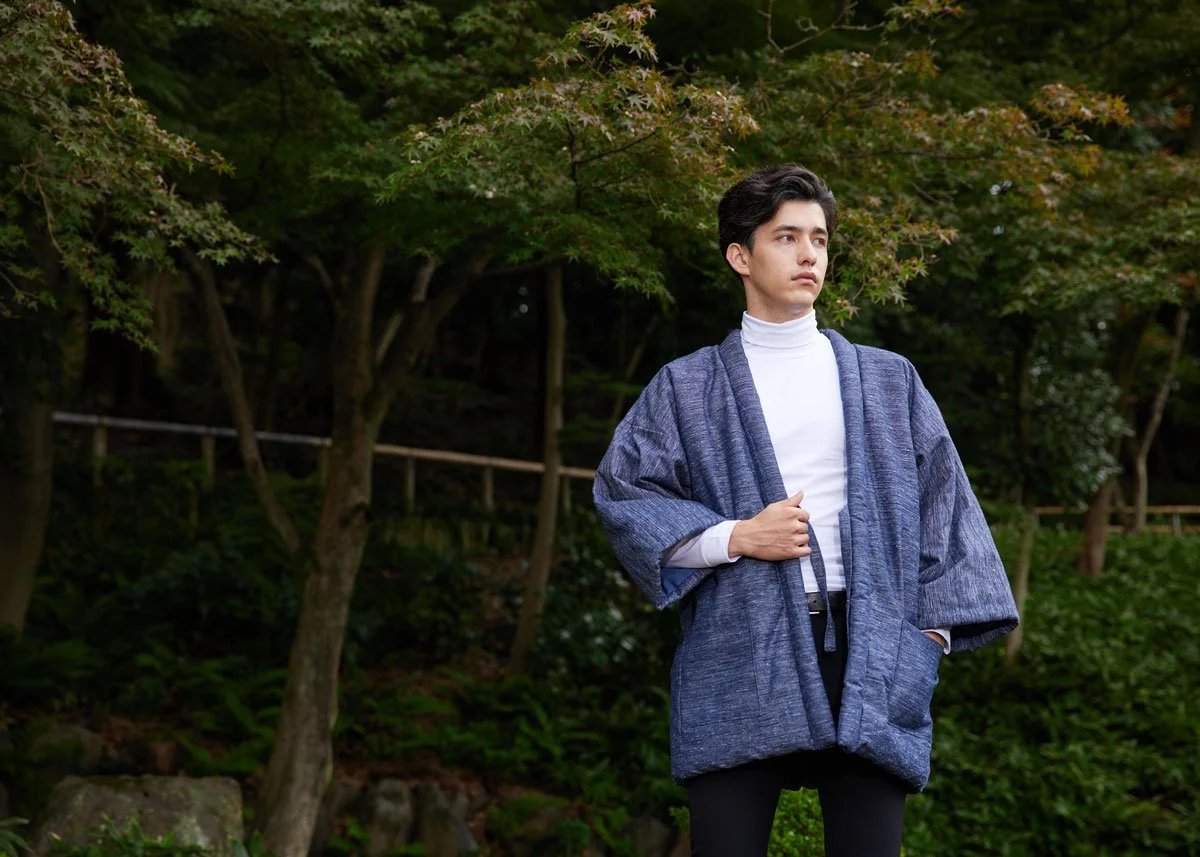
A hanten is a short, cotton-padded coat that has kept Japanese households warm since the Edo period, cut to hip or mid-thigh length and worn over a kimono or on its own. Unlike thinner traditional jackets, a hanten sandwiches quilted cotton batting between its outer shell and lining, which is why it has worked for centuries as both indoor loungewear and a light outdoor coat. It is worn by both men and women, closes with a simple front tie rather than buttons or a sash, and is still made and sold across Japan today.
What Is a Hanten?
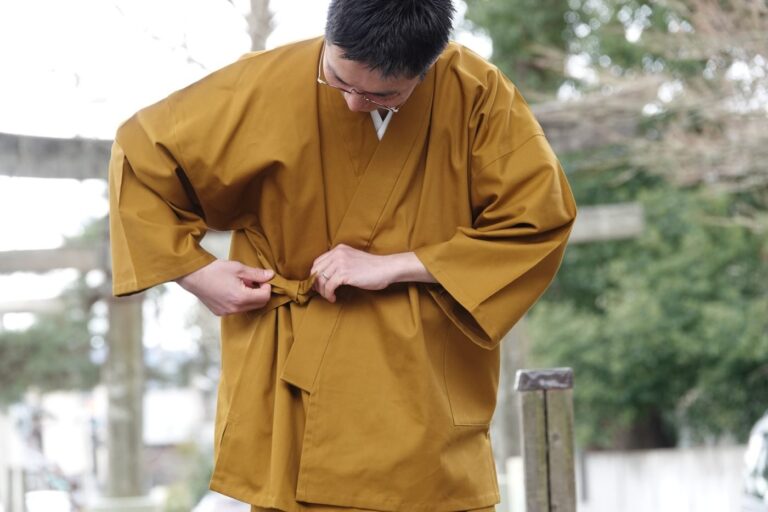
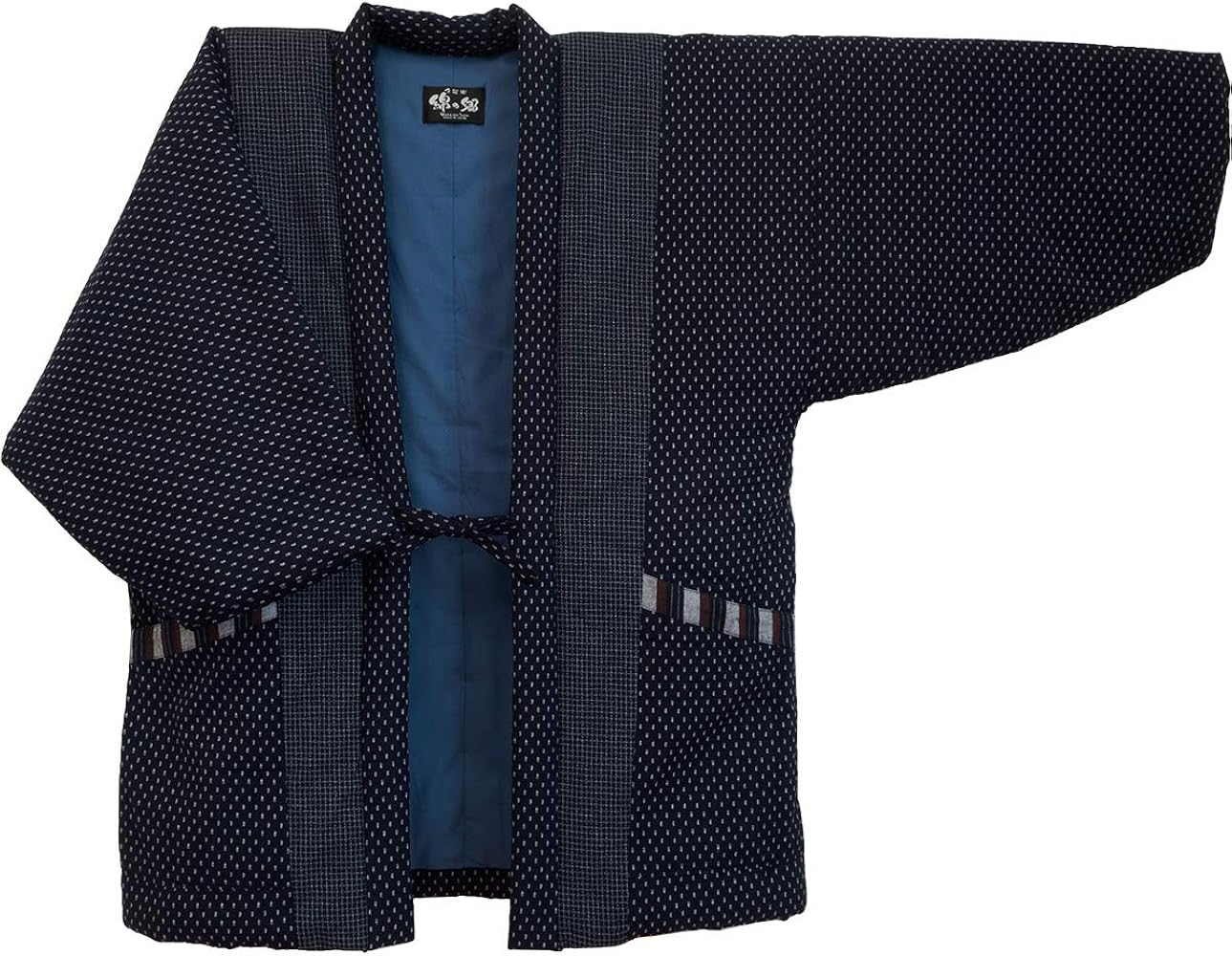
A hanten (also written 半纏, 半天, or 袢天) is a short, cotton-padded winter coat traditionally worn by Japanese men and women, cut to about mid-thigh with three-quarter-length sleeves and a black sateen collar. It is quilted with wadded cotton for warmth and often displays a family crest or pattern on the back.
It is one of the standard pieces of traditional Japanese clothing for men and women alike, with a shape that resembles a noragi patchwork work jacket and a haori. The fit is loose enough that most hanten are made in a single size rather than tailored per body type.
There is no real difference in cut between men’s and women’s versions; the distinction mostly comes down to color and pattern, with men’s hanten tending toward darker, plainer designs and women’s running brighter and more decorative, the same general split seen across traditional Japanese clothing for women.
History and Origins
Common people began wearing hanten during Japan’s Edo period (1603 to 1867), starting in the 18th century. Unlike the haori, which was restricted to certain social classes, a hanten could be worn by anyone, making it the everyday jacket of merchants, artisans, and laborers rather than a rank-based garment tied to samurai clothing.
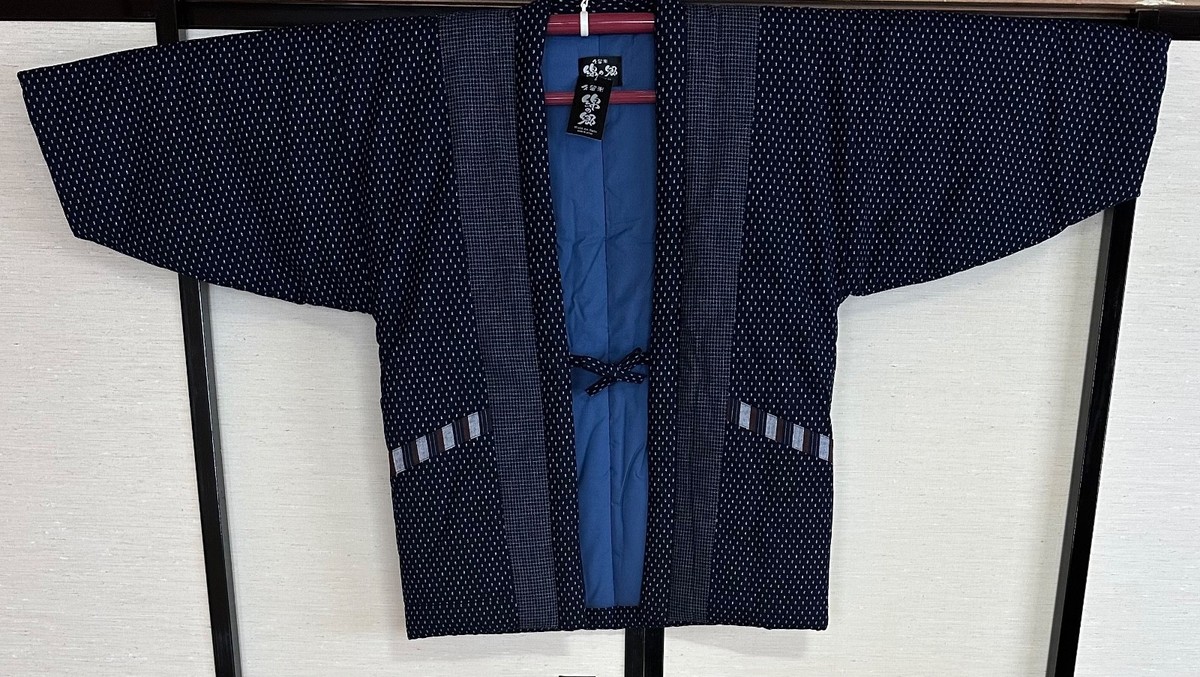
Production of hanten has centered on Kurume, a city in the Kyushu region, since the 1800s, using Kurume Kasuri, an indigo-dyed cotton weave developed through techniques introduced by Den Inoue. The Japanese government designated Kurume Kasuri an important intangible cultural property in 1957, and domestic hanten manufacturing is still concentrated in and around Kurume today. According to a 2022 report by The Mainichi, the jacket’s everyday use waned once fleece and other synthetic clothing became widely available, though it never disappeared from Japanese wardrobes entirely.
Types and Variations
A hanten is often confused with a few other short Japanese jackets that share a similar silhouette but serve different purposes. The clearest way to tell them apart is by padding, length, and whether the garment is meant to go over a kimono.
| Garment | Padding | Length | Worn over kimono | Typical use |
|---|---|---|---|---|
| Hanten | Thick cotton padding | Mid-thigh | Optional | Everyday winter wear |
| Haori | Thin or unpadded | Hip-length | Yes | Dressier occasions |
| Happi | Unpadded, plain cotton | Hip-length | No | Festivals and uniforms |
| Tanzen | Thick cotton padding | Full-length robe | Yes, closed with an obi | Cold-region indoor wear |
The haori comparison is the one people ask about most: both jackets are hip-length and worn over a kimono, but a hanten is thickly padded for warmth while a haori is a much thinner, lighter layer, and historically it was the haori, not the hanten, that carried class restrictions and formal lining details. A happi has a similar cut but is unpadded and meant as casual or uniform wear, often marked with large kanji or a company crest on the back, and today the terms hanten and happi are sometimes used interchangeably even though a happi was never designed to be a padded cold-weather coat. A tanzen is the odd one out: it is a full-length robe rather than a hip-length jacket, worn left over right and closed with an obi sash the same way a kimono is fastened, and it is more associated with the colder northern regions of Tohoku and Hokkaido.
Modern-Day Use and Revival
Hanten use never disappeared and has picked back up in recent years. The Mainichi’s 2022 reporting found demand for padded hanten rising as more people worked from home to save on heating costs, while younger buyers were drawn to the garment’s distinctly Japanese feel.
Production in Chikugo, part of Fukuoka’s historic hanten-making area, had fallen from roughly 3 million jackets a year at its 1980s peak to about 20,000, yet one local manufacturer reported that its online hanten sales doubled in fiscal year 2020 alone.
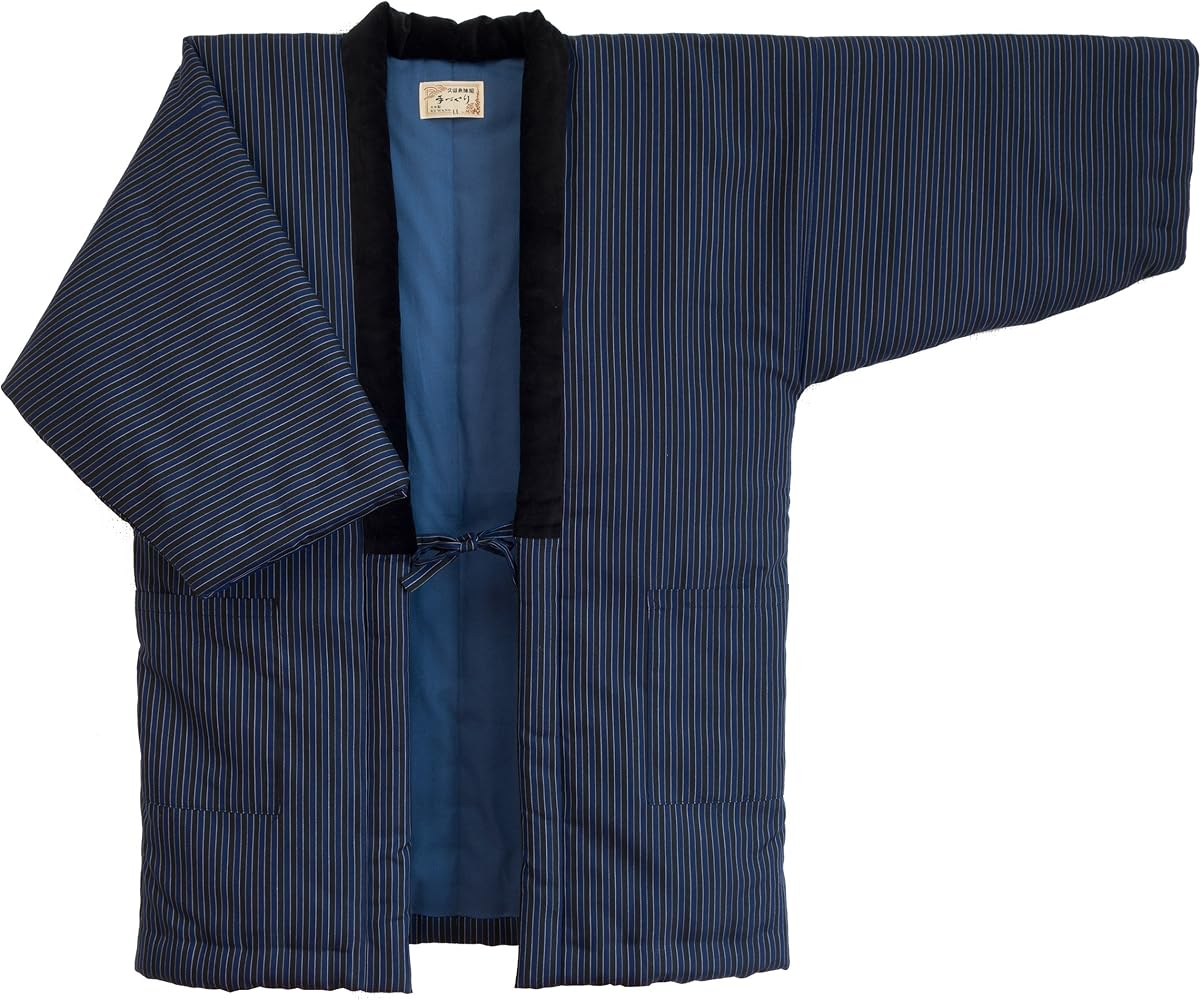
Many Japanese homes still rely on space heaters, electric carpets, and kotatsu tables rather than central heating, so a hanten continues to earn its keep as an eco-friendly way to stay warm indoors during winter. It is worn at festivals, over pajamas, layered on top of a kimono, or thrown over a T-shirt and jeans, and the same loose, one-size construction that makes it easy to layer over a kimono also makes it easy to wear at home alongside a yukata on a cold night. Because it is a cotton garment padded with a cotton and polyester blend, care stays simple: hand wash in warm water with a neutral detergent, skip the tumble dryer, and dry it in the shade so direct sunlight does not fade the fabric.
FAQs
What is a hanten?
A hanten is a short, cotton-padded winter coat from Japan, cut to about mid-thigh with three-quarter sleeves and closed with a simple front tie. It dates to the 18th century and was originally worn by common people rather than the upper classes.
What is the difference between a hanten and a haori?
A haori is hip-length like a hanten and also worn over a kimono, but it is a thin, unpadded or lightly lined jacket, while a hanten is thickly padded for warmth. Historically, wearing a haori was also restricted to certain social classes, while a hanten was available to anyone.
Can you wear a hanten over a kimono?
Yes. A hanten was originally designed to be worn over a kimono, though it does not require one and is just as commonly worn over a T-shirt, pajamas, or everyday clothing.
Is a hanten only worn in winter?
A hanten is padded for cold-weather warmth, so it is mainly worn during winter, but its light, breathable construction also makes it comfortable at night or at festivals outside the coldest months.
If a padded, kimono-inspired layer sounds like something worth adding to your own winter rotation, Kamicrew’s collection of Japanese-inspired outerwear is worth a browse.
Kamicrew Best Seller

Dont Touch Me Yokai Ukiyo-E Japanese T-Shirt
$25.49+
$29.99
(15% off)


Summer Vibes Salty Kawaii Japanese Hoodie
$44.99+
$49.99
(10% off)


Japanese Pin Horror 80s Retro Aesthetics T-Shirt
$25.49+
$29.99
(15% off)


El Gran Maja Japanese Kaiju T-Shirt
$25.49+
$29.99
(15% off)


Who Wants The Perfect Body Japan Capybara Kawaii Japanese Unisex Shirt
$25.49+
$29.99
(15% off)


Monster 8 Mask Vintage Animal Hoodie
$44.99+
$49.99
(10% off)


I Hate People Japanese Opossum Vintage Animal Hoodie
$44.99+
$49.99
(10% off)


I Got That Dog In Me Small Turtle Vintage Animal T-Shirt
$25.49+
$29.99
(15% off)

The Creation Of Cat Ukiyo-E Japanese T-Shirt
$25.49+
$29.99
(15% off)