
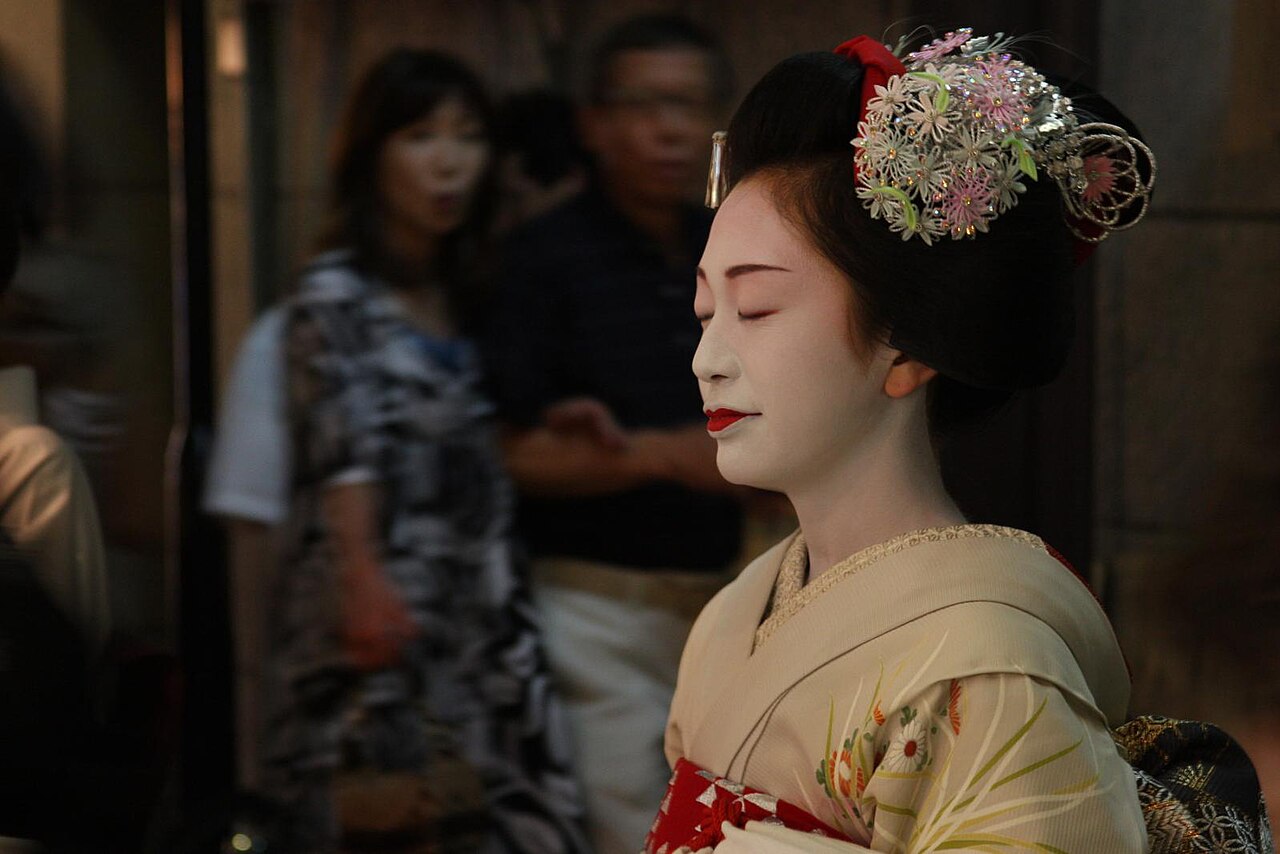
Kanzashi (簪) are the decorative hair ornaments worn in traditional Japanese hairstyles: long rigid hairpins, decorated combs, flat two-pronged pins, folded silk flowers and fabric hair ties. Unlike the combs and pins that hold a hairstyle together, kanzashi go in last and can be taken out and swapped to suit a different outfit, and traditionally each style belongs to a season. In English the term has narrowed, so most people who say kanzashi mean the folded-silk flower ornaments called tsumami kanzashi, or the folding technique itself. Both meanings are correct, and both are still made and worn in Japan today.
What Is Kanzashi?
A kanzashi is decoration rather than structure. The combs and pins that hold a traditional hairstyle together go in first; the kanzashi is added afterwards and can be removed and changed at will. That is why a single hairstyle can carry several of them at once, and why the same hairstyle can read as formal or casual depending on what is pinned into it.
Selection is not free-form. Traditionally each style of kanzashi belongs to a season, and among geisha and their apprentices it also signals age and rank. Ordinary wearers do not carry that coding, but the habit of matching the ornament to the formality of the kimono underneath it survives.
Where Kanzashi Came From
Kanzashi date to the Jomon period, when a single thin pointed stick worn in the hair was believed to ward off evil spirits. Protection, not decoration, is the origin of the object, and hair combs appear in the same period. One reading of the name traces it to kamizashi, from the act of inserting that stick into the hair; another traces it to kazashi, a flower vase, from the practice of wearing live plants in the hair during ceremonies.
During the Nara period, trade and envoy missions brought a great deal of Chinese material culture to Japan, including Chinese hairpins written with the same character as kanzashi, along with Chinese combs and the two-pronged clips called saishi. The Heian period then worked against all of it. Hair moved from being dressed up to being worn long and tied back low, and ornaments fell out of favour, though this is the period when kanzashi settled in as a general word for any hair ornament.
The reversal came in the Azuchi-Momoyama period, when hair went back up. The hanging taregami style gave way to a much wider range of dressed styles, the ancestors of modern nihongami, and those styles needed ornaments.
The Edo period is when kanzashi became what it is now. Hairstyles grew larger and more complicated, the Shimada and Katsuyama styles appeared, and a single head could carry a considerable number of ornaments; by the end of the era, fashionable courtesans wore three or four on each side. Materials widened to ivory, tortoiseshell, horse claw, gold and silver, and artisans began producing fine work, including pins sharp enough to serve as a defensive weapon. Most of the named styles still in use were created or perfected in the late Edo period. Westernisation in the Meiji era then cut the market away, and kanzashi went into a long decline it is only now coming out of.
Main Types of Kanzashi
Most kanzashi fall into eight recognised shapes, leaving aside the folded-silk pieces: bira-bira, ogi bira, kogai, kushi, hanagushi, tama, hirauchi and kanoko. They are made from lacquered wood, gold and silver plated metal, tortoiseshell, silk and, more recently, plastic. Early plastics such as bakelite are collected in their own right.
| Type | What it looks like | Notes |
|---|---|---|
| Bira-bira | Two-pronged pin with a rounded plate at the tip and metal strips hung from its edge on small rings | The strips move as the wearer moves; many carry a stamped crest, and some add bells or silk-flower chains called shidare |
| Ogi bira | A fan-shaped bira-bira stamped with the wearer’s crest | Worn by maiko |
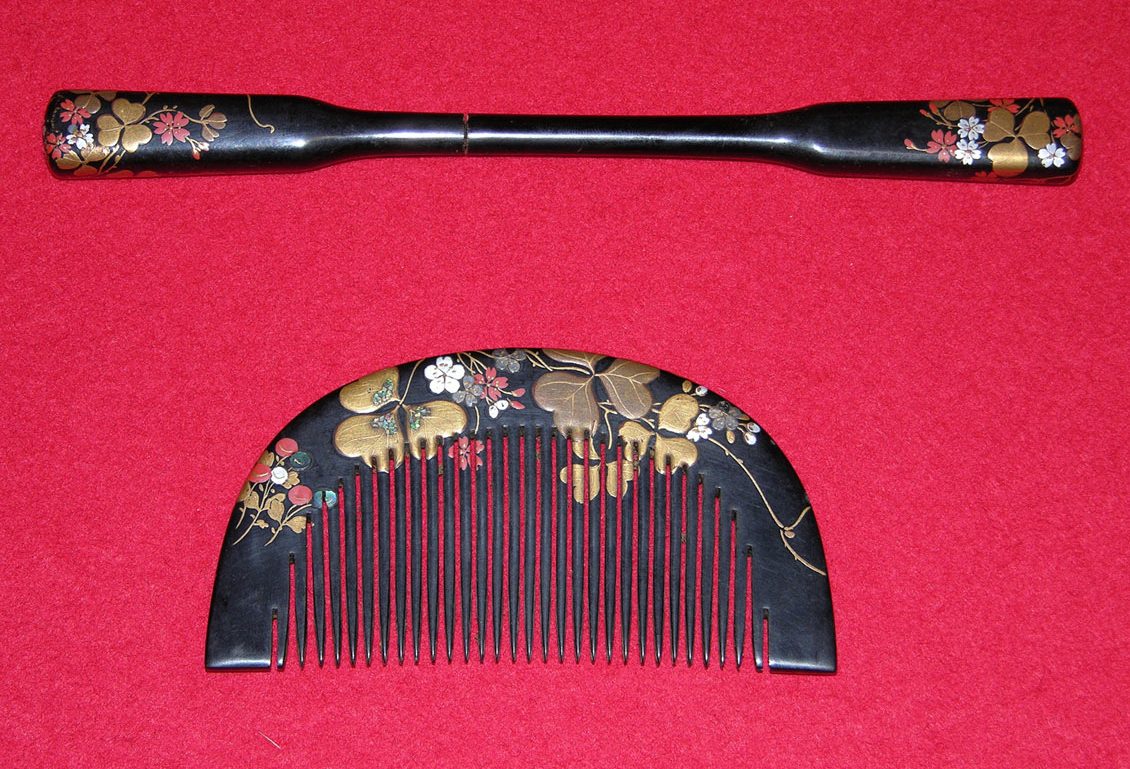
| Kogai | Two-piece stick shape, wider at both ends, resembling a sheathed sword | One end is removable so it can be set into the hairstyle; usually tortoiseshell, lacquered wood, ceramic or metal |
| Kushi | Comb, rounded or rectangular, with the design on the broad handle | Often inlaid with mother of pearl or gilded, and commonly sold as a matched set with a kogai |
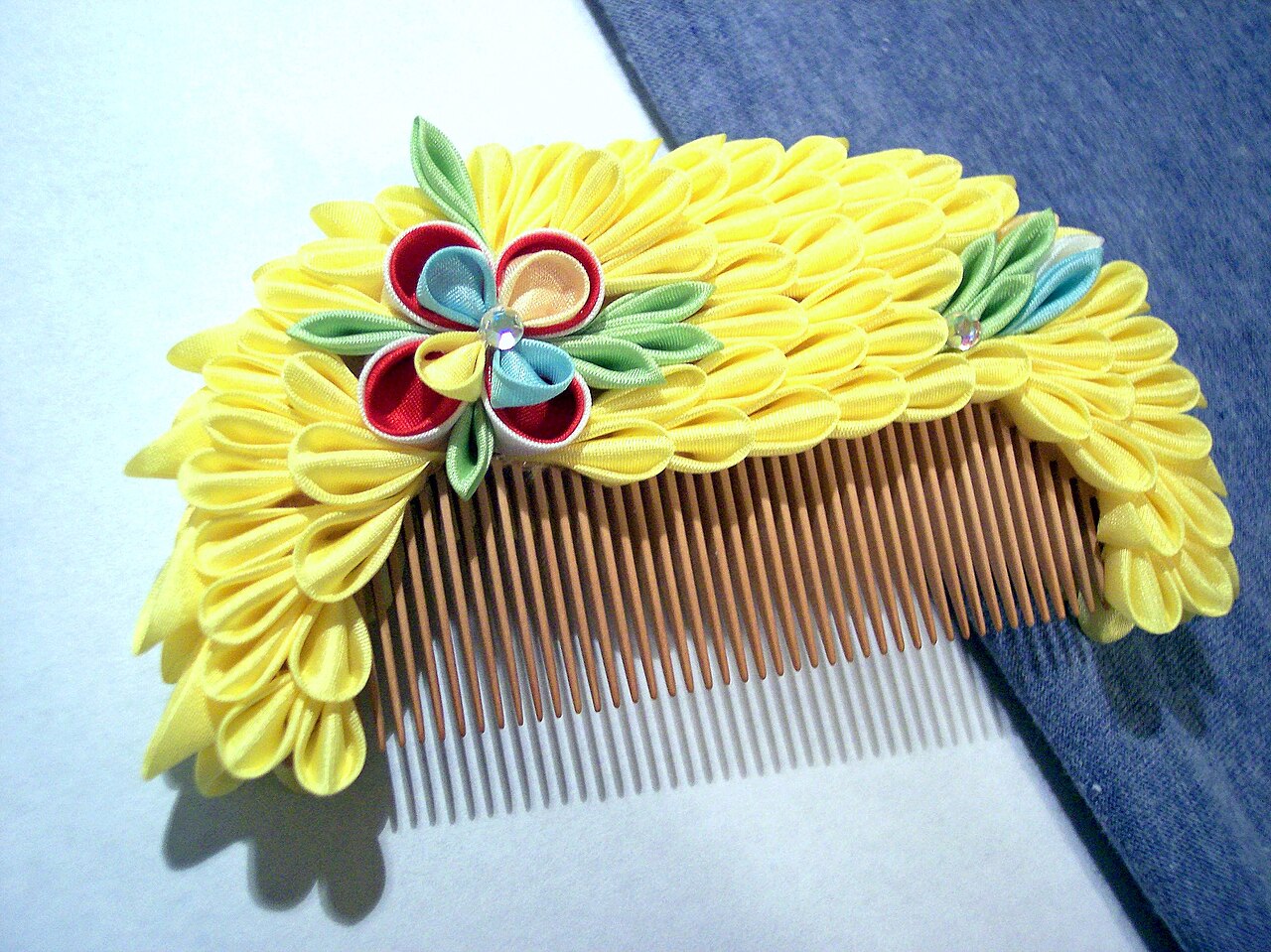
| Hanagushi | A kushi decorated with folded silk flowers | Popular as an informal option |
| Tama | Single-pronged pin finished with one coloured bead | Jade, coral or shibori-dyed fabric; red was traditionally worn in winter and green in summer |
| Hirauchi | Two-pronged pin with a flat rounded end, worn at the back of the head | Lacquered, gilded, inlaid, or carved in metal filigree |
| Kanoko | Bright fabric ties, sometimes padded, in kanoko shibori cloth | Tied around part of the bun, usually pink or red |
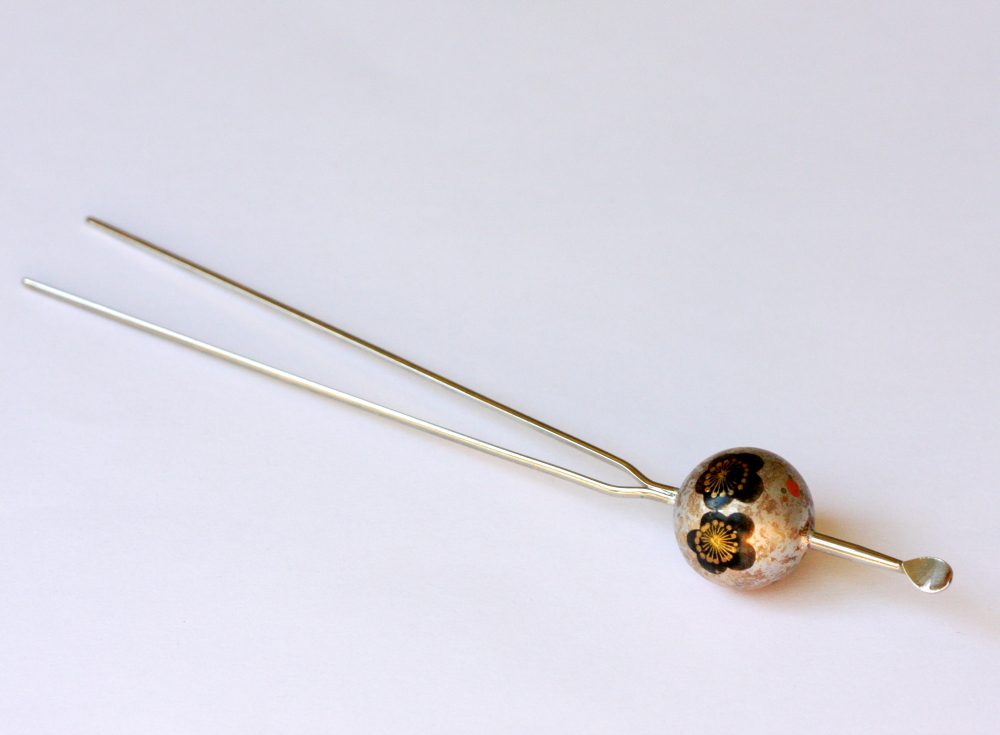
Beyond those eight, a set of rarer styles exists for specific hairstyles, for maiko in particular districts, or for kabuki roles.
| Rarer style | What it is | Setting or signal |
|---|---|---|
| Bonten | Large silver wire flowers | Worn either side of the bun on the katsuyama and fukiwa hairstyles |
| Miokuri | Metal strips that hang down the back | Hang from the central bun |
| Tachibana kanzashi | Ripe and unripe tachibana orange fruit in jade and coral | Where a maiko places them shows her seniority |
| Chirimen tegara | Folded triangle of crepe | Pinned into the back of the hair; its colour marks seniority |
| Kanoko dome | Short, heavily decorated pins | Set into the centre of the bun |
| Maezashi | Small single-motif pins | Chosen purely to the wearer’s taste |
How Hana Kanzashi Are Made
Hana kanzashi are made by the tsumami technique, which means pinched kanzashi and describes the method exactly. Squares of dyed or printed silk are folded with tweezers, opened out and lined up into triangles, then glued onto a base with rice paste. One finished piece can contain anywhere from five to seventy-five squares of silk, sometimes more, and pieces that depict flowers are the ones called hana kanzashi.
The material of choice is habutae, a high quality plain-weave silk slightly lighter than kimono cloth, and the paste is hime nori, made from rice or wheat cooked soft. Petal size follows the flower: small plum blossoms are cut at roughly 2.3 cm square, while the largest flowers, peonies and cherry blossoms, need pieces around 6 cm. Petals are set on a round paperboard base attached to a wire rod, bound with two colours of low-twist silk thread, and left to dry for about twenty-four hours. Finished flowers are clustered into bouquets, and stamens are added using mizuhiki, a thin twine of washi paper.
None of this is written down. As the Art Research Center at Ritsumeikan University records in its study of hana kanzashi, the designs and the methods are not preserved on paper, and long-standing patterns are rebuilt from the craftsmen’s memory and experience. A traditional kanzashi apprenticeship runs five to ten years, and the number of traditionally trained makers in Japan fell from an estimated fifteen in 2002 to five in 2010. Habutae itself, along with the best starch and some traditional tools, has become hard to source. Against that, tsumami kanzashi were designated a traditional handcraft of the Tokyo region in 1982, the technique has become a widely taught hobby craft, and some hobbyists have set up as independent artisans without going through the apprenticeship at all.
The Seasonal Hana Kanzashi Calendar
Hana kanzashi change with the month, and in practice the only people who track the seasons closely enough to follow the calendar are geisha and their apprentices. A maiko needs around thirteen types across the year, counting festival variants, and a new set is made when she makes her debut. Senior geisha wear less elaborate ornaments and follow the seasons more quietly, often only by changing the colour of a tama kanzashi.
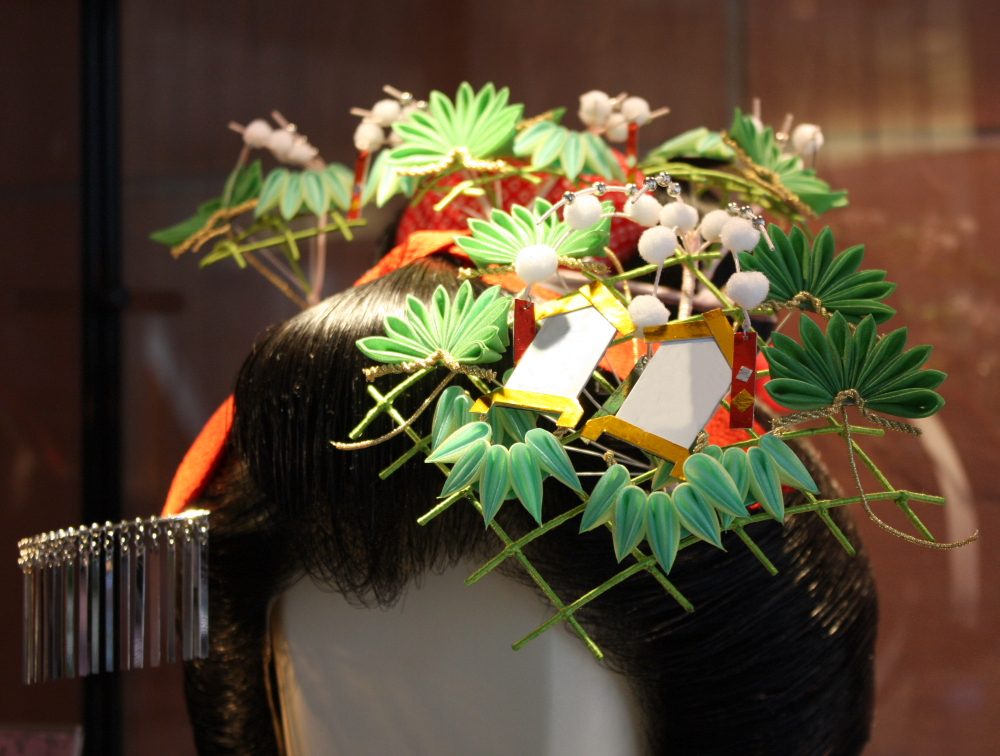
- January: an auspicious New Year theme, commonly shochikubai, the pine, bamboo and plum combination in green, red and white, plus sparrows, spinning tops and hagoita battledore paddles
- February: trailing deep pink or red plum blossom for young love and the approach of spring, sometimes with dangling bura decorations, or a pinwheel and kusudama flowerball for Setsubun
- March: yellow and white rapeseed flowers with butterflies, and peach blossom, narcissus, camellia or peony; a rare Hina Matsuri doll design appears this month
- April: soft pink cherry blossom with butterflies and bonbori lanterns, in three-bloom or five-bloom arrangements, or a single silver butterfly of mizuhiki cord
- May: purple wisteria and flag iris in blue or pink, the iris marking the height of spring and wisteria carrying its long association with the Imperial court
- June: green willow with carnations, or less often hydrangea, both suited to the rainy season
- July: fans for the Gion Festival, usually round uchiwa, with dragonflies and swirling water lines; fireworks and dewdrops on grass also appear
- August: large morning glory, or susuki grass rendered as a starburst of silvered paper spines, white-backed for senior maiko and pink-backed for junior maiko
- September: purple bellflower, often mixed with bush clover
- October: chrysanthemum, a symbol of the Imperial family, one large flower for senior maiko and a cluster of small ones for juniors
- November: trailing autumn leaves, most often Japanese maple, with ginkgo and liquidambar also used
- December: mochibana rice-cake flowers for luck, and two blank maneki nameplates that a maiko asks two favourite kabuki actors to sign at the Minamiza Theatre
- New Year: un-husked ears of rice, worn on the right by maiko and on the left by geisha, with eyeless white doves; the wearer fills in one eye and asks someone she likes to draw the other
When Kanzashi Is Worn Today
Kanzashi are worn today mainly by geisha, maiko, sumo wrestlers, brides, and modern tayu and oiran re-enactors, and several of those groups use pre-styled wigs rather than their own hair. Traditional Japanese hairstyles are rare in daily life now, so the full seasonal system, and the use of kanzashi to mark age and status, survives almost entirely inside that world and in kabuki costume.
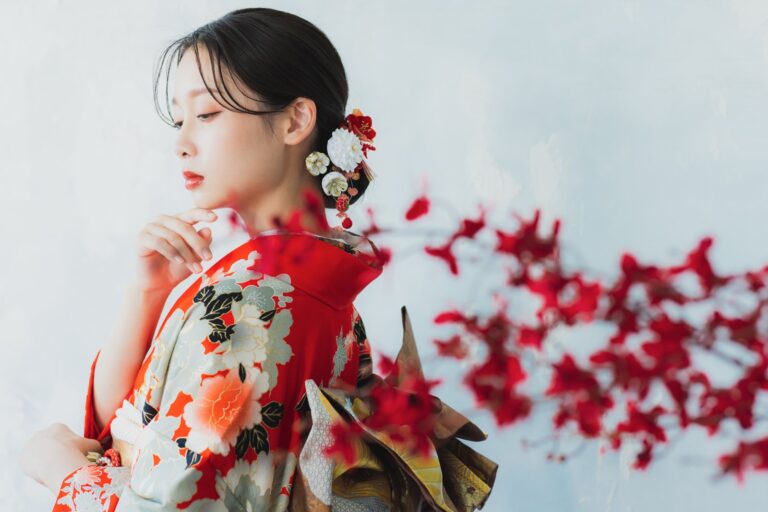
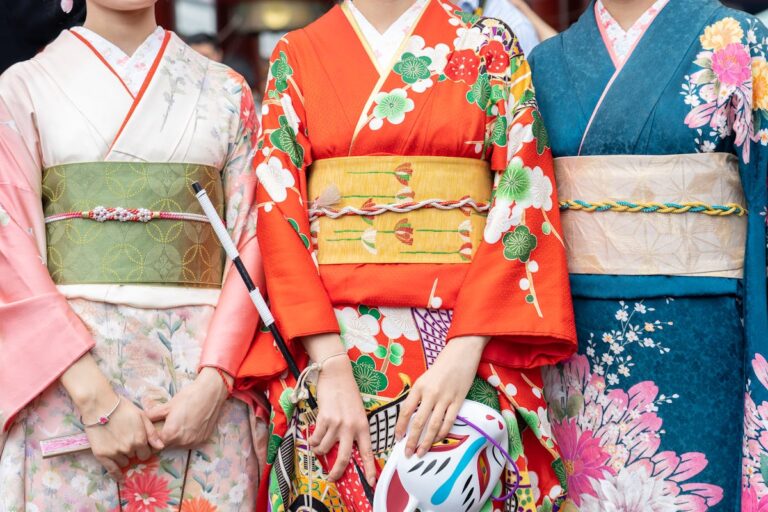
Everywhere else, kanzashi has come back as an accessory rather than a coded uniform. It still turns up wherever formal Japanese dress does: a furisode or a tomesode, a Shichi-Go-San celebration for a young child, and traditional bridal dress, where the takashimada hairstyle remains the classic setting for it. Girls in kimono wear them to festivals, and a light tsumami clip suits a yukata at a summer matsuri. Modern varieties are made and sold as hairclips, which is why kanzashi now pairs comfortably with Western clothes as well as Japanese ones, and simple pieces are easy to find as inexpensive souvenirs in Japanese markets.
How to Style Kanzashi Respectfully
Anyone can wear kanzashi. The care needed is not about permission but about not borrowing signals that mean something specific to someone else. Four things are worth getting right: matching formality to the garment, letting the hairstyle carry the ornament, watching the season, and leaving the maiko markers alone.
- Match formality to the garment. A hanagushi or a small tsumami clip reads informal; lacquered kogai and kushi sets, or paired hana kanzashi, belong with formal dress
- Let the hairstyle carry it. Kanzashi is added over the pins and combs that already hold the hair, so the style has to be secure before the ornament goes in
- Watch the season. A cherry blossom piece in October is out of step, and the traditional red-in-winter, green-in-summer rule for tama kanzashi is easy to follow
- Leave the maiko markers alone. The large paired hana kanzashi, the ogi bira with a crest, the tachibana and chirimen tegara that encode seniority: these are working insignia for apprentices in the geisha districts, not general accessories
The seasonal instinct behind all of it, dressing to the month rather than to a trend, is the part most worth taking. If you like where that leads, Kamicrew’s ukiyo-e print collection works the same traditional motifs into pieces you can wear on an ordinary day.
FAQs
What is kanzashi used for?
Kanzashi decorate a finished hairstyle. Unlike the combs and pins that hold the hair in place, they are added last and can be removed and changed to suit the outfit. Historically, the original single stick was worn as protection against evil spirits rather than as decoration.
What are kanzashi made of?
Traditional materials include lacquered wood, gold and silver plated metal, tortoiseshell, silk, jade and coral, with plastic used in modern pieces. Tsumami kanzashi are made from squares of habutae silk folded with tweezers and glued with hime nori rice paste.
Is kanzashi only for geisha?
No. Geisha and maiko are the main keepers of the seasonal system and the status coding, but kanzashi are also worn with formal kimono, at Shichi-Go-San and weddings, at festivals, and as everyday hairclips with Western clothes.
How do you wear kanzashi with a kimono?
Set the hairstyle first with its structural combs and pins, then add the kanzashi and match its formality to the kimono. Hana kanzashi are usually worn in pairs, one on each side of the head, often with a matching kushi comb.
What is hana kanzashi?
Hana kanzashi are tsumami kanzashi that depict flowers, usually built as a cluster of folded silk blooms on a wire base. They may carry bira-bira metal strips or long streamers of petals, and maiko wear a different design for each month of the year.
Kamicrew Best Seller

Dont Touch Me Yokai Ukiyo-E Japanese T-Shirt
$25.49+
$29.99
(15% off)


Summer Vibes Salty Kawaii Japanese Hoodie
$44.99+
$49.99
(10% off)


Japanese Pin Horror 80s Retro Aesthetics T-Shirt
$25.49+
$29.99
(15% off)


El Gran Maja Japanese Kaiju T-Shirt
$25.49+
$29.99
(15% off)


Who Wants The Perfect Body Japan Capybara Kawaii Japanese Unisex Shirt
$25.49+
$29.99
(15% off)


Monster 8 Mask Vintage Animal Hoodie
$44.99+
$49.99
(10% off)


I Hate People Japanese Opossum Vintage Animal Hoodie
$44.99+
$49.99
(10% off)


I Got That Dog In Me Small Turtle Vintage Animal T-Shirt
$25.49+
$29.99
(15% off)

The Creation Of Cat Ukiyo-E Japanese T-Shirt
$25.49+
$29.99
(15% off)