
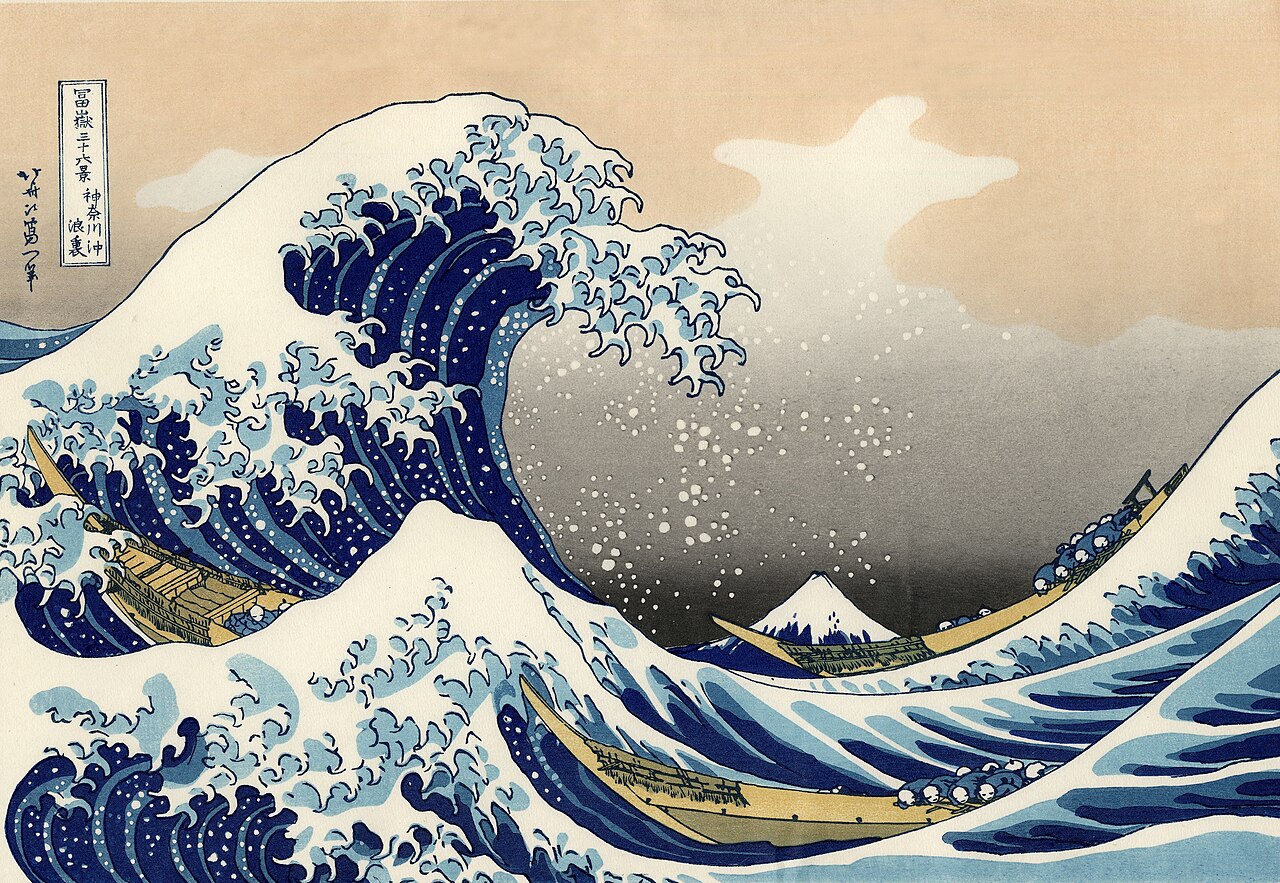
Japanese wave art is the tradition of treating moving water as a subject in its own right, and it is dominated by one image: Katsushika Hokusai’s woodblock print of a cresting wave off the coast of Kanagawa, made around 1830 to 1832 and catalogued by the Metropolitan Museum of Art as “Under the Wave off Kanagawa”. It is the first sheet in a series of thirty-six views of Mount Fuji, and it went on to become the most famous work of art Japan has produced. None of the other prints in that series came close to its reach.
The wave did not arrive out of nowhere. Painters in Japan had been treating moving water as a subject in its own right for two centuries before Hokusai carved his blocks, and knowing that older tradition is what separates a poster print from an actual reading of the picture.
What “The Great Wave off Kanagawa” actually shows
“The Great Wave off Kanagawa” shows three long fishing boats caught between a towering wave on the left and Mount Fuji in the distance. The wave takes up almost half the sheet, its foam breaking into what looks like an army of claws. The impression held by the Metropolitan Museum of Art measures 25.7 by 37.9 centimetres, ink and colour on paper.
The title places the scene in the bay of Kanagawa, the prefecture that today borders Tokyo. The composition rests on three elements:
- waves,
- fishing boats,
- and Mount Fuji.
Clouds fill part of the sky, and the title and Hokusai’s signature, brushed in Japanese characters, sit in a cartouche in the upper left corner.
The foam crests are the detail viewers return to, breaking apart into claws reaching down toward the water. Some descriptions find ghosts in the spray. Others see skeletons, or the silhouette of a dragon. The wave piles up on the verge of collapsing onto the three boats below it, and the fishermen are visibly fighting the churning sea to keep from capsizing.
There is a way out of the picture, though. A corridor in the water opens onto the background, and Hokusai set Mount Fuji there, a mountain many Japanese consider sacred. He printed it in grey, so that its snow-covered peak reads like a beacon on the horizon rather than one more mass of moving water. The Metropolitan Museum’s impression entered that collection in 1929 through the bequest of Mrs H. O. Havemeyer.
Katsushika Hokusai, the artist behind the wave
Katsushika Hokusai (1760 to 1849) was born and died in Edo, the city now called Tokyo, and is regarded today as the most significant representative of ukiyo-e. He made prints, taught drawing and woodblock printing, and worked under a reported thirty or more pseudonyms. He was already past sixty when the commission for the thirty-six views of Mount Fuji arrived.
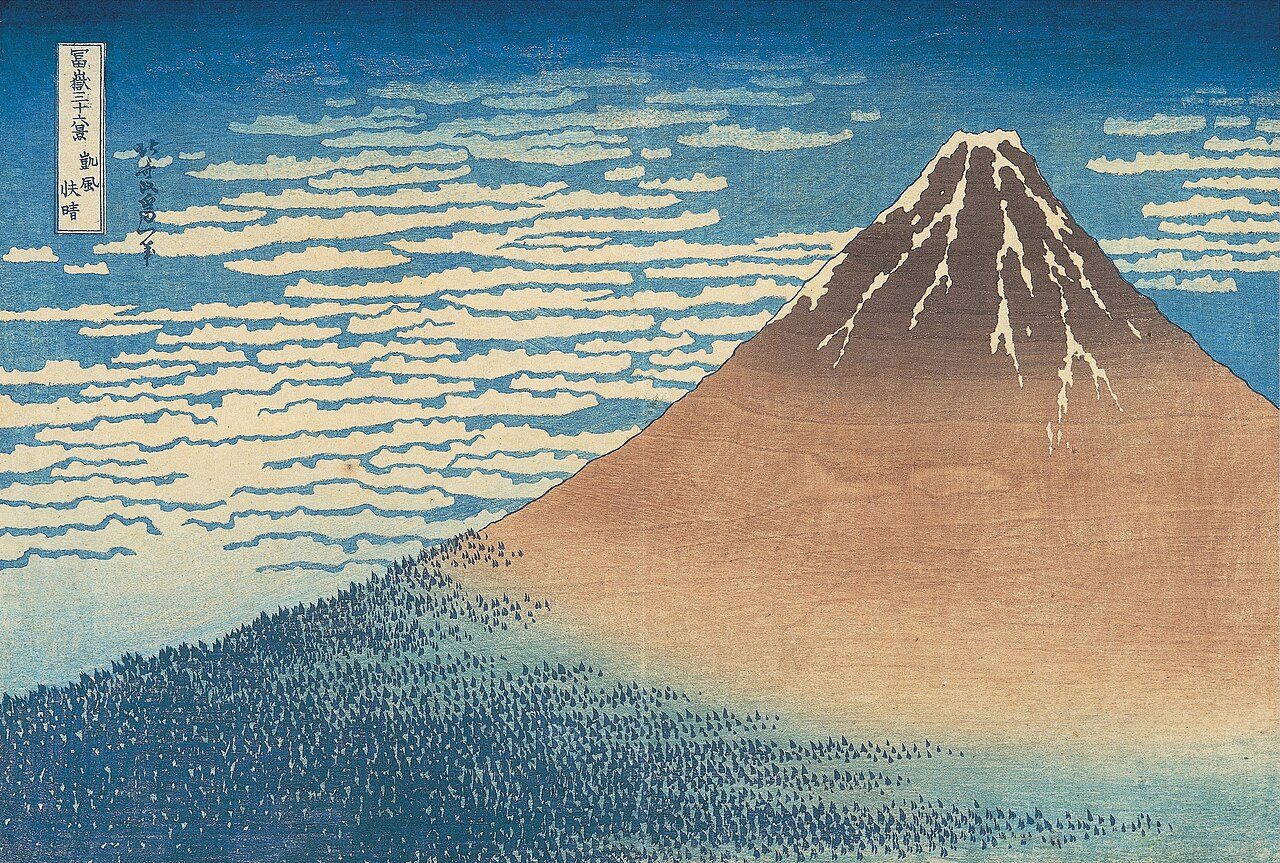
Over roughly five years Hokusai produced the thirty-six views, showing the volcano and the landscape around it from every angle he could invent. “The Great Wave” gives a view of Fuji from out at sea, which was almost certainly not something Hokusai stood and observed. The scene is more likely a construction, his answer to the question of what the mountain would look like from the water.
Ukiyo-e, and the Edo period that produced it
Ukiyo-e was the predominant form of artistic expression in Japan during the Edo period, which the Metropolitan Museum of Art dates from 1615 to 1868. The Tokugawa shogunate kept the country closed to most of the world, yet the economy prospered, and wealthy merchants funded a cultural boom. Printmaking was the branch of that boom that reached the widest audience.
The isolation policy was strict, and applied to the West in particular. Only a small number of trade representatives from China, Korea and the Netherlands were granted access.
Isolation did not make the country poor. That merchant prosperity produced a class with money to spend on things other than land, and their appetite for culture lifted theatre, music, fashion, literature and the fine arts together.
How the print was made, and the blue that changed it
“The Great Wave” is a colour woodblock print, with a separate block carved for every colour the picture needs. At least seven colours went into the finished sheet: dark blue, medium blue, light blue, light grey, dark grey, beige and pink. The dark blue matters most historically, because Hokusai was among the first woodblock artists to take up Prussian blue.
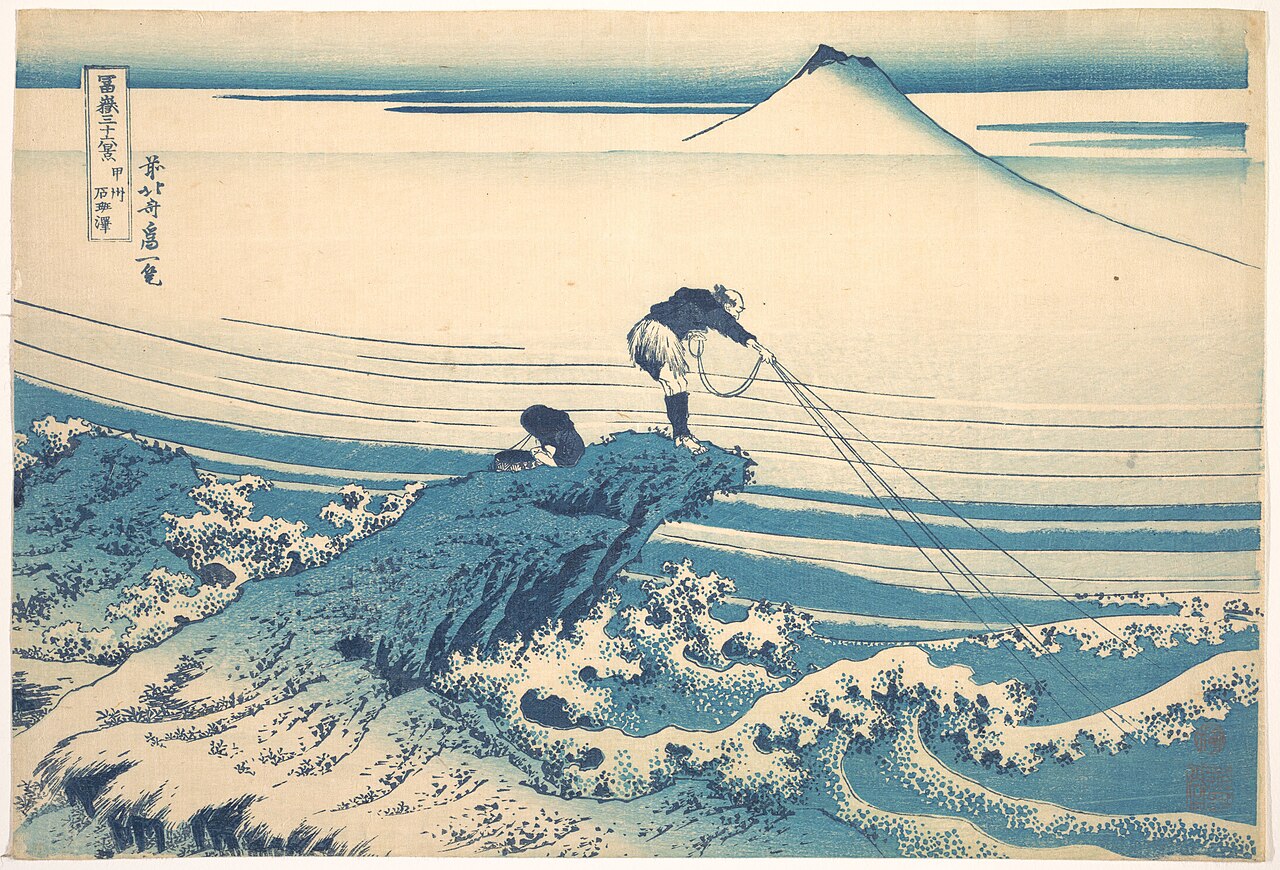
Hokusai worked in the traditional Japanese technique of colour woodblock printing. The design is carved into wooden blocks, the colours are applied to those blocks by hand, and the image is then transferred to paper. He almost certainly made numerous preparatory sketches first, which served as the templates the blocks were carved from. The sea in “The Great Wave” is essentially an argument for the new pigment.
The print was popular in Japan during Hokusai’s own lifetime and was pulled in large numbers. It is believed that more than eight thousand impressions came off the original blocks, and that fewer than two hundred of them survive. Those survivors vary in colour and in fineness of detail, which is why two photographs of what is nominally the same print can look like different pictures. Copies are held by the British Museum, the National Museum of Tokyo, the Metropolitan Museum of Art, the Bavarian State Library in Munich and the Rijksmuseum in Amsterdam.
What Japanese wave art symbolizes
Japanese wave art, and Hokusai’s Great Wave above all, is most often read as the two faces of nature: the beauty of the sea set against its untamed and destructive power. Two further readings run alongside it, human transience in the helpless fishermen, and Mount Fuji as Japan itself standing firm while a threat from outside breaks over it.
Hokusai may have been interested in nothing more than the beauty of the landscape he was commissioned to draw, but the picture has attracted interpretation for as long as people have looked at it.
The reading about human transience turns on the fishermen in their boats, plainly helpless against what is about to land on them. The third reading turns on geography. The wave looks poised to break over Mount Fuji, and a threat to that cultural and religious icon has been read as a threat to Japan itself from foreign powers, with the sacred mountain left standing as the promise of stability that outlasts the storm.
None of these readings cancels out the others, which is part of why the print keeps working. The ghosts and skeletons that viewers keep finding in the foam sit comfortably next to the spirits and monsters of Japanese folklore, in which the sea is one of the places where the human and the supernatural meet. After the earthquake and tsunami of 2011, the almost two-hundred-year-old print was referenced and reproduced again, and each generation appears to arrive at a reading of its own.
Waves in Japanese art before Hokusai
Water was already the main event in Japanese painting two centuries before “The Great Wave”. Tawaraya Sotatsu (about 1570 to about 1640) painted waves as pattern in lavish gold and silver, advanced the tarashikomi technique, and founded the style later named rinpa after the Edo painter Ogata Korin (1658 to 1716). Rinpa ran from the early seventeenth century into the early twentieth.
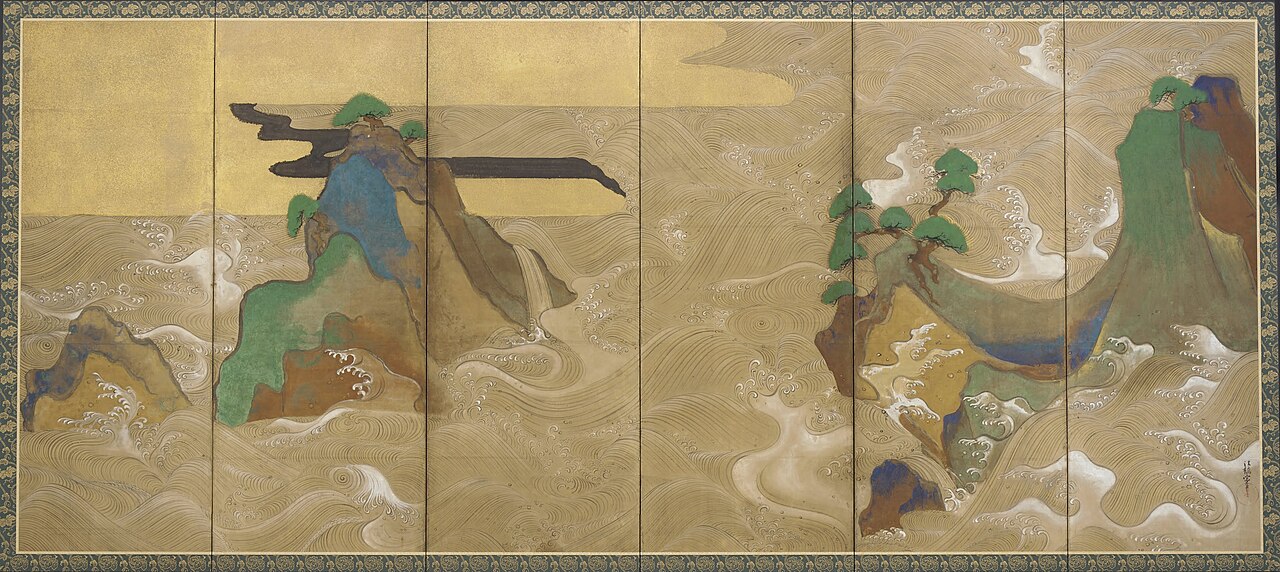
Sotatsu is one of the most influential and most elusive figures in the history of Japanese visual culture, recognisable for a bold, abstracted style, lavish swaths of gold and silver, and rich jewel tones. How the working-class owner of a Kyoto fan shop turned into a sophisticated designer with a network of aristocratic collaborators is still an open question.
His folding screen Waves at Matsushima, now in the Freer Gallery of Art, treats a stretch of coastline as pattern: curling crests, pine-topped rocky islands and gold cloud bands arranged across six panels. Tarashikomi, or “dropping in”, is the technique of dropping paint into a still-wet background so that it pools into delicate accidents, the kind of detail that makes flower petals and water ripples look grown rather than drawn.
Rinpa takes its name from Ogata Korin, though its foundations belong to Sotatsu and his frequent collaborator Hon’ami Koetsu (1558 to 1637). By the late nineteenth century the style had become, in Western eyes, close to a synonym for Japanese culture itself.
How the Japanese wave reached the rest of the world
Japan’s isolation ended in the 1860s, and Japanese prints reached European artists within a generation. Vincent van Gogh, Paul Gauguin, Gustav Klimt and Egon Schiele were all fascinated by Japanese art, and Claude Monet built a personal collection of more than 250 Japanese works, about twenty of them by Hokusai. Claude Debussy put the print on his “La Mer” score.
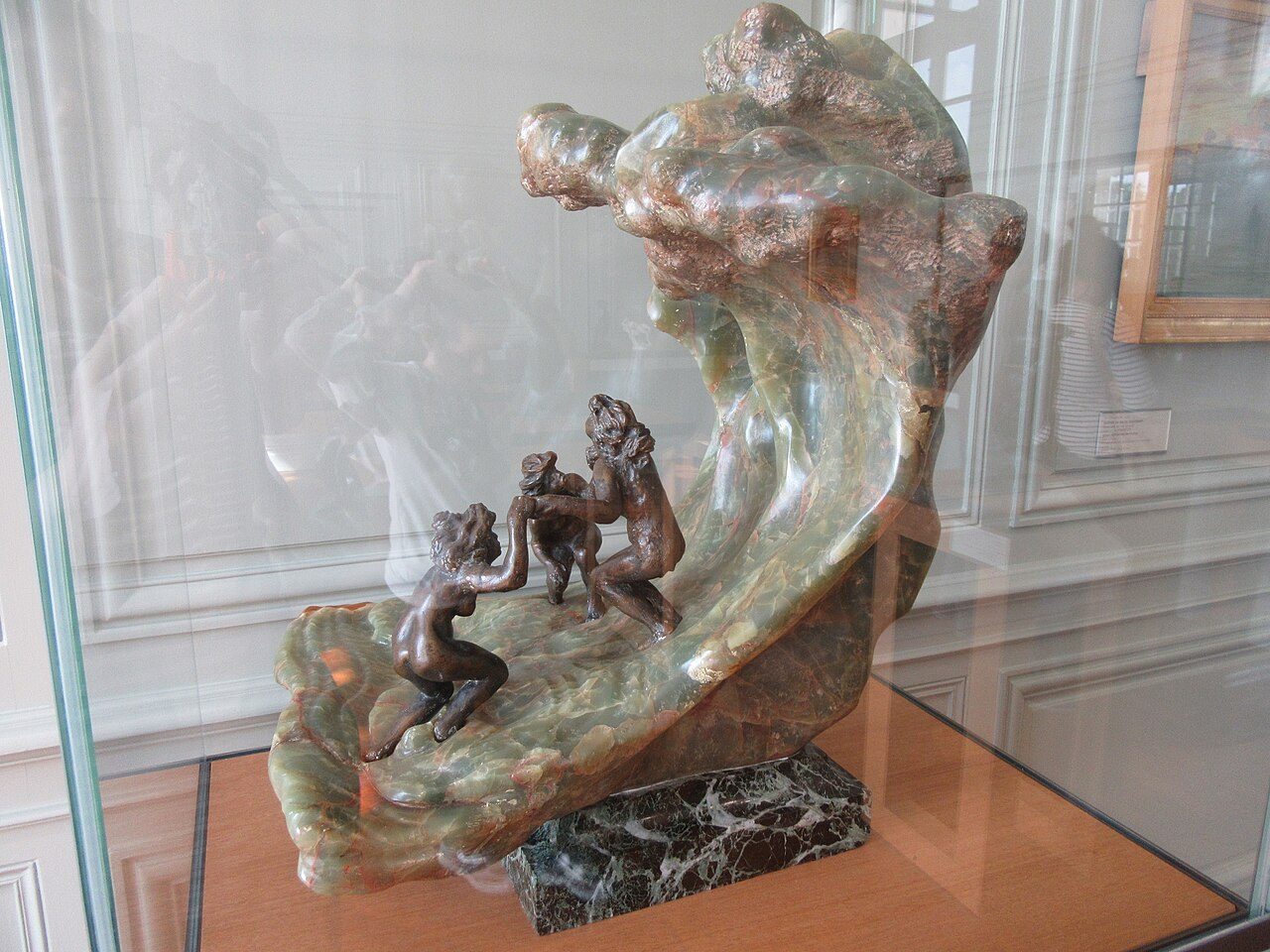
An exchange of artworks began alongside the economic opening, and the wave travelled beyond painting. Debussy chose the print as the cover image for the first edition of his score for “La Mer”, and Camille Claudel quoted its curling crest unmistakably in her sculpture “The Wave”.
Influence ran the other way too. The first modern Sotatsu exhibition, held in Tokyo in 1913, galvanised the art world there and inspired a new generation of Japanese artists, while echoes of rinpa design turn up in Klimt, in Matisse and throughout Art Deco.
Wearing the Japanese wave motif today
The wave motif is now part of the visual furniture of ordinary life. It has been copied, quoted and varied countless times, used in advertising and printed on more products than anyone could reasonably count, and Japan still treats it as an ambassador for the country and its culture. Reading it back to its source means seeing what is actually there.
That ubiquity is exactly why the print rewards knowing what is in the picture: three boats, a sacred mountain, and a wave caught in the instant before it lands.
If that is an image you would rather wear than frame, Kamicrew, a Japanese-fashion streetwear label, carries Edo-period woodblock imagery onto tees and hoodies in its ukiyo-e print shirts.
Kamicrew Best Seller

Dont Touch Me Yokai Ukiyo-E Japanese T-Shirt
$25.49+
$29.99
(15% off)


Summer Vibes Salty Kawaii Japanese Hoodie
$44.99+
$49.99
(10% off)


Japanese Pin Horror 80s Retro Aesthetics T-Shirt
$25.49+
$29.99
(15% off)


El Gran Maja Japanese Kaiju T-Shirt
$25.49+
$29.99
(15% off)


Who Wants The Perfect Body Japan Capybara Kawaii Japanese Unisex Shirt
$25.49+
$29.99
(15% off)


Monster 8 Mask Vintage Animal Hoodie
$44.99+
$49.99
(10% off)


I Hate People Japanese Opossum Vintage Animal Hoodie
$44.99+
$49.99
(10% off)


I Got That Dog In Me Small Turtle Vintage Animal T-Shirt
$25.49+
$29.99
(15% off)

The Creation Of Cat Ukiyo-E Japanese T-Shirt
$25.49+
$29.99
(15% off)