
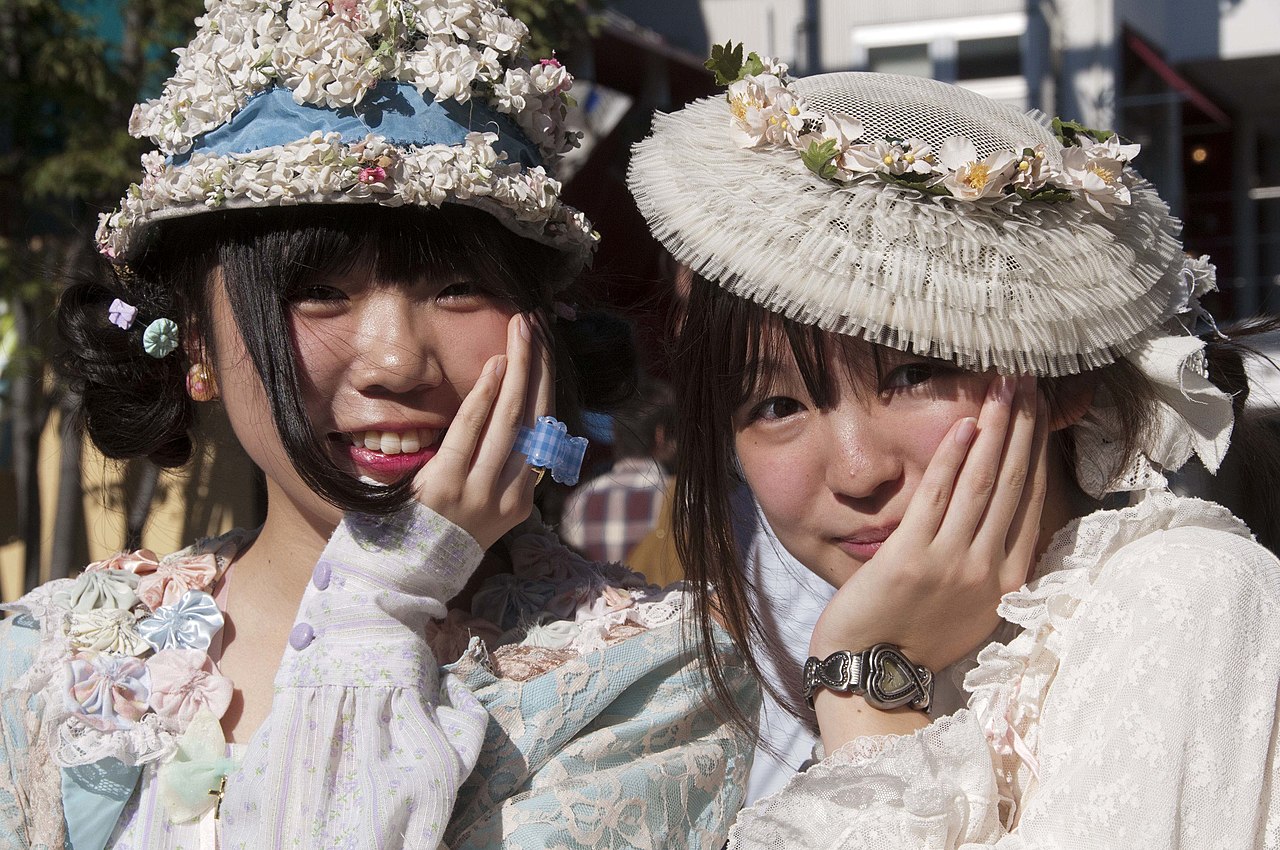
Harajuku fashion styles are not one look. Harajuku is an umbrella term for a family of Japanese street subcultures that grew out of one Tokyo neighbourhood, and the seven best known are lolita, decora, fairy kei, gyaru, visual kei, mori kei and cyber kei. What holds them together is an approach rather than a silhouette: extreme individuality, elaborate construction, and open indifference to conventional fashion rules. Each one has its own colour palette, its own accessories, and its own unwritten rules about what belongs and what does not.
The district itself sits in Shibuya, Tokyo. By the 1970s it had become the city’s temple of fashion, rock and the avant garde, and the movement most people now call Harajuku fashion took shape in the early 1980s. This is a map of the substyles, what each one actually looks like on a body, and where to start if you want to wear a piece of it.
Harajuku fashion styles at a glance
Seven substyles account for most of what gets labelled Harajuku, plus a set of newer pastel offshoots. They span roughly forty years, from the Victorian silhouettes of late 1970s lolita to the neon and clear plastic of contemporary cyber kei. Here is the short version before the detail.
| Style | Emerged | Signature |
|---|---|---|
| Lolita | Late 1970s onward | Victorian silhouette, petticoats, lace |
| Decora | Late 1990s | Layered bright plastic accessories |
| Fairy kei | 1980s toy nostalgia | Faded pastels, retro cartoon motifs |
| Gyaru | Peaked early 2000s | Bleached hair, tanned skin, bold makeup |
| Visual kei | 1980s, peaked early 1990s | Androgynous rock styling, dramatic hair |
| Mori kei | 2006 to 2007 | Earth tones, natural fibres, soft layers |
| Cyber kei | Contemporary | Neon, reflective fabric, clear plastic |
Where the Harajuku codes came from
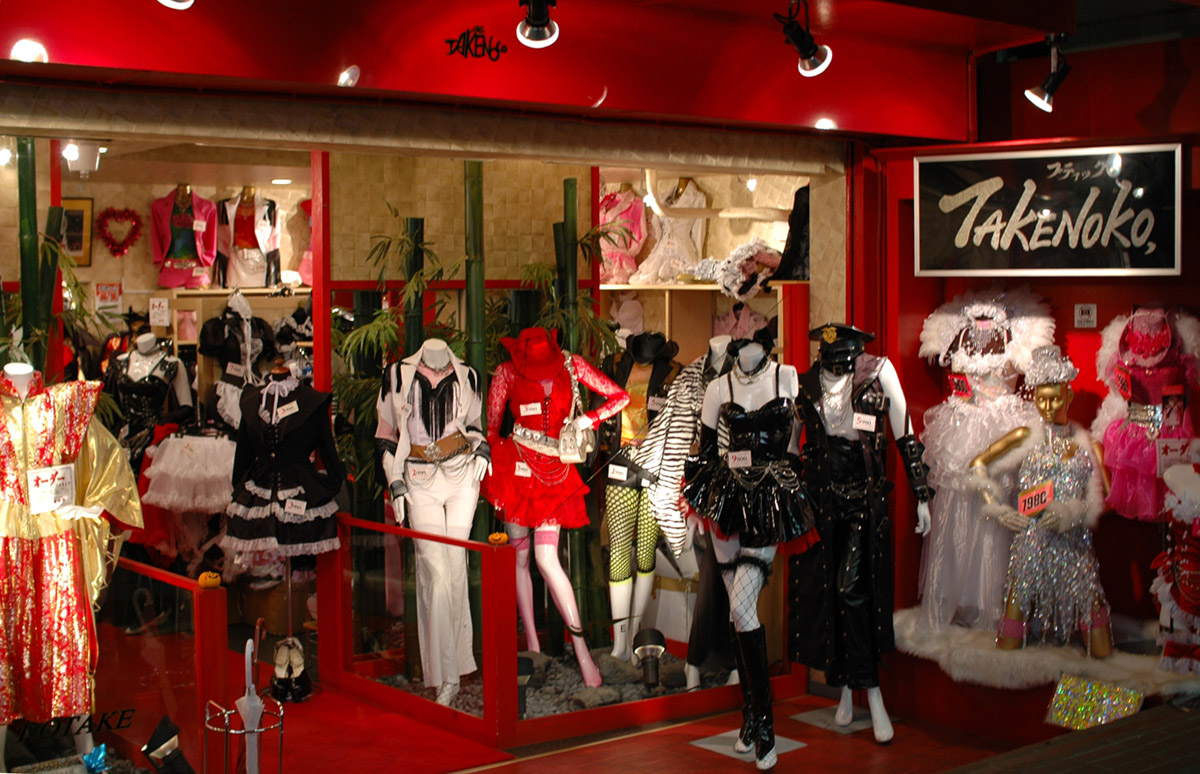
Harajuku became a fashion district through post-war proximity to American culture, then turned into a global reference point through street photography. American music, magazines and clothing reached the neighbourhood via Washington Heights, the housing complex built for US personnel next door, and arrivals got reinterpreted locally rather than copied. That mix is why Harajuku styles so often read as Victorian, punk and kawaii at the same time.
Through the 1970s young people gathered on closed-off streets in theatrical personal outfits, less as shoppers than as performers. The Takenokozoku dance troupes of the early 1980s were the first Harajuku movement to draw crowds from outside the neighbourhood. Then in 1997 the photographer Shoichi Aoki launched FRUiTS, a magazine of nothing but Harajuku street snaps, and the scene stopped being local. FRUiTS is why a teenager in Ohio or Manchester could recognise decora before ever visiting Japan.
The pedestrian Sunday closures that gave the scene its stage ended in the late 1990s, and Gwen Stefani’s 2004 “Harajuku Girls” era pushed the aesthetic into Western pop culture in a way many Japanese wearers found reductive. The retail spine survived all of it. Tokyo’s official travel guide describes Takeshita Street as a 350 metre run starting across the road from JR Harajuku Station, and notes that behind its kawaii reputation sit boutiques specialising in grunge and goth. LaForet Harajuku stacks seven floors of boutiques nearby, Omotesando runs a wealthier luxury strip alongside it, and the Ura-Harajuku backstreets around Cat Street hold the smaller independent labels.
Lolita, a Victorian kawaii universe
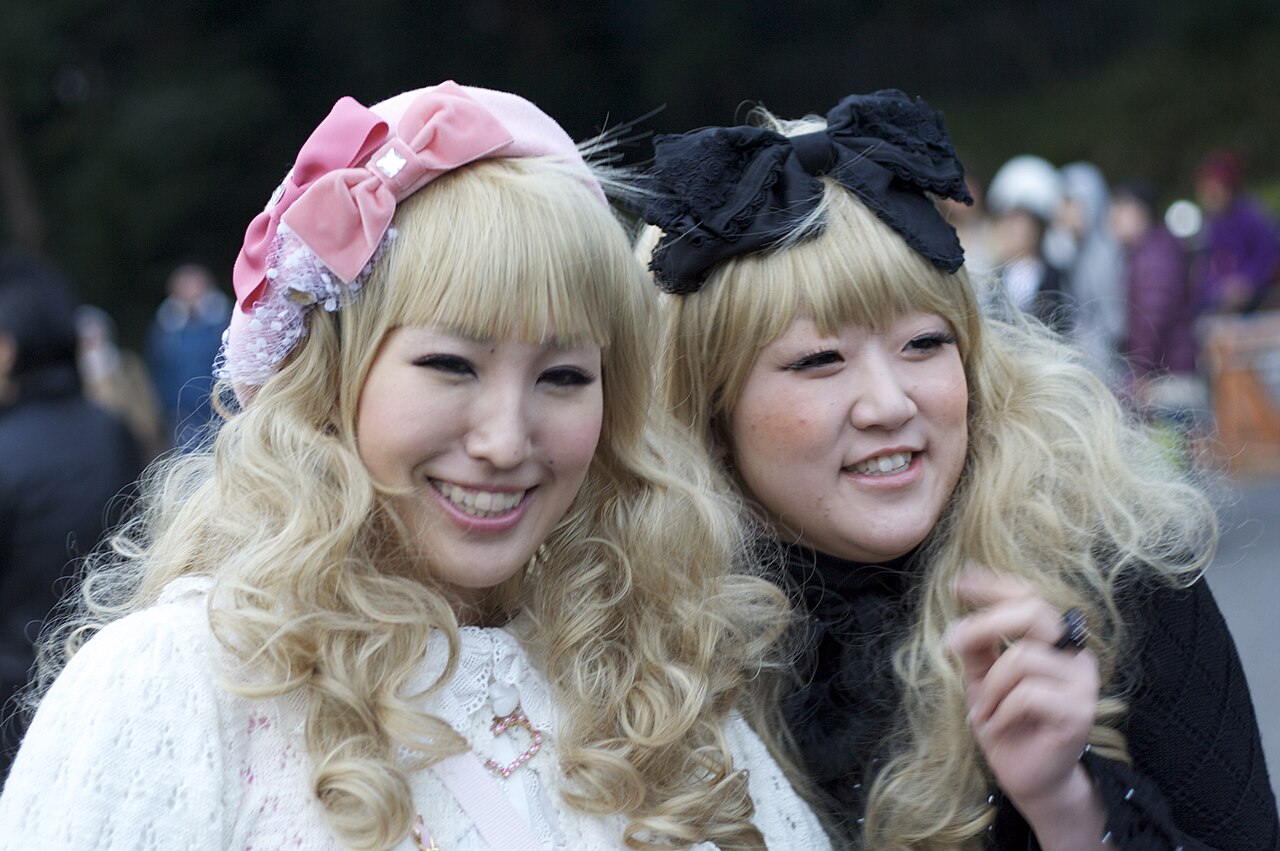
Lolita takes its silhouette from Victorian and Rococo dress and its mood from kawaii culture. The non-negotiables are a knee-length skirt held out by a puffy petticoat, a detailed blouse, and coordinated accessories down to the socks and headwear. It is the most rule-bound style in Harajuku and the most demanding to assemble. Angelic Pretty and Baby, The Stars Shine Bright are the labels that codified it, and its origin in the 1970s was closer to a quiet protest against social rigidity than to costume.
Sweet lolita runs on sugary pastels with cupcake, fruit and bow motifs and stuffed-animal bags. Gothic lolita keeps the same shape but swaps in black with red or purple accents, crosses, skulls and heavier makeup. Classic lolita drops the sweetness for muted, vintage-leaning elegance, and punk lolita crashes tartan, chains, safety pins and platform boots into the Victorian outline. Further out sit the specialist offshoots: fruits lolita with its printed motifs, country lolita, wa lolita reworking traditional Japanese garments, and guro lolita with its horror styling.
Decora, where more is never enough
Decora is short for decoration style, and it emerged in Harajuku in the late 1990s as the most maximalist thing in the district. The method is literal: layer accessories until they nearly hide the clothing underneath. Plastic hair clips go on by the dozen, then rings, bracelets, layered necklaces, fake nails, stickers, novelty glasses, character goods and a plush bag. Adhesive bandages get worn as decoration rather than for injuries. Much of the wardrobe comes out of children’s sections, and acid brights do the work that black does in other subcultures.
Kyary Pamyu Pamyu is the performer most responsible for exporting the look. For anyone building it, the standing piece of craft advice is to keep a single dominant colour running through the pile, because without an anchor the outfit reads as noise rather than as a coordinate. Start with layered colourful basics, a fistful of hair clips and one plush bag, then keep adding.
The pastel kei offshoots
Fairy kei, yami kawaii and yume kawaii share decora’s pastel palette while rejecting its volume. All three trade the accessory pile for softness, faded colour and a single conceptual hook, and all three are newer than the lolita and gyaru families they sit alongside.
- Fairy kei works in faded lavender, mint and washed baby pink, drawing on 1980s toy and cartoon nostalgia of the My Little Pony and Care Bears kind. Thrifted pastel sweaters, tulle skirts, oversized hair bows and lace-trimmed socks carry it.
- Yami kawaii translates roughly as sick-cute, and it pairs pastel softness with medical imagery: bandages, pill and syringe graphics, heart-shaped eye patches, oversized soft silhouettes. It exists to make depression, anxiety and social pressure visible instead of hiding them.
- Yume kawaii and jirai kei are the newer additions, part of the contemporary wave that blends older Harajuku subcultures with social-media aesthetics.
All three sit inside the wider kawaii fashion tradition that Harajuku turned into an export.
Gyaru, ganguro and the tanned rebellion
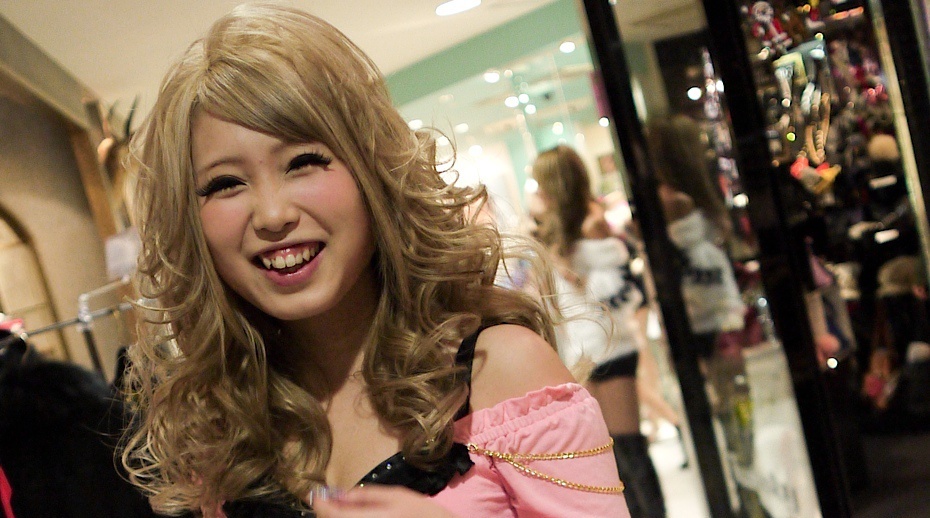
Gyaru comes from the English word gal, and the style is a refusal of the pale-skinned, restrained ideal that dominated Japanese beauty standards. Bleached and teased hair, tanning, heavy contouring, false lashes, circle lenses and very long nails are the shared vocabulary. It peaked in the early 2000s and it splinters further than any other Harajuku family.
Ganguro pushed the tan and the bleached blonde to their limit. Yamanba, manba and banba took it further again with deep tan, white circles painted around the eyes, white lipstick and coloured contact lenses. Kogal built its version out of shortened school-uniform pieces. Hime gyaru went princess, b-gyaru went R&B with sportswear and braids, kuro gyaru went darkest of all, and the bosozoku-influenced end of the family runs on black leather and chains. The differences between gyaru styles come down to how the tan, the hair and the makeup are dialled, more than to the garments.
Mori kei, cyber kei and the streetwear crossover
Not every Harajuku style is loud. Mori kei runs on muted earth tones and natural fibres, cyber kei on neon and industrial plastics, and the streetwear side of the neighbourhood produced labels that went on to shape global menswear. These three are the quiet, the futurist and the commercial ends of the same district.
Mori kei, or mori girl, arrived around 2006 to 2007 as a woodland-flavoured counter-move: long layered dresses and skirts, big wool sweaters, shawls, hand-knitted ponchos, browns and beiges and forest greens and blue-greys, in linen, cotton, wool and leather, with light makeup and unfussy hair.
At the opposite pole, cyber kei builds a version of Harajuku for a future that never arrived. Neon, reflective fabric and clear plastic, LED pieces, visors, utility vests, holographic jackets and platform boots, layered like armour and often deliberately genderless. Cosplay overlaps with all of this without being a fashion style in its own right, since the goal there is to replicate a specific character, and makeup does most of the heavy lifting.
The other Harajuku, the one that fed global menswear, is the streetwear side. A Bathing Ape, Undercover and Supreme built their reputations in and around these blocks, while Comme des Garçons, Issey Miyake and Yohji Yamamoto operate from the Aoyama end. Techwear sits alongside them, working in technical fabrics with labels like Stone Island and Acronym. Japanese streetwear brands and visual kei both come out of the same neighbourhood, but they solve completely different problems.
Visual kei, fashion as performance
Visual kei was born in Japan’s rock scene in the 1980s and peaked in the early 1990s, with X Japan as its founding act. The look is androgynous by design: bleached or vividly coloured hair styled tall and dramatic, dark or high-contrast punk-derived clothing, military coats, leather, lace and velvet, and heavy eyeliner. David Bowie and J-rock stagecraft both feed it. It is the one Harajuku style where the outfit is closer to a costume for a performance than to daywear, and visual kei fashion is usually read as character work rather than as personal style.
How to build a Harajuku inspired look
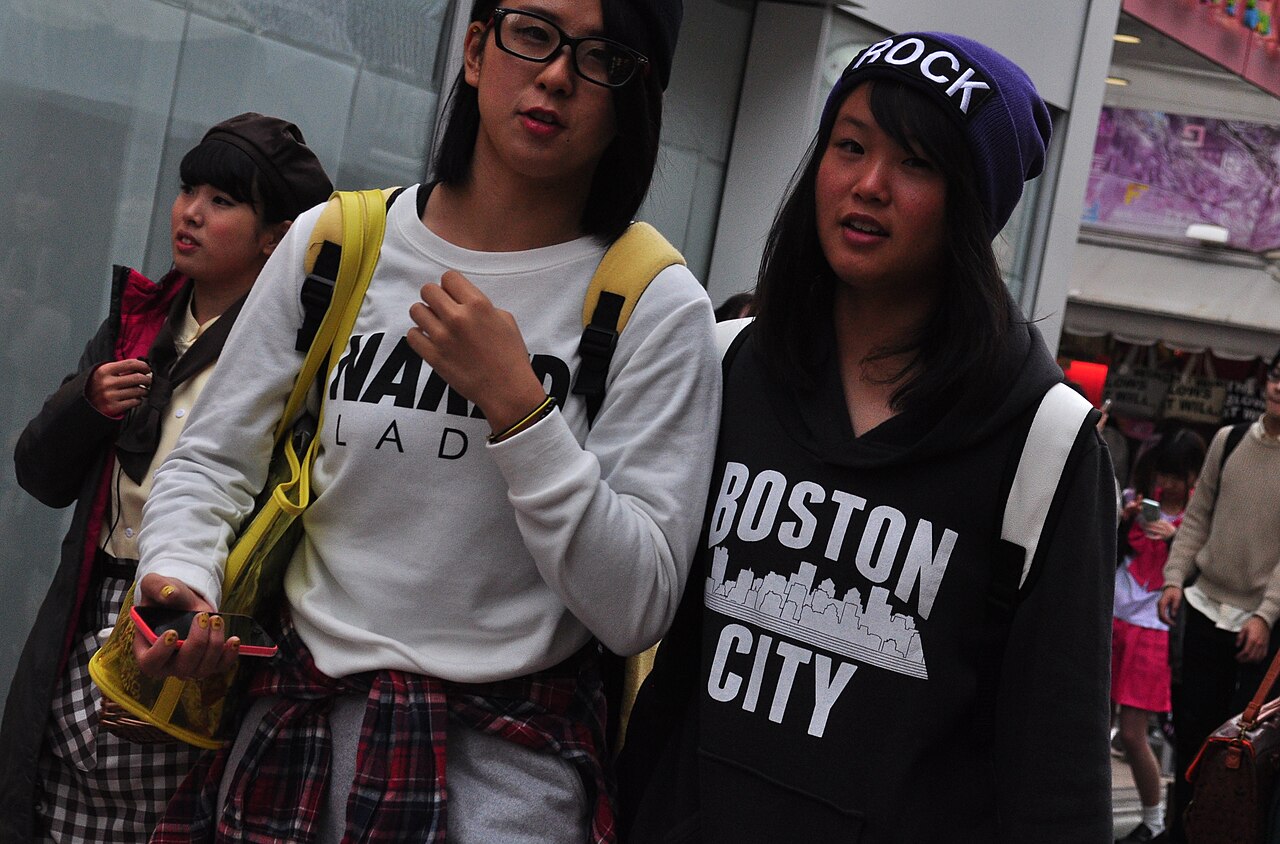
Building a Harajuku look means layering rather than picking one subculture and committing to it. The instruction every Harajuku style shares is to choose what you actually like and assemble something that reads as yours, which is why mixing trends is normal here rather than a beginner’s mistake.
Layering is the mechanism. Stack garments, mix colours that should not work, accumulate accessories past the point where a Western stylist would stop, and put traditional Japanese pieces next to modern ones. Thrifting is how most wearers of the pastel styles actually build a wardrobe, since faded 1980s knitwear is not something you can order new.
Two guardrails keep it from collapsing. Keep one dominant colour so the accessories read as a decision. And start small: a graphic layer you already own, then a handful of clips or pins, then one statement bag, adding a piece at a time until the coordinate holds together. Kamicrew designs its graphic tees as that base layer, printed with Japanese motifs and cut to sit under exactly this kind of stacking.
FAQs
What is Harajuku fashion?
Harajuku fashion is an umbrella term for the street subcultures that developed in the Harajuku district of Shibuya, Tokyo, not a single style. It covers looks as different as lolita, decora, gyaru, visual kei, mori kei and cyber kei, connected by a shared commitment to individuality and elaborate self-construction rather than by any common silhouette.
What are the main Harajuku fashion styles?
The core families are lolita with its Victorian silhouette, decora with its layered accessories, fairy kei with its faded pastels, gyaru with its bleached hair and tanning, visual kei with its androgynous rock styling, mori kei with its earth-toned natural layers, and cyber kei with its neon and plastic. Most other named styles are offshoots of one of these.
Is Harajuku fashion still popular?
The scene is smaller than at its peak, since the Sunday street closures that hosted it ended in the late 1990s. Contemporary Harajuku blends the older subcultures with global streetwear and social-media aesthetics, and newer styles such as yume kawaii and jirai kei have emerged from that mix.
Where do you shop for Harajuku fashion in Tokyo?
Takeshita Street is the main run, with LaForet Harajuku stacking seven floors of boutiques nearby. The Ura-Harajuku backstreets around Cat Street hold smaller independent labels, and Omotesando covers the luxury end.
Can you mix different Harajuku styles?
Yes, and mixing is closer to the norm than to a violation. The practical limit is coherence: keep one dominant colour running through the outfit so the combination reads as a deliberate coordinate rather than as clutter.
Kamicrew Best Seller

Dont Touch Me Yokai Ukiyo-E Japanese T-Shirt
$25.49+
$29.99
(15% off)


Summer Vibes Salty Kawaii Japanese Hoodie
$44.99+
$49.99
(10% off)


Japanese Pin Horror 80s Retro Aesthetics T-Shirt
$25.49+
$29.99
(15% off)


El Gran Maja Japanese Kaiju T-Shirt
$25.49+
$29.99
(15% off)


Who Wants The Perfect Body Japan Capybara Kawaii Japanese Unisex Shirt
$25.49+
$29.99
(15% off)


Monster 8 Mask Vintage Animal Hoodie
$44.99+
$49.99
(10% off)


I Hate People Japanese Opossum Vintage Animal Hoodie
$44.99+
$49.99
(10% off)


I Got That Dog In Me Small Turtle Vintage Animal T-Shirt
$25.49+
$29.99
(15% off)

The Creation Of Cat Ukiyo-E Japanese T-Shirt
$25.49+
$29.99
(15% off)