
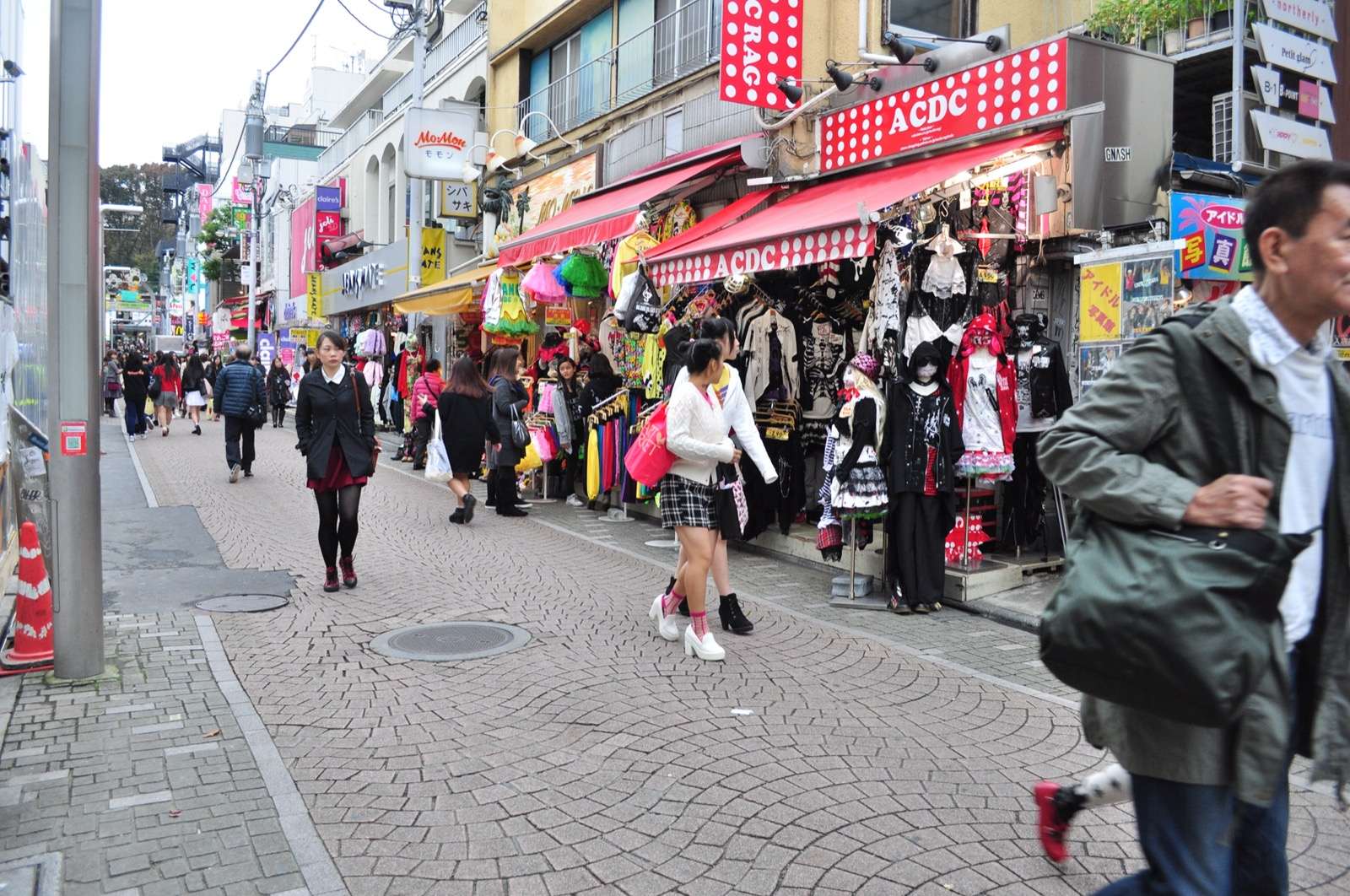
Japanese punk fashion is a Tokyo adaptation of 1970s British punk that keeps the original hardware, safety pins, bondage straps, studded leather and torn shirts, but assembles it with far more precision than the London version it borrowed from. Black dominates, with white and one or two sharp accent colors. Makeup is central rather than optional, which is the clearest break from British punk. Since the 1980s the style has absorbed neighboring Japanese subcultures, so a punk outfit in Harajuku can carry lace or pastel dye and still read as punk.
What is Japanese punk fashion?
Japanese punk fashion is a rebellion style built from deliberately damaged clothing: ripped or cut shirts closed with safety pins, DIY patches and slogans, bondage pants hung with zippers, chains and studs, leather biker jackets, and heavy black eye makeup. It emerged in Japan from the mid-1970s and splintered into named substyles including goth punk, punk lolita and kawaii punk.
Shirts are ripped or cut, sometimes stitched back together or held shut with safety pins, and customized with DIY patches and hand-added buttons. Statement slogans printed across the chest are standard. Bottoms mean bondage pants hung with zippers, chains, straps, buckles, studs and rings, or else ripped jeans and acid wash denim pulled in with a heavy belt.
Japanese punk fashion vs British punk
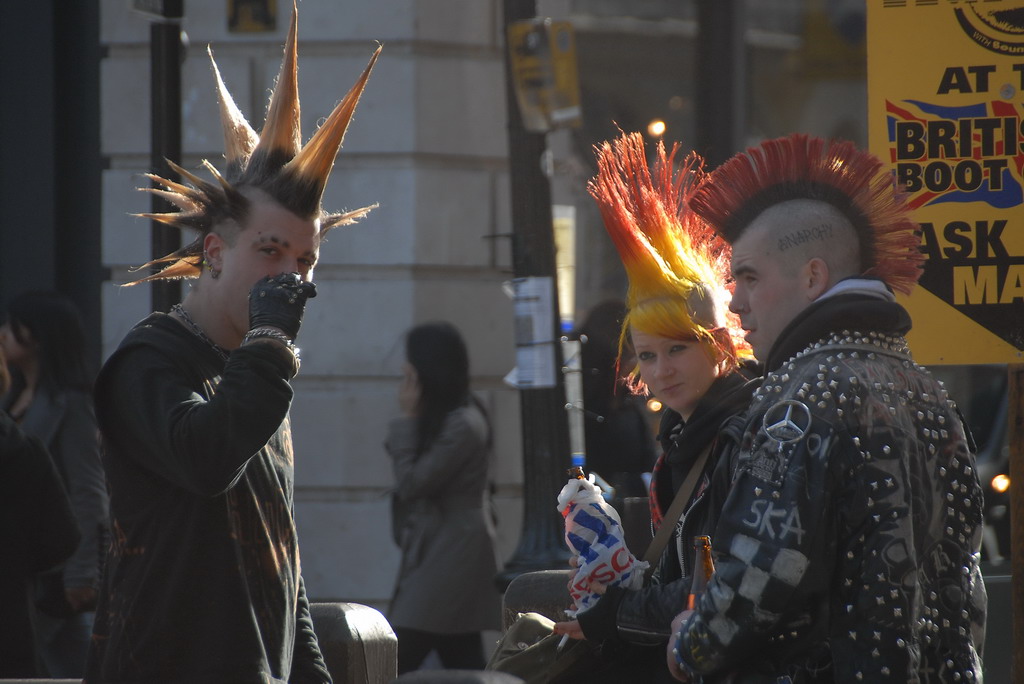
Japanese punk and British punk use the same vocabulary of rips, studs and bondage hardware, but differ in three consistent ways: Japanese punk treats the look as craft rather than calculated mess, it puts makeup at the center of the outfit, and it hybridized with local subcultures such as lolita and kawaii styling in a way British punk never did.
| Aspect | British punk | Japanese punk |
|---|---|---|
| Finish | Deliberately wrecked | Precise, treated as craft |
| Makeup | Secondary | Central to the look |
| Local crossovers | None | Lolita, kawaii, cyber |
| Origin point | 430 King’s Road, London | Harajuku and Ura-Harajuku, Tokyo |
The scene also carries an internal contradiction that outsiders notice quickly: the clothing is confrontational, but the people wearing it tend to stay polite. Rebellion and respect run side by side.
Where Japanese punk fashion came from
Punk clothing was invented at 430 King’s Road in Chelsea, London, where Vivienne Westwood and Malcolm McLaren ran a shop opened in 1974 as SEX and renamed Seditionaries: Clothes for Heroes in 1976. Japan had its own proto-punk stirring by the early 1970s, absorbed the Western wave in the mid-1970s, and built a hardcore scene through the 1980s.
The garments that defined punk construction came out of that London shop, and the Sex Pistols wore them: bondage trousers cut with a zippered seam under the crotch, a removable bum flap and hobble straps that restricted the wearer’s stride, loose-woven mohair jumpers designed to unravel, and torn dresses decorated with metal chains and safety pins. The V&A’s account of Westwood’s punk years documents how far that distressed logic was pushed, screen-printing provocations onto frayed T-shirts.
Japan did not simply import it. Proto-punk was already stirring in the early 1970s with Murahachibu, formed in Kyoto and known for provocative shows that regularly ended in violence, and Zuno Keisatsu, whose name translates as Brain Police. Western punk then landed in the mid-1970s with bands like Friction and Supermilk emerging from the scene. The 1980s hardened the scene: Anarchy formed in Saitama in 1978 and won Yamaha’s East West contest in 1979 with lyrics ridiculing the Imperial family that drew right-wing protests, The Stalin pushed stage antics to extremes, and a hardcore wave carried The Comes, Execute, Gauze and G.I.S.M. in Tokyo alongside SS in Kansai. The Blue Hearts later took a melodic version of it mainstream. The same decade produced visual kei, whose theatrical costuming shares punk’s roots without being the same thing.
The commercial turn came in 1987, when Westwood opened her first store outside the UK in Tokyo. By then Japanese designers were already deconstructing clothes on their own terms. Yohji Yamamoto, Rei Kawakubo and Issey Miyake, the trio often called the big three, worked with the raw and unfinished aesthetic that punk had legitimized, and the Harajuku streets around them became fertile ground for the avant-garde.
The key visual elements of Japanese punk style
Japanese punk style runs on four element groups: a black and white base with one or two accent colors, damaged tops worn with bondage pants or ripped denim, spiked or neon-dyed hair, and heavy black eye makeup over pale foundation. Leather, chains, studs and cross or skull motifs carry the accessories.
Clothing and color scheme
Black and white form the base, then one or two accent colors cut through: red, dark purple, neon, occasionally metallic, and in the softer hybrids pastel. Gray fills in as a neutral. On top, expect leather biker jackets and slogan-printed shirts, either torn or reassembled. Below, bondage pants remain the signature piece, with plaid skirts and petticoats standing in on the more feminine builds. Corsets and lace appear where the style has crossed with gothic dressing.
Hair and makeup
The mohawk, spiked hair and shaved undercut all carry over from classic punk, but Japanese punks push them further with bright neon dye, asymmetric cuts and styled fauxhawks. Makeup is where the divergence is sharpest. Heavy black eyeliner, smoky or deliberately smudged eyeshadow, pale foundation and dark lipstick are the base, with graphic designs painted across the face when the look calls for it.
Footwear and accessories
Platform shoes and biker boots handle the footing. Accessories lean hard on leather, straps, chains and studs: studded chokers, harnesses, fingerless gloves and heavy belts, finished with cross or skull motifs. Westwood’s rocking horse ballerina shoe still circulates as a reference point for the more fashion-literate end of the style.
The main Japanese punk substyles
Japanese punk splintered into six recognized branches: goth punk, punk lolita, kawaii punk, cyber and tech punk, avant-garde punk, and classic punk revival. Each keeps punk’s hardware of studs, chains and safety pins while swapping the palette, silhouette or fabric it sits on.
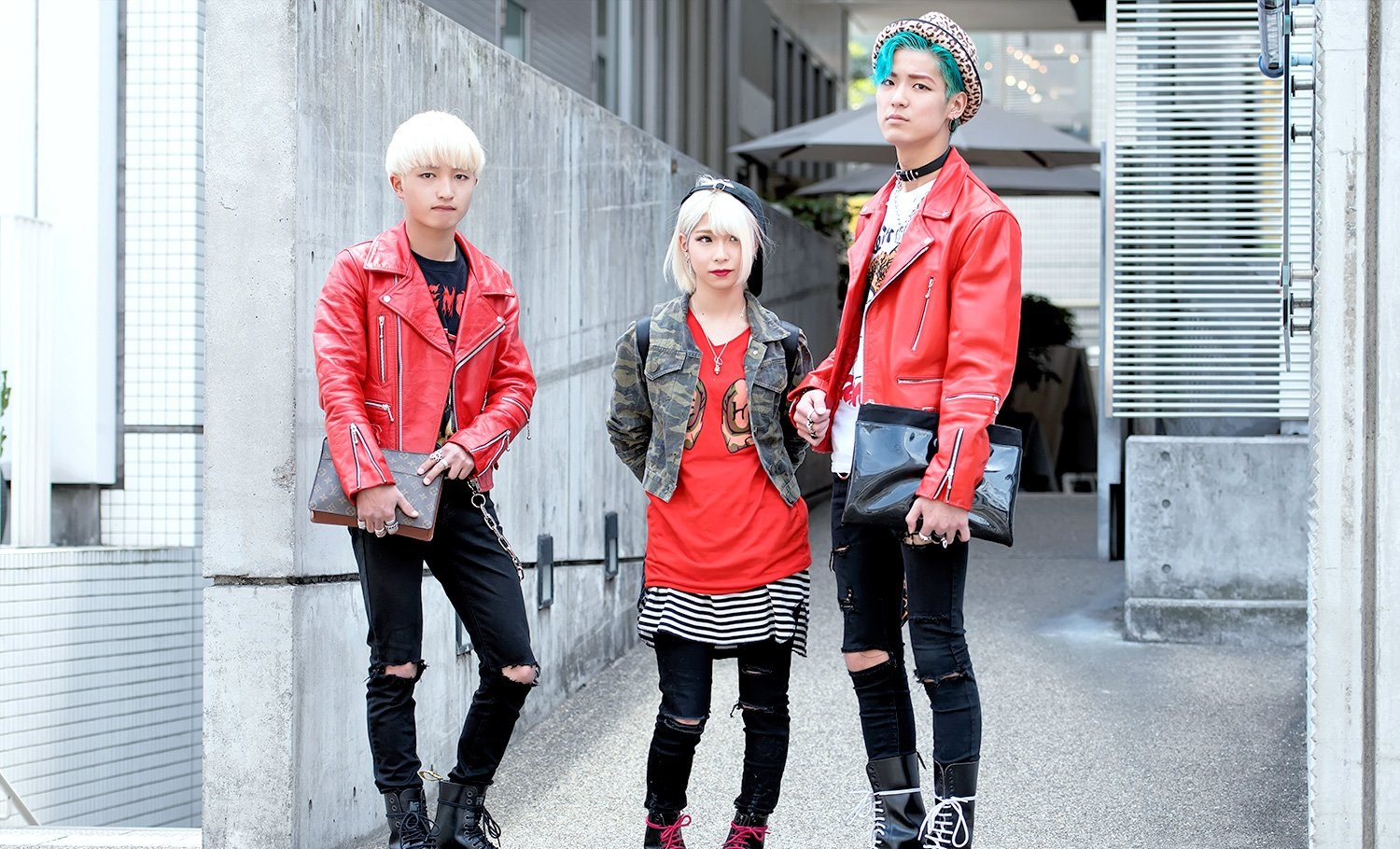
- Goth punk (ゴスパンク), which trades punk’s brightness for black-on-black and borrows the silhouettes and lace of gothic lolita dressing.
- Punk lolita, where the lolita silhouette of petticoats and structured skirts is cut with safety pins, plaid, chains and studs.
- Kawaii punk, which softens the palette toward pastel while keeping the hardware, and is the clearest example of punk absorbing a neighboring Japanese aesthetic rather than resisting it.
- Cyber and tech punk, closer in spirit to cyberpunk fashion, with synthetic fabrics and hardware standing in for leather and denim.
- Avant-garde punk, the designer-facing end, drawing on the deconstruction the big three made respectable.
- Classic punk revival, which stays close to the 1970s London template.
Visual kei sits adjacent to these rather than inside them. It shares the theatrical instinct and some of the hardware, but it grew out of a music-scene costuming tradition and is not a punk substyle.
Japanese punk fashion brands and designers
The Japanese labels carrying punk construction are Undercover, founded by Jun Takahashi in 1990, Sacai, started by Chitose Abe in 1999, TAKAHIROMIYASHITA TheSoloist from 2010, and the street-level Glad News from 2003 and The Attic from the early 2000s. All trace back to the Ura-Harajuku district in Tokyo.
Punk’s DIY ethos did not stay in the clubs. It fed independent artists, designers and label founders across manga, anime, street art and fashion, and Ura-Harajuku became its commercial engine. Hiroshi Fujiwara, Jun Takahashi, Takahiro Miyashita, Junya Watanabe and NIGO all worked out of that orbit, producing GOODENOUGH, Undercover, Number (N)ine, BAPE and Fragment Design, which is why so many Japanese streetwear brands trace back to a punk lineage rather than a sportswear one.
Undercover is the most direct translation of punk into designer clothing. Sacai works the spliced and reconstructed garment. TAKAHIROMIYASHITA TheSoloist runs a darker, more tailored register. For reading the scene as it happened, KERA! covered the subculture side and POPEYE the wider street-fashion beat.
How to build a Japanese punk look
Build a Japanese punk outfit in five steps: cut or rip a black or white shirt and close it with safety pins, add bondage pants or belted ripped denim, layer a leather biker jacket with chains and studded accessories, apply pale foundation with heavy black eyeliner and dark lipstick, then spike or neon-dye the hair and set the makeup.
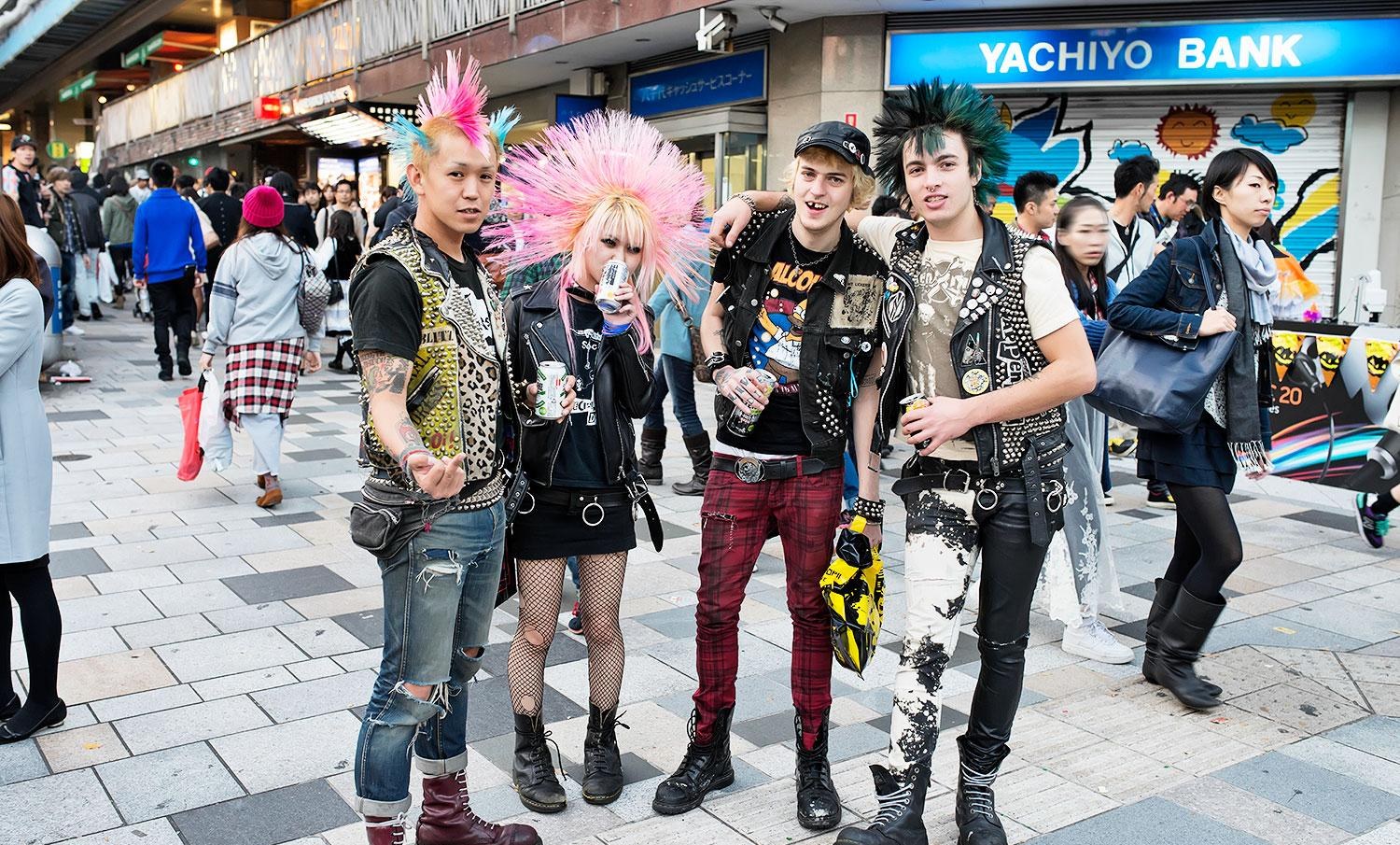
- Start with a damaged base layer, taking a black or white shirt and ripping or cutting it deliberately, then closing the openings with safety pins or stitching the pieces back together. Add the patches and buttons yourself, since the DIY step is the point rather than a shortcut.
- Choose your bottom half, where bondage pants read most clearly as punk. Ripped jeans or acid wash denim with a heavy belt is the easier substitute, and a plaid skirt over a petticoat takes the look feminine without leaving the style.
- Layer on leather and hardware, starting with a biker jacket, then chains, studded chokers, harnesses, fingerless gloves and cross or skull motifs. Restraint matters less here than coherence.
- Commit to the makeup, meaning pale foundation, heavy black eyeliner, smudged smoky eyeshadow and dark lipstick. This is the step most beginners underplay, and it is the one that makes the outfit Japanese punk rather than generic alternative dressing.
- Deal with the hair, then set it, spiking it, dyeing it a neon shade or cutting it asymmetrically. A fauxhawk gets the shape without the commitment of a shaved head. Setting spray keeps the makeup intact through a show, and an oil-based or dual-phase remover takes it off afterwards, since heavy eye product does not come off with water.
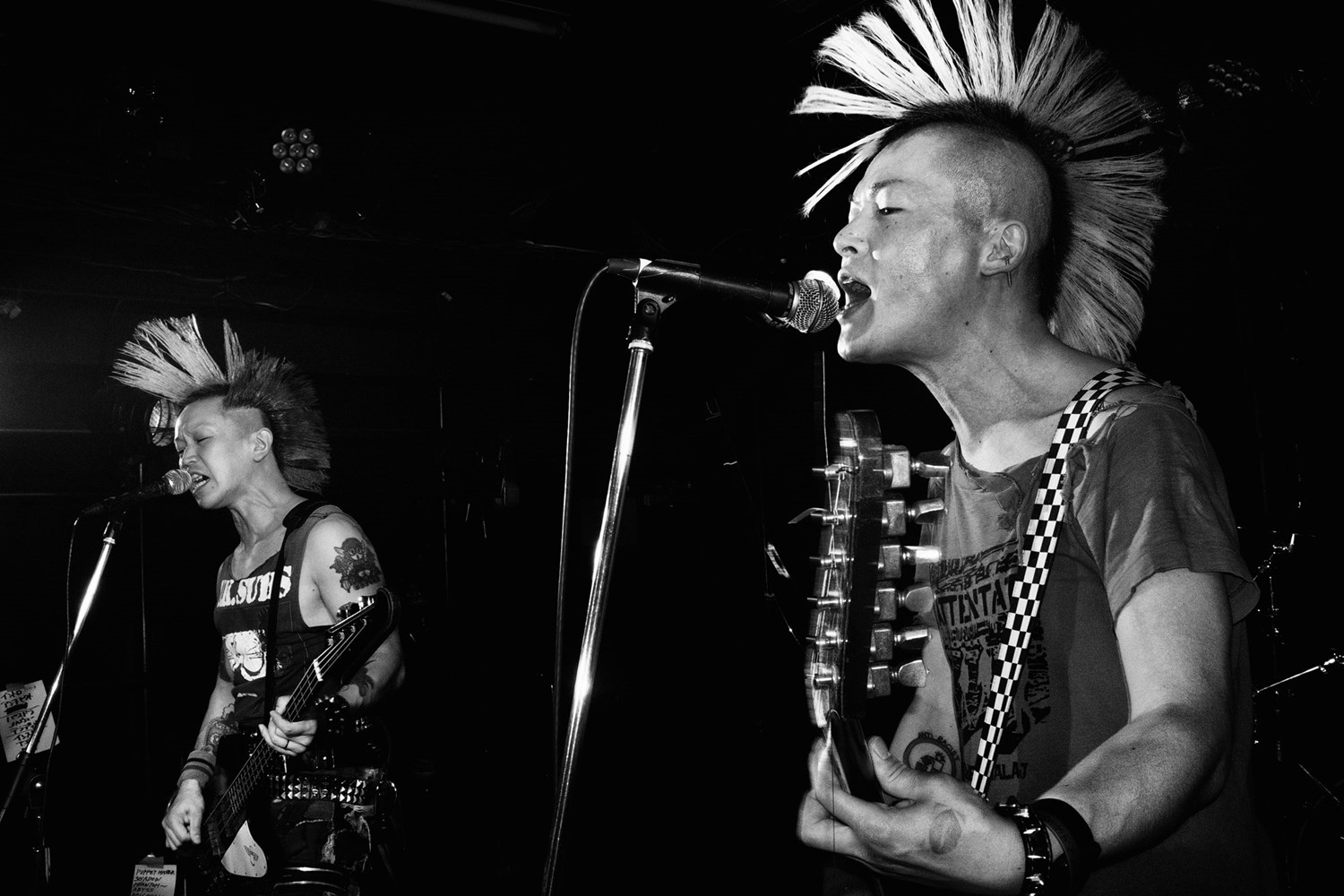
The scene is still physically located. Antiknock in Shinjuku, Earthdom in Shin-Okubo and Shelter in Shimokitazawa remain Tokyo punk venues, with Fandango, Hokage and King Cobra covering Osaka.
FAQs
What is Japanese punk fashion?
Japanese punk fashion is a Japanese adaptation of British punk built on deliberately damaged clothing: ripped shirts closed with safety pins, bondage pants with zippers and chains, leather biker jackets, studded accessories, spiked or neon hair, and heavy black eye makeup over pale foundation. It runs on a black and white base with one or two accent colors.
How is Japanese punk fashion different from British punk?
Three ways. The execution is more precise, with spiked hair and decorated jackets treated as craft rather than as calculated mess. Makeup does much more work in the Japanese version, functioning as a core element instead of a finishing touch. And Japanese punk hybridized with local subcultures such as lolita and kawaii styling, which British punk never did.
What are the Japanese punk fashion substyles?
Six branches are commonly named: goth punk, which goes black-on-black with gothic lolita silhouettes; punk lolita, which cuts the lolita shape with studs and safety pins; kawaii punk, which shifts the palette to pastel; cyber and tech punk, built on synthetic fabrics; avant-garde punk, the designer end; and classic punk revival, closest to the 1970s London template.
Can a beginner put together a Japanese punk look?
Yes. A black shirt you are willing to cut, a pair of ripped jeans with a heavy belt, one leather jacket and a handful of studded accessories will produce a recognizable outfit. Bondage pants and a full makeup routine are what you add once you know the style suits you.
Is visual kei the same as Japanese punk fashion?
No. Visual kei emerged from the same 1980s Japanese music scene and shares some hardware and theatricality, but it is a band-costuming tradition with its own conventions. Treating the two as interchangeable flattens both.
If the hardware and the folklore both appeal to you, Kamicrew’s graphic tees and hoodies sit in the same territory, built around Japanese motifs for people who would rather wear the reference than explain it.
Kamicrew Best Seller

Dont Touch Me Yokai Ukiyo-E Japanese T-Shirt
$25.49+
$29.99
(15% off)


Summer Vibes Salty Kawaii Japanese Hoodie
$44.99+
$49.99
(10% off)


Japanese Pin Horror 80s Retro Aesthetics T-Shirt
$25.49+
$29.99
(15% off)


El Gran Maja Japanese Kaiju T-Shirt
$25.49+
$29.99
(15% off)


Who Wants The Perfect Body Japan Capybara Kawaii Japanese Unisex Shirt
$25.49+
$29.99
(15% off)


Monster 8 Mask Vintage Animal Hoodie
$44.99+
$49.99
(10% off)


I Hate People Japanese Opossum Vintage Animal Hoodie
$44.99+
$49.99
(10% off)


I Got That Dog In Me Small Turtle Vintage Animal T-Shirt
$25.49+
$29.99
(15% off)

The Creation Of Cat Ukiyo-E Japanese T-Shirt
$25.49+
$29.99
(15% off)